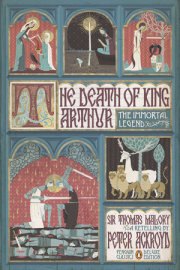
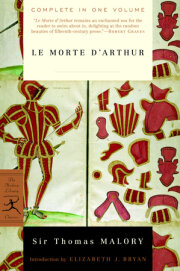
Volume two of Le Morte D'Arthur, Sir Thomas Malory's powerful and elegaic version of the Arthurian legend, recounts the adventures of Sir Tristram de Liones and the treachery of Sir Mordred, and follows Sir Launcelot's quest for The Holy Grail, his fatally divided loyalties, and his great, forbidden love for the beautiful Queen Guenever. Culminating in an account of Arthur's final battle against the scheming, deceitful Mordred, this is the definitive re-telling of the Arthurian myth, weaving a story of adultery, treachery and ultimately—in its tragic finale—death. Edited and published by William Caxton in 1485, Malory's moving prose romance looks back to an idealised Medieval age of chivalry, drawing on French and English verse sources to create an epic masterpiece of passion, enchantment, war and betrayal.

For more than seventy years, Penguin has been the leading publisher of classic literature in the English-speaking world. With more than 1,700 titles, Penguin Classics represents a global bookshelf of the best works throughout history and across genres and disciplines. Readers trust the series to provide authoritative texts enhanced by introductions and notes by distinguished scholars and contemporary authors, as well as up-to-date translations by award-winning translators.
Scholars have determined that there were at least six Thomas Malorys alive in the 1400s when Le Morte d'Arthur was written. Considerable evidence points to the likeliest author as one Sir Thomas Malory or Maleore of Newbold Revell in Warwickshire, who was born in the first quarter of the fifteenth century. A member of the gentry, he became a soldier in the service of Richard Beauchamp, Earl of Warwick, with whom he fought in the siege of Calais in 1436. In records of the period he is accused of various crimes--including armed robbery, attempted murder, and rape--and he is said to have executed several dramatic escapes from prison.

Several things about Malory seem indisputable. As in Arthur's time when post-Roman Britain was in a state of fierce tribal war, he lived in an age of great unrest. Europe was still recovering from the Black Plague and a century of war. In England, two powerful families fought for the throne. Although he may have been a scoundrel, Malory was also, it seems clear, a man of ideals who believed in courage and loyalty, and who mourned the passing of chivalry. Incarcerated for long periods, he had many hours to fill his imagination with French romances and tales of chivalry, volumes of which were readily at hand. It is thought that Le Morte d'Arthur was written during his imprisonment.

Malory referred to himself as a 'knight-prisoner.' With a military man's passion for the details of conquest, a prisoner's sense of injustice, and a penitent's desire for redemption, he dedicated himself wholeheartedly to this retelling of the Arthurian legends. Sir Thomas Malory died, it is presumed, around 1471. View titles by Sir Thomas Malory

About

Volume two of Le Morte D'Arthur, Sir Thomas Malory's powerful and elegaic version of the Arthurian legend, recounts the adventures of Sir Tristram de Liones and the treachery of Sir Mordred, and follows Sir Launcelot's quest for The Holy Grail, his fatally divided loyalties, and his great, forbidden love for the beautiful Queen Guenever. Culminating in an account of Arthur's final battle against the scheming, deceitful Mordred, this is the definitive re-telling of the Arthurian myth, weaving a story of adultery, treachery and ultimately—in its tragic finale—death. Edited and published by William Caxton in 1485, Malory's moving prose romance looks back to an idealised Medieval age of chivalry, drawing on French and English verse sources to create an epic masterpiece of passion, enchantment, war and betrayal.

For more than seventy years, Penguin has been the leading publisher of classic literature in the English-speaking world. With more than 1,700 titles, Penguin Classics represents a global bookshelf of the best works throughout history and across genres and disciplines. Readers trust the series to provide authoritative texts enhanced by introductions and notes by distinguished scholars and contemporary authors, as well as up-to-date translations by award-winning translators.

Author

Scholars have determined that there were at least six Thomas Malorys alive in the 1400s when Le Morte d'Arthur was written. Considerable evidence points to the likeliest author as one Sir Thomas Malory or Maleore of Newbold Revell in Warwickshire, who was born in the first quarter of the fifteenth century. A member of the gentry, he became a soldier in the service of Richard Beauchamp, Earl of Warwick, with whom he fought in the siege of Calais in 1436. In records of the period he is accused of various crimes--including armed robbery, attempted murder, and rape--and he is said to have executed several dramatic escapes from prison.

Several things about Malory seem indisputable. As in Arthur's time when post-Roman Britain was in a state of fierce tribal war, he lived in an age of great unrest. Europe was still recovering from the Black Plague and a century of war. In England, two powerful families fought for the throne. Although he may have been a scoundrel, Malory was also, it seems clear, a man of ideals who believed in courage and loyalty, and who mourned the passing of chivalry. Incarcerated for long periods, he had many hours to fill his imagination with French romances and tales of chivalry, volumes of which were readily at hand. It is thought that Le Morte d'Arthur was written during his imprisonment.

Malory referred to himself as a 'knight-prisoner.' With a military man's passion for the details of conquest, a prisoner's sense of injustice, and a penitent's desire for redemption, he dedicated himself wholeheartedly to this retelling of the Arthurian legends. Sir Thomas Malory died, it is presumed, around 1471. View titles by Sir Thomas Malory