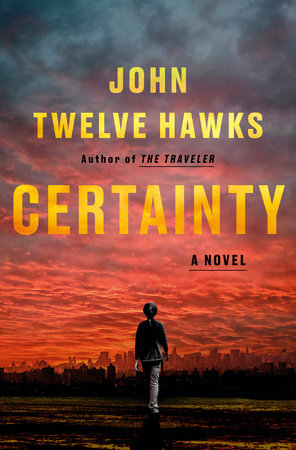
Men's Health Most Anticipated Sci-Fi of the 2026 • The intense dystopian world-building of John Twelve Hawks (The Traveler) returns with a masterful journey through the near future of Artificial Intelligence, in which a wise, orphaned ten-year-old girl goes on the run with only her trusty "Interactive Toy" to guide her toward New York City, where a dark landscape, and perhaps a hidden hero, await her.

In a post-pandemic future where AI has infiltrated daily life, the line between what is real and what is digital has eroded to nothing. As Manhattan is overrun by wireheads who spend their days literally plugged into virtual reality, algorithms and robots have replaced everything from the criminal justice system to individual loved ones. 

As long as she can remember, ten-year-old Kate has felt like someone was watching her. She has been orphaned since the pandemic, her foster parents find her eccentric and off-putting, and her legal guardian is nowhere to be seen. Now, an algorithm has predicted the very worst—​within thirty days, Kate will either be killed, or become a killer. When two police officers arrive at her home in Maine intending to implant her with a tracking device, Kate is urged by her trusted AI Interactive Toy (a talking stuffed seal named Zeno) to make an immediate escape. Confused and looking for answers, the girl sets a course for New York City and begins an Orwellian journey into the unknown.

Gripping, intricately plotted, and delightfully imaginative, Certainty is a profound and eerily prescient novel about the ever-blurring line between man and machine. Amid the murder investigation of a gifted AI robot-maker, a missing-person being tracked down in the darkest corners of virtual reality, and Kate's harrowing journey to New York, John Twelve Hawks's novel explores the spectacular humanity to be found in a world where humans are themselves endangered.
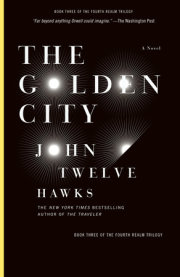
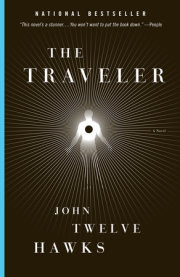
JOHN TWELVE HAWKS is author of the New York Times Bestseller, The Traveler, the first book in a trilogy that includes The Dark River and The Golden City. The Fourth Realm Trilogy has been translated into 25 languages. Known as “JTH” by his readers, Hawks followed the trilogy with Spark, a stand-alone novel, and a nonfiction book, Against Authority: Freedom and the Rise of the Surveillance States. His readers have translated this e-book into multiple languages. For more than 20 years, JTH has lived a deliberately “anonymous life” to show his resistance to the continual government and corporate attack on privacy. He has discussed his life choices in a published essay, Writing as the Sky Rains Death. In addition, Hawks and the British DJ, John Digweed, created The Traveler Album, a musical collaboration that combined spoken passages of the novel with progressive house music.  JTH worked as a war correspondent and turned to fiction to understand a fractured reality. Like several of his characters, he has lived in London, New York City, Paris and Berlin. View titles by John Twelve Hawks
CAUTION: This email originated from outside of Penguin Random House. Please be extra cautious when opening file attachments or clicking on links.

1 | Kate and Zeno

Kate was playing chess with her harp seal friend when men with guns entered the house. No phone call or text message preceded their appearance; they just arrived.

The other kids at her school would have been frightened if two policemen knocked on their front door, but Kate wasn’t surprised by anything that occurred at the Noland house. She was a project that the Nolands had taken on like finding a leak in the basement or killing a mole in the vegetable garden, and they clearly weren’t pleased with her behavior. Sometimes she would be eating dinner, and they would announce a new rule. Nothing was ever explained.

The only way she could stay safe was to sneak around the house and eavesdrop on what was going on. And that’s what she was doing after she came home from school—­spying. The Nolands’ house in Scarborough, Maine, had been built more than a hundred years ago by a wealthy man who liked the Queen Anne style of architecture. The two-­story house had a turret, gable roofs, and a porch facing the street. While the two police officers were miles away, turning off the interstate highway, Kate sat at the top of a curved staircase and listened to every word coming from the living room.

So far, it wasn’t a very interesting conversation. Mrs. Noland was in the living room entertaining a solid-­looking woman with frizzy hair who had looted the homes of families who had died during the Stem-­flu pandemic. She had just sold Mrs. Noland a set of six cups and saucers, and now they were using them to sip tea in the living room.

“So, where did you find these, Darlene?”

“Beautiful, aren’t they? Bone china is thinner and smoother than regular porcelain. A set was left on the top shelf of a kitchen cupboard in an old house in South Portland.”

“I know you have glassware and plates,” Mrs. Noland said. “What else are you selling?”

“Silverware. Pots and pans. Anything that can be found in a kitchen or dining room.”

“Clothing? Shoes?”

“Practical clothes. Nothing too fancy other than fur coats. Most of my customers are looking for jeans, woolen shirts, work boots, and cotton underwear.”

“What about children’s clothing? It’s getting cold and Katherine needs a warm jacket.”

“No problem. If I don’t have the right size, I can call a few friends.”

A cup clicked down on a saucer. “Is there anything you won’t buy and sell?”

“Nothing chipped or broken. No family photographs, trophies, or diplomas. Oh, and no Bibles. There are millions of Bibles left behind, after the Fall, and no one wants them. A dealer I know in Waterville ended up with boxes of Bibles and hymnals from three abandoned churches. He stuffed them between layers of Sheetrock and insulated his garage.”

“What about games?” Kate called out from her hiding place.

The two women looked surprised when they heard Kate’s voice coming from the staircase. “Katherine? What are you doing up here?” Mrs. Noland asked. “I thought you were outside.”

“I was outside. Now I’m inside.”

“You need to stop creeping around the house.”

“Lizards creep, and I’m not a lizard.” Kate climbed down five steps and leaned over the banister so they could see her. “Do you sell board games?”

“Don’t answer that question,” Mrs. Noland said. “My daughter already has boxes of games in her closet.”

“And you play with her? Really?” The frizzy-­haired lady raised her eyebrows. “I wouldn’t have the patience for that.”

“Of course I don’t play them. Those ridiculous games go on forever, and they bore me to tears. She plays with her IT.”

“His name is Zeno,” Kate said. “He likes it when you say his name.”

“Go back to your room, Katherine. You’re not part of this conversation.”

As Kate clomped up the stairs, Mrs. Noland sighed loudly. “Katherine doesn’t have any friends.”

“Buy a nubot nanny.”

“She has her silly old IT. That’s enough.”


No baby pictures of Kate existed, but she had seen a photograph taken seven years ago when she first arrived at the Noland house. The three-­year-­old Kate stood alone, clutching Zeno. That meant they had known each other before she met the Nolands. Zeno was an Interactive Toy, but an IT wasn’t like a kite or a soccer ball. He was a harp seal with an artificial intelligence program that was linked to a database in the Cloud. Kate knew that Zeno was a computer stuffed into a plush toy, but he was also her best friend. When the sun was shining, they worked on their fort in the woods or played board games. At night, when the wind moaned and tried to push through cracks in the window frame, the seal told her elaborate stories.

Kate had seen fairy-­tale movies with singing and dancing and a happy ending, but she preferred Zeno’s darker, older versions. In the original Cinderella, the wicked sisters went to the royal wedding and birds pecked out their eyes. In Snow White, the evil queen was forced to wear red-­hot iron shoes and dance until she dropped dead. In the kid movies, people always had a reason for their actions, and they usually sang a song about the reason. In Zeno’s stories, people were either rich or poor, good or bad, and then they walked out of their house and had adventures.

Earlier that year there was an IT Day at Kate’s school, and kids brought their toys to class. The new generation of Interactive Toys had eyes that blinked when they looked at you and mouths that moved when they talked. Zeno’s voice came from a little speaker in his chest, and his fake fur was matted and stained. Her classmates took turns showing their toys in front of the group. The dolls and stuffed animals sang songs and told silly jokes, but when it was Zeno’s turn he just watched everything and refused to speak.

Late that night, when the Nolands were asleep and Zeno was lying near her pillow, she asked Zeno why he had stayed silent.

“I’m your friend, Katherine. I don’t perform for people. It’s vulgar to show off in front of others.”

“I’m sorry, Zeno.”

“We’re both learning about each other. That takes time.”


Rounding the corner into her bedroom, Kate found Zeno where she left him, charging his body through a data port under his nose. Her friend had a silver-­gray coat with black spots. Although the harp seal couldn’t move any part of his body, his bright yellow eyes saw and analyzed whatever appeared in front of him.

“Are you charged?”

“Thanks for asking. I’m in fine fettle. You may unplug me if you wish.”

Zeno spoke with a British accent. Kate felt that it made everything he said sound more thoughtful and precise. It annoyed the Nolands when Kate said “brolly” instead of umbrella and tossed her gym clothes into the car’s “boot.”

“How was school, Katherine?” he asked. “Did anything interesting occur?”

“I was gobsmacked by a math quiz. Did I use the word right?”

“ ‘Gobsmacked’ means utterly surprised or astonished.”

“I was astonished when Ms. Dahlen reached into her desk drawer and pulled out a test.”

“Is any adult near this bedroom?”

“Nope. Mrs. Noland is downstairs talking about silverware.”

“Check the cell phone for messages. You haven’t done it for several days.”


The phone was the only secret that Kate possessed, and Zeno shared it with her. On her sixth birthday, Kate asked the Nolands what she looked like when she was a baby, and they told her that they didn’t have any pictures because her real parents had died during the pandemic. A year or so after their death, an organization called Safe Haven had put her on a chartered bus and shipped her to Maine. Kate wanted to know more, but that was all the Nolands were going to tell her, because children didn’t have to know everything.

After Kate rode her new bicycle and ate one slice of birthday cake, she went upstairs, crawled into bed with Zeno, and cried. When she was done, the harp seal told her a story about an ugly duckling who hid in the marshes and turned into a swan.

Over the next four years Kate felt like she was changing, but her life was still the same. She went to school, stood in line with the other kids, and sat scrunched down in her desk.

Everything would have continued in the same boring way, but then something happened that made the ordinary world shatter into pieces.

On the afternoon of her tenth birthday, Kate stood outside her school waiting for Mrs. Noland. As little kids swirled around her playing tag, Kate noticed an older woman with braided black hair walking slowly across the grass. The woman stopped nearby to check her phone, then turned her head and spoke to Kate.

“Kait-­ta. Mi chiquitina,” she said. “I am Paloma Flores. Do you remember me?”

“No.”

The woman held up her phone and displayed a photograph of the three-­year-­old Kate sitting on a playground swing with Zeno on her lap.

“I was your niñera after your parents died. I was very sad when you went away.”

Kate felt like Dorothy in The Wizard of Oz. Her normal life had been in shades of drab gray, then suddenly the world appeared in different colors. “Why am I here? I don’t want to be with the Nolands.”

“It was dangerous for you to stay in New York City, so your guardian decided that you should live with people who had a different name. The Nolands used to email photographs of you, but they stopped two years ago. It’s your birthday. I wanted to make sure that you were sana y salva.

“I don’t like the Nolands, and they don’t like me.”

“Your guardian will find a way to bring you to New York City. That’s where we live. . . .” Paloma glanced over her shoulder, then handed Kate a note card with an address scrawled on the back. Then she pulled a cell phone and a charger out of her purse.

“This is a prepaid phone. If you are in danger, we’ll text you. If there’s an emergency, call one of the three contact numbers stored in the phone and leave a message. Don’t use this phone for any other purpose. And never show it to the Nolands.”

“I understand.” Looking over Paloma’s shoulder, Kate saw a blue sedan turn the corner and head down the street. “That’s Mrs. Noland’s car. She’s going to pick me up.”

“Do you still have Zeno?”

“Of course. He’s back home in my bedroom.”

“Don’t ever lose him or give him away. Zeno is important to you.”

When the Nolands’ car reached the curb, Paloma turned away and walked quickly up the sidewalk. Kate had slipped the phone and charger into her backpack.

When she got into the car, Mrs. Noland gave her a critical look. “Why was that woman talking to you?”

“She has a kid my age and wanted to know what I liked about the school.”

“What did you tell her?”

“I like recess and lunch.”

“Why are you smiling so much?”

“It’s my birthday.”

“I met Mrs. Taggart at the grocery store. She said that you told everyone in your class that you were going to get a pony for a birthday present.”

“I said I could get one. Anything is possible.”

“Once again, you’ve made up a story and lied.” Mrs. Noland locked the car doors and headed down the street. “You will never, ever be given a pony as long as you live with us.”


Kate stood up, opened the bedroom door a few inches, and heard the two women chatting down in the living room. Moving quickly, she knelt and crawled over to the closet. The prepaid phone was hidden beneath a patch of stained carpet that covered the closet floor. The LCD screen glowed when she touched a button.

“No messages, Zeno. There are never any messages.”

“That means that you aren’t in danger, Katherine. Let’s play a game.”

“What about chess? It’s difficult, but I’m getting better. Right?”

“You have improved.”

Zeno preferred to look down on objects, so Kate placed the chessboard on the floor and then set the harp seal in the middle of a big pillow.

“You’re white, Zeno. You go first.”

“Move my king’s pawn to the e4 square.”

Kate moved Zeno’s piece first, then moved her king’s pawn forward so that the two pieces were facing each other.

“Now move my king’s knight to square f3.”

Kate moved Zeno’s piece and placed her queen’s knight on square c6. “This looks like the Ruy Lopez opening.”

“Correct. You’re an excellent student, Katherine.”

“If I’m a good student, then why was Mr. Noland angry about my report card?”

“Don’t worry about grades. You notice details and remember. Those two qualities are very important skills. Now move my bishop to b5.”

Kate made a whooshing sound as she moved Zeno’s bishop on a long diagonal. She crossed her legs and studied the board. “I’m going to move my other knight to f6.”
Praise for John Twelve Hawks' Certainty

"The author of the Fourth Realm Trilogy has a knack for keeping narratives hopping—even at their knottiest. A lively character in thought and action, Kate is one of the more appealing pre-teens to appear in recent dystopian fiction. And Zeno is never shy about stealing scenes. Those who reject AI and those who embrace it will find much to enjoy here."
--Kirkus Reviews

"Readers who have been waiting for a new book by the reclusive author, who keeps his real identity a closely-guarded secret, will not be disappointed. This is a magnificent novel set in a world that is both recognizably our own but at the same time markedly different.... The book stands alongside the author's Fourth Realm trilogy as a brilliant examination of the way our future might play out."
--Booklist

About

Men's Health Most Anticipated Sci-Fi of the 2026 • The intense dystopian world-building of John Twelve Hawks (The Traveler) returns with a masterful journey through the near future of Artificial Intelligence, in which a wise, orphaned ten-year-old girl goes on the run with only her trusty "Interactive Toy" to guide her toward New York City, where a dark landscape, and perhaps a hidden hero, await her.

In a post-pandemic future where AI has infiltrated daily life, the line between what is real and what is digital has eroded to nothing. As Manhattan is overrun by wireheads who spend their days literally plugged into virtual reality, algorithms and robots have replaced everything from the criminal justice system to individual loved ones. 

As long as she can remember, ten-year-old Kate has felt like someone was watching her. She has been orphaned since the pandemic, her foster parents find her eccentric and off-putting, and her legal guardian is nowhere to be seen. Now, an algorithm has predicted the very worst—​within thirty days, Kate will either be killed, or become a killer. When two police officers arrive at her home in Maine intending to implant her with a tracking device, Kate is urged by her trusted AI Interactive Toy (a talking stuffed seal named Zeno) to make an immediate escape. Confused and looking for answers, the girl sets a course for New York City and begins an Orwellian journey into the unknown.

Gripping, intricately plotted, and delightfully imaginative, Certainty is a profound and eerily prescient novel about the ever-blurring line between man and machine. Amid the murder investigation of a gifted AI robot-maker, a missing-person being tracked down in the darkest corners of virtual reality, and Kate's harrowing journey to New York, John Twelve Hawks's novel explores the spectacular humanity to be found in a world where humans are themselves endangered.

Author

JOHN TWELVE HAWKS is author of the New York Times Bestseller, The Traveler, the first book in a trilogy that includes The Dark River and The Golden City. The Fourth Realm Trilogy has been translated into 25 languages. Known as “JTH” by his readers, Hawks followed the trilogy with Spark, a stand-alone novel, and a nonfiction book, Against Authority: Freedom and the Rise of the Surveillance States. His readers have translated this e-book into multiple languages. For more than 20 years, JTH has lived a deliberately “anonymous life” to show his resistance to the continual government and corporate attack on privacy. He has discussed his life choices in a published essay, Writing as the Sky Rains Death. In addition, Hawks and the British DJ, John Digweed, created The Traveler Album, a musical collaboration that combined spoken passages of the novel with progressive house music.  JTH worked as a war correspondent and turned to fiction to understand a fractured reality. Like several of his characters, he has lived in London, New York City, Paris and Berlin. View titles by John Twelve Hawks

Excerpt

CAUTION: This email originated from outside of Penguin Random House. Please be extra cautious when opening file attachments or clicking on links.

1 | Kate and Zeno

Kate was playing chess with her harp seal friend when men with guns entered the house. No phone call or text message preceded their appearance; they just arrived.

The other kids at her school would have been frightened if two policemen knocked on their front door, but Kate wasn’t surprised by anything that occurred at the Noland house. She was a project that the Nolands had taken on like finding a leak in the basement or killing a mole in the vegetable garden, and they clearly weren’t pleased with her behavior. Sometimes she would be eating dinner, and they would announce a new rule. Nothing was ever explained.

The only way she could stay safe was to sneak around the house and eavesdrop on what was going on. And that’s what she was doing after she came home from school—­spying. The Nolands’ house in Scarborough, Maine, had been built more than a hundred years ago by a wealthy man who liked the Queen Anne style of architecture. The two-­story house had a turret, gable roofs, and a porch facing the street. While the two police officers were miles away, turning off the interstate highway, Kate sat at the top of a curved staircase and listened to every word coming from the living room.

So far, it wasn’t a very interesting conversation. Mrs. Noland was in the living room entertaining a solid-­looking woman with frizzy hair who had looted the homes of families who had died during the Stem-­flu pandemic. She had just sold Mrs. Noland a set of six cups and saucers, and now they were using them to sip tea in the living room.

“So, where did you find these, Darlene?”

“Beautiful, aren’t they? Bone china is thinner and smoother than regular porcelain. A set was left on the top shelf of a kitchen cupboard in an old house in South Portland.”

“I know you have glassware and plates,” Mrs. Noland said. “What else are you selling?”

“Silverware. Pots and pans. Anything that can be found in a kitchen or dining room.”

“Clothing? Shoes?”

“Practical clothes. Nothing too fancy other than fur coats. Most of my customers are looking for jeans, woolen shirts, work boots, and cotton underwear.”

“What about children’s clothing? It’s getting cold and Katherine needs a warm jacket.”

“No problem. If I don’t have the right size, I can call a few friends.”

A cup clicked down on a saucer. “Is there anything you won’t buy and sell?”

“Nothing chipped or broken. No family photographs, trophies, or diplomas. Oh, and no Bibles. There are millions of Bibles left behind, after the Fall, and no one wants them. A dealer I know in Waterville ended up with boxes of Bibles and hymnals from three abandoned churches. He stuffed them between layers of Sheetrock and insulated his garage.”

“What about games?” Kate called out from her hiding place.

The two women looked surprised when they heard Kate’s voice coming from the staircase. “Katherine? What are you doing up here?” Mrs. Noland asked. “I thought you were outside.”

“I was outside. Now I’m inside.”

“You need to stop creeping around the house.”

“Lizards creep, and I’m not a lizard.” Kate climbed down five steps and leaned over the banister so they could see her. “Do you sell board games?”

“Don’t answer that question,” Mrs. Noland said. “My daughter already has boxes of games in her closet.”

“And you play with her? Really?” The frizzy-­haired lady raised her eyebrows. “I wouldn’t have the patience for that.”

“Of course I don’t play them. Those ridiculous games go on forever, and they bore me to tears. She plays with her IT.”

“His name is Zeno,” Kate said. “He likes it when you say his name.”

“Go back to your room, Katherine. You’re not part of this conversation.”

As Kate clomped up the stairs, Mrs. Noland sighed loudly. “Katherine doesn’t have any friends.”

“Buy a nubot nanny.”

“She has her silly old IT. That’s enough.”


No baby pictures of Kate existed, but she had seen a photograph taken seven years ago when she first arrived at the Noland house. The three-­year-­old Kate stood alone, clutching Zeno. That meant they had known each other before she met the Nolands. Zeno was an Interactive Toy, but an IT wasn’t like a kite or a soccer ball. He was a harp seal with an artificial intelligence program that was linked to a database in the Cloud. Kate knew that Zeno was a computer stuffed into a plush toy, but he was also her best friend. When the sun was shining, they worked on their fort in the woods or played board games. At night, when the wind moaned and tried to push through cracks in the window frame, the seal told her elaborate stories.

Kate had seen fairy-­tale movies with singing and dancing and a happy ending, but she preferred Zeno’s darker, older versions. In the original Cinderella, the wicked sisters went to the royal wedding and birds pecked out their eyes. In Snow White, the evil queen was forced to wear red-­hot iron shoes and dance until she dropped dead. In the kid movies, people always had a reason for their actions, and they usually sang a song about the reason. In Zeno’s stories, people were either rich or poor, good or bad, and then they walked out of their house and had adventures.

Earlier that year there was an IT Day at Kate’s school, and kids brought their toys to class. The new generation of Interactive Toys had eyes that blinked when they looked at you and mouths that moved when they talked. Zeno’s voice came from a little speaker in his chest, and his fake fur was matted and stained. Her classmates took turns showing their toys in front of the group. The dolls and stuffed animals sang songs and told silly jokes, but when it was Zeno’s turn he just watched everything and refused to speak.

Late that night, when the Nolands were asleep and Zeno was lying near her pillow, she asked Zeno why he had stayed silent.

“I’m your friend, Katherine. I don’t perform for people. It’s vulgar to show off in front of others.”

“I’m sorry, Zeno.”

“We’re both learning about each other. That takes time.”


Rounding the corner into her bedroom, Kate found Zeno where she left him, charging his body through a data port under his nose. Her friend had a silver-­gray coat with black spots. Although the harp seal couldn’t move any part of his body, his bright yellow eyes saw and analyzed whatever appeared in front of him.

“Are you charged?”

“Thanks for asking. I’m in fine fettle. You may unplug me if you wish.”

Zeno spoke with a British accent. Kate felt that it made everything he said sound more thoughtful and precise. It annoyed the Nolands when Kate said “brolly” instead of umbrella and tossed her gym clothes into the car’s “boot.”

“How was school, Katherine?” he asked. “Did anything interesting occur?”

“I was gobsmacked by a math quiz. Did I use the word right?”

“ ‘Gobsmacked’ means utterly surprised or astonished.”

“I was astonished when Ms. Dahlen reached into her desk drawer and pulled out a test.”

“Is any adult near this bedroom?”

“Nope. Mrs. Noland is downstairs talking about silverware.”

“Check the cell phone for messages. You haven’t done it for several days.”


The phone was the only secret that Kate possessed, and Zeno shared it with her. On her sixth birthday, Kate asked the Nolands what she looked like when she was a baby, and they told her that they didn’t have any pictures because her real parents had died during the pandemic. A year or so after their death, an organization called Safe Haven had put her on a chartered bus and shipped her to Maine. Kate wanted to know more, but that was all the Nolands were going to tell her, because children didn’t have to know everything.

After Kate rode her new bicycle and ate one slice of birthday cake, she went upstairs, crawled into bed with Zeno, and cried. When she was done, the harp seal told her a story about an ugly duckling who hid in the marshes and turned into a swan.

Over the next four years Kate felt like she was changing, but her life was still the same. She went to school, stood in line with the other kids, and sat scrunched down in her desk.

Everything would have continued in the same boring way, but then something happened that made the ordinary world shatter into pieces.

On the afternoon of her tenth birthday, Kate stood outside her school waiting for Mrs. Noland. As little kids swirled around her playing tag, Kate noticed an older woman with braided black hair walking slowly across the grass. The woman stopped nearby to check her phone, then turned her head and spoke to Kate.

“Kait-­ta. Mi chiquitina,” she said. “I am Paloma Flores. Do you remember me?”

“No.”

The woman held up her phone and displayed a photograph of the three-­year-­old Kate sitting on a playground swing with Zeno on her lap.

“I was your niñera after your parents died. I was very sad when you went away.”

Kate felt like Dorothy in The Wizard of Oz. Her normal life had been in shades of drab gray, then suddenly the world appeared in different colors. “Why am I here? I don’t want to be with the Nolands.”

“It was dangerous for you to stay in New York City, so your guardian decided that you should live with people who had a different name. The Nolands used to email photographs of you, but they stopped two years ago. It’s your birthday. I wanted to make sure that you were sana y salva.

“I don’t like the Nolands, and they don’t like me.”

“Your guardian will find a way to bring you to New York City. That’s where we live. . . .” Paloma glanced over her shoulder, then handed Kate a note card with an address scrawled on the back. Then she pulled a cell phone and a charger out of her purse.

“This is a prepaid phone. If you are in danger, we’ll text you. If there’s an emergency, call one of the three contact numbers stored in the phone and leave a message. Don’t use this phone for any other purpose. And never show it to the Nolands.”

“I understand.” Looking over Paloma’s shoulder, Kate saw a blue sedan turn the corner and head down the street. “That’s Mrs. Noland’s car. She’s going to pick me up.”

“Do you still have Zeno?”

“Of course. He’s back home in my bedroom.”

“Don’t ever lose him or give him away. Zeno is important to you.”

When the Nolands’ car reached the curb, Paloma turned away and walked quickly up the sidewalk. Kate had slipped the phone and charger into her backpack.

When she got into the car, Mrs. Noland gave her a critical look. “Why was that woman talking to you?”

“She has a kid my age and wanted to know what I liked about the school.”

“What did you tell her?”

“I like recess and lunch.”

“Why are you smiling so much?”

“It’s my birthday.”

“I met Mrs. Taggart at the grocery store. She said that you told everyone in your class that you were going to get a pony for a birthday present.”

“I said I could get one. Anything is possible.”

“Once again, you’ve made up a story and lied.” Mrs. Noland locked the car doors and headed down the street. “You will never, ever be given a pony as long as you live with us.”


Kate stood up, opened the bedroom door a few inches, and heard the two women chatting down in the living room. Moving quickly, she knelt and crawled over to the closet. The prepaid phone was hidden beneath a patch of stained carpet that covered the closet floor. The LCD screen glowed when she touched a button.

“No messages, Zeno. There are never any messages.”

“That means that you aren’t in danger, Katherine. Let’s play a game.”

“What about chess? It’s difficult, but I’m getting better. Right?”

“You have improved.”

Zeno preferred to look down on objects, so Kate placed the chessboard on the floor and then set the harp seal in the middle of a big pillow.

“You’re white, Zeno. You go first.”

“Move my king’s pawn to the e4 square.”

Kate moved Zeno’s piece first, then moved her king’s pawn forward so that the two pieces were facing each other.

“Now move my king’s knight to square f3.”

Kate moved Zeno’s piece and placed her queen’s knight on square c6. “This looks like the Ruy Lopez opening.”

“Correct. You’re an excellent student, Katherine.”

“If I’m a good student, then why was Mr. Noland angry about my report card?”

“Don’t worry about grades. You notice details and remember. Those two qualities are very important skills. Now move my bishop to b5.”

Kate made a whooshing sound as she moved Zeno’s bishop on a long diagonal. She crossed her legs and studied the board. “I’m going to move my other knight to f6.”

Praise

Praise for John Twelve Hawks' Certainty

"The author of the Fourth Realm Trilogy has a knack for keeping narratives hopping—even at their knottiest. A lively character in thought and action, Kate is one of the more appealing pre-teens to appear in recent dystopian fiction. And Zeno is never shy about stealing scenes. Those who reject AI and those who embrace it will find much to enjoy here."
--Kirkus Reviews

"Readers who have been waiting for a new book by the reclusive author, who keeps his real identity a closely-guarded secret, will not be disappointed. This is a magnificent novel set in a world that is both recognizably our own but at the same time markedly different.... The book stands alongside the author's Fourth Realm trilogy as a brilliant examination of the way our future might play out."
--Booklist

Books for National Poetry Month

For National Poetry Month in April, we’re highlighting a selection of classic and contemporary poetry collections and novels-in-verse.   Poetry Month – Middle School Titles Poetry Month – High School Titles   Download free thematic educator guides:  Middle School Guide on Teaching Poetry High School Guide on Teaching Poetry

Read more