Download high-resolution image
Listen to a clip from the audiobook
audio pause button
0:00
0:00

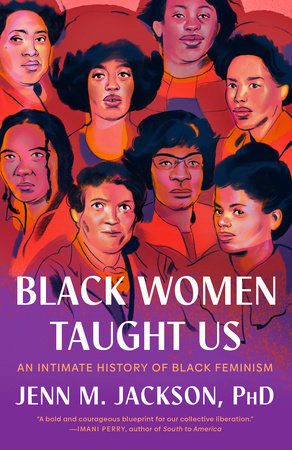
Black Women Taught Us

An Intimate History of Black Feminism

Listen to a clip from the audiobook
audio pause button
0:00
0:00
Paperback
$20.00 US
5.16"W x 7.99"H x 0.8"D  
On sale Jan 13, 2026 | 400 Pages | 9780593243350
Grades 9-12 + AP/IB

See Additional Formats
A reclamation of essential history and a hopeful gesture toward a better political future, this is what listening to Black women looks like—from a professor of political science and columnist for Teen Vogue.

“Jenn M. Jackson is a beautiful writer and excellent scholar. In this book, they pay tribute to generations of Black women organizers and set forward a bold and courageous blueprint for our collective liberation.”—Imani Perry, author of South to America

FINALIST FOR THE PEN OPEN BOOK AWARD

This is my offering. My love letter to them, and to us.

Jenn M. Jackson, PhD, has been known to bring historical acuity to some of the most controversial topics in America today. Now, in their first book, Jackson applies their critical analysis to the questions that have long energized their work: Why has Black women’s freedom fighting been so overlooked throughout history, and what has our society lost because of our refusal to engage with our forestrugglers’ lessons?

A love letter to those who have been minimized and forgotten, this collection repositions Black women’s intellectual and political work at the center of today’s liberation movements.

Across eleven original essays that explore the legacy of Black women writers and leaders—from Harriet Jacobs and Ida B. Wells to the Combahee River Collective and Audre Lorde—Jackson sets the record straight about Black women’s longtime movement organizing, theorizing, and coalition building in the name of racial, gender, and sexual justice in the United States and abroad. These essays show, in both critical and deeply personal terms, how Black women have been at the center of modern liberation movements despite the erasure and misrecognition of their efforts. Jackson illustrates how Black women have frequently done the work of liberation at great risk to their lives and livelihoods.

For a new generation of movement organizers and co-strugglers, Black Women Taught Us serves as a reminder that Black women were the first ones to teach us how to fight racism, how to name that fight, and how to imagine a more just world for everyone.
Jenn M. Jackson, PhD, is an award-winning professor of political science at Syracuse University and a columnist for Teen Vogue, where they write the popular “Speak On It” column that “explores how today’s social and political life is influenced by generations of racial and gender (dis)order.” A queer genderflux androgynous Black woman, Jackson primary research is in Black Politics with a focus on Black Feminism, racial trauma and threat, gender and sexuality, and social movements. Black Women Taught Us is their first book. View titles by Jenn M. Jackson, PhD
Introduction

Black Women Taught Us

Every Wednesday as I grew up, our tiny two-bedroom home became a concert hall for a majestic group of gospel singers. Auntie Donna Faye (no blood relation to me), a tall woman with a perfect asymmetrical bob, long curved fingernails, and a no-nonsense glare, was the alto who always rested right in the vocal pocket. Auntie Barbara (also no blood relation), who was the oldest of the group but would never share her actual age, always wore a big curly wig and bright-red lipstick. She was a soprano from another generation of Black singers. Sharon was a quiet, sarcastic woman whose baritone voice could rumble the whole house when she murmured an mhmmmmmm along to any song. Sometimes, I would tiptoe into the living room during rehearsal just to hear Sharon’s mhmmmmmms and sneak back out before my mom noticed. My mother’s sister, Deborah, was one of the greatest voices I had ever heard, a soprano whose vibrato made you feel like you were lying in a blanket fresh out of the dryer. I also thought she was the A Different World actress Jasmine Guy for most of my childhood because she resembled the actress so closely. Cassandra, the group’s pianist and vocal arranger, would glide into the room with her deep voice and thick-rimmed glasses every week. She was such a quietly powerful presence.

Then there was my mother, Cynthia. An unassuming woman standing at five foot five, she was always in a battle with her weight. She was, and still is, a beautiful, brownskinned woman with a perfectly placed mole nestled at the base of her philtrum, the area right below the nose that some people call the Cupid’s bow. My mother could sing anything and exuded so much charisma when she performed that most audience members got excited just to see her open her mouth and to bask in her gifts.

As a child, I always looked forward to seeing this aweinspiring group of women, who would crowd into our living room for their Wednesday rehearsals, circling our upright piano, singing all manner of gospel songs. Cassandra named the group “Majesty” before I was born and, just as it was for her kids, it was one of the first words I learned.

Majesty toured Oakland and the rest of the San Francisco Bay Area throughout the eighties and nineties, performing traditional gospel hits. They were known for their vocal embellishments that stemmed from years of listening to and studying the greats, like Shirley Caesar and the Clark Sisters. Singing high into the rafters and deep into the vocal valleys was common for them. The members of Majesty were different from the singers my church community and family saw on Bobby Jones Gospel every Sunday afternoon: They were our mothers, aunties, grandmothers, church leaders, and Sunday school teachers. They were the women who raised us, cooked for us, put on our Band-Aids, and scolded us for crossing the street without looking first.

They were ours.

“Fill my cup, let it overflow. Fill my cup, let it oh-ver-flow. Fill it up! Fill it up! And let it oh-oooh-oooh-oh-ver-flow. Let it oh-oh-oh-ver-flow, with love,” they would sing while forming their lips into perfect “O” shapes. They also sang “12 Gates to the City” by the Famous Davis Sisters. The harmonies that emanated from that living room sounded like they were ordained by God, likely because they were. Meanwhile, in my room, I’d be entertaining the kids. Sometimes, Auntie Barbara would bring a grandchild or two, and Sharon would do the same. I would immediately shift from being a usually lonely only child into a makeshift hostess and pseudo-mother for the younger kids. I’d set up the little ones with video games so that I’d be free to style the hair of my younger “cousins”: Esther, Lee Lee, and Lizzy, Cassandra’s three little girls. She had five children in total, but the boys were usually as far away from my makeshift hair salon as possible. We all had a nickname or two at that point. The house was only ever full like this on rehearsal nights and holidays. They were some of the most joyful nights of my young life.

To prepare for these evenings and my weekly hosting duties, I taught myself how to cook. I wanted to offer something, a small gift, to these women who brought so much warmth to my home. Rehearsal was at the end of the day, often after they had been working for hours and caring for children. Feeding them seemed like a kind and necessary gesture. By around the age of four, I could scramble eggs. At age eight, I tried my hand at baked chicken.

“Cynthia, this chicken is raw in the middle,” Auntie Barbara told my mom one week as she pulled the meat from the bone, exposing the red vertebrae and tendons that were clearly undercooked.

“Jennifer, be careful,” my mom scolded.

“Yes, Mommy,” I replied, feeling deflated.

“Don’t be too hard on her, Cynthia. The chicken is seasoned so well,” Auntie Barbara told her. “You did good, baby. Just cook it a little longer next time and poke it with a knife to see if blood comes out, okay?” she said as she leaned over to me, her lipstick bright and smudged from the chicken.

“Yes, Auntie Barbara,” I said, feeling determined to do better, as though this was an assignment for me to conquer.

Like my Auntie Barbara and the other members of Majesty, my mother, grandmothers, and my extended community of Black women and queer folks would often offer me lessons, teachings from their own lives—lessons that they had struggled to learn themselves, but that had likely saved them time and again. Auntie Donna taught me about navigating the world in a tall, large-bodied frame. “Don’t ever get dressed up and put on lipstick without throwing on some earrings, girl!” she would tell me at church. I still chuckle about this lesson whenever I see the collection of spare earrings on my desk. Sometimes the lessons were harder and carried more weight, like when my grandmother, an outspoken, ambitious, and headstrong Black woman, warned me, “Baby, people like us spend a lot of time alone, so you just have to find the people who love you and love them right back.” I was eleven years old when she said that. At the time, I didn’t understand what she meant by “people like us.” I understand now.

This informal knowledge network and storytelling community introduced me to the central tenets of Black Feminism before I had the language or the training to utter those words in that sequence. But no one tells you—at least, no one told me—that these quiet, quotidian experiences, these everyday Black feminisms, matter, or that they contain essential wisdom and knowledge for living. The recipes, the dating advice, the movement work, and the church and community organizing. Instead, just like most of the world, I failed to see these women’s work in my life as nuanced, different, significant, or deeply rooted in an ongoing fight for liberation and freedom. It wasn’t until I was surrounded by whiteness that these lessons became clearer to me.
“Jenn M. Jackson is a beautiful writer and excellent scholar. In this book, they pay tribute to generations of Black women organizers and set forward a bold and courageous blueprint for our collective liberation.”—Imani Perry, author of South to America

“Jenn M. Jackson’s debut pays homage to the Black women who led movements for freedom, justice and liberation in the U.S. and around the globe. From Audre Lorde to Ida B. Wells, Jackson’s eleven critical and thoughtful essays illuminate these leaders and implore us to learn from their legacies.”Ms., “Our Favorite Books of the Year”

“Jackson’s love letter to Black women and girls, past, present, and future, is a balm for weary souls, a reclamation, a psalm, a grounding, centering, deeply erudite book that uses the intellectual legacy of Black feminists to remind us of the stuff we are made of. In a world deeply committed to ignoring, mishearing, and disregarding Black women, to forgetting them, this book will not let us forget. It demands we remember. And it buoys us, reminding us that in our quest for freedom, Black feminists have always known the way, or made one.”—Brittney Cooper, author of Eloquent Rage: A Black Feminist Discovers Her Superpower

“With their clear, deliberate prose, Jackson takes everything that makes their Teen Vogue column and academic writing special and elevates it to new heights. Each chapter is a coming-of-age vignette that offers a vital lesson in Black feminist theory.”—Evette Dionne, author of Lifting as We Climb

Black Women Taught Us is a powerful and hopeful love letter to the Black feminist thinkers, writers, activists, and organizers who have fought for our liberation. It is an essential, life affirming text.”—George M. Johnson, author of All Boys Aren’t Blue

“In their enlightening new book, Black Women Taught Us, Jenn M. Jackson celebrates the iconic Black feminists who built a movement, and also shares their own personal story of growing and learning with these brilliant canonical thinkers. It is intimate and essential reading, a beautiful bridge connecting ancestral and contemporary Black women activists.”—Deesha Philyaw, author of The Secret Lives of Church Ladies

“[Jackson's book] ably highlights the longstanding importance and contemporary relevance of Black feminism, as well as the challenges that remain in having its voices heard and acted upon properly. Galvanizing appraisals of Black women’s enduring search for freedom.”Kirkus Reviews

About

A reclamation of essential history and a hopeful gesture toward a better political future, this is what listening to Black women looks like—from a professor of political science and columnist for Teen Vogue.

“Jenn M. Jackson is a beautiful writer and excellent scholar. In this book, they pay tribute to generations of Black women organizers and set forward a bold and courageous blueprint for our collective liberation.”—Imani Perry, author of South to America

FINALIST FOR THE PEN OPEN BOOK AWARD

This is my offering. My love letter to them, and to us.

Jenn M. Jackson, PhD, has been known to bring historical acuity to some of the most controversial topics in America today. Now, in their first book, Jackson applies their critical analysis to the questions that have long energized their work: Why has Black women’s freedom fighting been so overlooked throughout history, and what has our society lost because of our refusal to engage with our forestrugglers’ lessons?

A love letter to those who have been minimized and forgotten, this collection repositions Black women’s intellectual and political work at the center of today’s liberation movements.

Across eleven original essays that explore the legacy of Black women writers and leaders—from Harriet Jacobs and Ida B. Wells to the Combahee River Collective and Audre Lorde—Jackson sets the record straight about Black women’s longtime movement organizing, theorizing, and coalition building in the name of racial, gender, and sexual justice in the United States and abroad. These essays show, in both critical and deeply personal terms, how Black women have been at the center of modern liberation movements despite the erasure and misrecognition of their efforts. Jackson illustrates how Black women have frequently done the work of liberation at great risk to their lives and livelihoods.

For a new generation of movement organizers and co-strugglers, Black Women Taught Us serves as a reminder that Black women were the first ones to teach us how to fight racism, how to name that fight, and how to imagine a more just world for everyone.

Author

Jenn M. Jackson, PhD, is an award-winning professor of political science at Syracuse University and a columnist for Teen Vogue, where they write the popular “Speak On It” column that “explores how today’s social and political life is influenced by generations of racial and gender (dis)order.” A queer genderflux androgynous Black woman, Jackson primary research is in Black Politics with a focus on Black Feminism, racial trauma and threat, gender and sexuality, and social movements. Black Women Taught Us is their first book. View titles by Jenn M. Jackson, PhD

Excerpt

Introduction

Black Women Taught Us

Every Wednesday as I grew up, our tiny two-bedroom home became a concert hall for a majestic group of gospel singers. Auntie Donna Faye (no blood relation to me), a tall woman with a perfect asymmetrical bob, long curved fingernails, and a no-nonsense glare, was the alto who always rested right in the vocal pocket. Auntie Barbara (also no blood relation), who was the oldest of the group but would never share her actual age, always wore a big curly wig and bright-red lipstick. She was a soprano from another generation of Black singers. Sharon was a quiet, sarcastic woman whose baritone voice could rumble the whole house when she murmured an mhmmmmmm along to any song. Sometimes, I would tiptoe into the living room during rehearsal just to hear Sharon’s mhmmmmmms and sneak back out before my mom noticed. My mother’s sister, Deborah, was one of the greatest voices I had ever heard, a soprano whose vibrato made you feel like you were lying in a blanket fresh out of the dryer. I also thought she was the A Different World actress Jasmine Guy for most of my childhood because she resembled the actress so closely. Cassandra, the group’s pianist and vocal arranger, would glide into the room with her deep voice and thick-rimmed glasses every week. She was such a quietly powerful presence.

Then there was my mother, Cynthia. An unassuming woman standing at five foot five, she was always in a battle with her weight. She was, and still is, a beautiful, brownskinned woman with a perfectly placed mole nestled at the base of her philtrum, the area right below the nose that some people call the Cupid’s bow. My mother could sing anything and exuded so much charisma when she performed that most audience members got excited just to see her open her mouth and to bask in her gifts.

As a child, I always looked forward to seeing this aweinspiring group of women, who would crowd into our living room for their Wednesday rehearsals, circling our upright piano, singing all manner of gospel songs. Cassandra named the group “Majesty” before I was born and, just as it was for her kids, it was one of the first words I learned.

Majesty toured Oakland and the rest of the San Francisco Bay Area throughout the eighties and nineties, performing traditional gospel hits. They were known for their vocal embellishments that stemmed from years of listening to and studying the greats, like Shirley Caesar and the Clark Sisters. Singing high into the rafters and deep into the vocal valleys was common for them. The members of Majesty were different from the singers my church community and family saw on Bobby Jones Gospel every Sunday afternoon: They were our mothers, aunties, grandmothers, church leaders, and Sunday school teachers. They were the women who raised us, cooked for us, put on our Band-Aids, and scolded us for crossing the street without looking first.

They were ours.

“Fill my cup, let it overflow. Fill my cup, let it oh-ver-flow. Fill it up! Fill it up! And let it oh-oooh-oooh-oh-ver-flow. Let it oh-oh-oh-ver-flow, with love,” they would sing while forming their lips into perfect “O” shapes. They also sang “12 Gates to the City” by the Famous Davis Sisters. The harmonies that emanated from that living room sounded like they were ordained by God, likely because they were. Meanwhile, in my room, I’d be entertaining the kids. Sometimes, Auntie Barbara would bring a grandchild or two, and Sharon would do the same. I would immediately shift from being a usually lonely only child into a makeshift hostess and pseudo-mother for the younger kids. I’d set up the little ones with video games so that I’d be free to style the hair of my younger “cousins”: Esther, Lee Lee, and Lizzy, Cassandra’s three little girls. She had five children in total, but the boys were usually as far away from my makeshift hair salon as possible. We all had a nickname or two at that point. The house was only ever full like this on rehearsal nights and holidays. They were some of the most joyful nights of my young life.

To prepare for these evenings and my weekly hosting duties, I taught myself how to cook. I wanted to offer something, a small gift, to these women who brought so much warmth to my home. Rehearsal was at the end of the day, often after they had been working for hours and caring for children. Feeding them seemed like a kind and necessary gesture. By around the age of four, I could scramble eggs. At age eight, I tried my hand at baked chicken.

“Cynthia, this chicken is raw in the middle,” Auntie Barbara told my mom one week as she pulled the meat from the bone, exposing the red vertebrae and tendons that were clearly undercooked.

“Jennifer, be careful,” my mom scolded.

“Yes, Mommy,” I replied, feeling deflated.

“Don’t be too hard on her, Cynthia. The chicken is seasoned so well,” Auntie Barbara told her. “You did good, baby. Just cook it a little longer next time and poke it with a knife to see if blood comes out, okay?” she said as she leaned over to me, her lipstick bright and smudged from the chicken.

“Yes, Auntie Barbara,” I said, feeling determined to do better, as though this was an assignment for me to conquer.

Like my Auntie Barbara and the other members of Majesty, my mother, grandmothers, and my extended community of Black women and queer folks would often offer me lessons, teachings from their own lives—lessons that they had struggled to learn themselves, but that had likely saved them time and again. Auntie Donna taught me about navigating the world in a tall, large-bodied frame. “Don’t ever get dressed up and put on lipstick without throwing on some earrings, girl!” she would tell me at church. I still chuckle about this lesson whenever I see the collection of spare earrings on my desk. Sometimes the lessons were harder and carried more weight, like when my grandmother, an outspoken, ambitious, and headstrong Black woman, warned me, “Baby, people like us spend a lot of time alone, so you just have to find the people who love you and love them right back.” I was eleven years old when she said that. At the time, I didn’t understand what she meant by “people like us.” I understand now.

This informal knowledge network and storytelling community introduced me to the central tenets of Black Feminism before I had the language or the training to utter those words in that sequence. But no one tells you—at least, no one told me—that these quiet, quotidian experiences, these everyday Black feminisms, matter, or that they contain essential wisdom and knowledge for living. The recipes, the dating advice, the movement work, and the church and community organizing. Instead, just like most of the world, I failed to see these women’s work in my life as nuanced, different, significant, or deeply rooted in an ongoing fight for liberation and freedom. It wasn’t until I was surrounded by whiteness that these lessons became clearer to me.

Praise

“Jenn M. Jackson is a beautiful writer and excellent scholar. In this book, they pay tribute to generations of Black women organizers and set forward a bold and courageous blueprint for our collective liberation.”—Imani Perry, author of South to America

“Jenn M. Jackson’s debut pays homage to the Black women who led movements for freedom, justice and liberation in the U.S. and around the globe. From Audre Lorde to Ida B. Wells, Jackson’s eleven critical and thoughtful essays illuminate these leaders and implore us to learn from their legacies.”Ms., “Our Favorite Books of the Year”

“Jackson’s love letter to Black women and girls, past, present, and future, is a balm for weary souls, a reclamation, a psalm, a grounding, centering, deeply erudite book that uses the intellectual legacy of Black feminists to remind us of the stuff we are made of. In a world deeply committed to ignoring, mishearing, and disregarding Black women, to forgetting them, this book will not let us forget. It demands we remember. And it buoys us, reminding us that in our quest for freedom, Black feminists have always known the way, or made one.”—Brittney Cooper, author of Eloquent Rage: A Black Feminist Discovers Her Superpower

“With their clear, deliberate prose, Jackson takes everything that makes their Teen Vogue column and academic writing special and elevates it to new heights. Each chapter is a coming-of-age vignette that offers a vital lesson in Black feminist theory.”—Evette Dionne, author of Lifting as We Climb

Black Women Taught Us is a powerful and hopeful love letter to the Black feminist thinkers, writers, activists, and organizers who have fought for our liberation. It is an essential, life affirming text.”—George M. Johnson, author of All Boys Aren’t Blue

“In their enlightening new book, Black Women Taught Us, Jenn M. Jackson celebrates the iconic Black feminists who built a movement, and also shares their own personal story of growing and learning with these brilliant canonical thinkers. It is intimate and essential reading, a beautiful bridge connecting ancestral and contemporary Black women activists.”—Deesha Philyaw, author of The Secret Lives of Church Ladies

“[Jackson's book] ably highlights the longstanding importance and contemporary relevance of Black feminism, as well as the challenges that remain in having its voices heard and acted upon properly. Galvanizing appraisals of Black women’s enduring search for freedom.”Kirkus Reviews