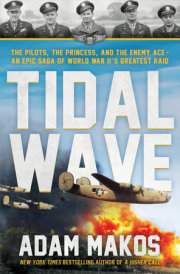
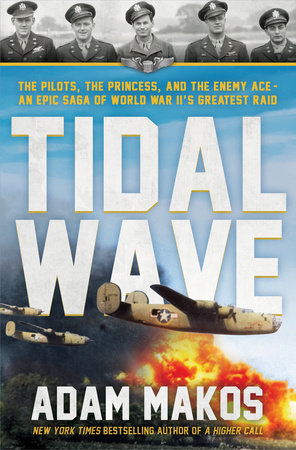
Tidal Wave

The Pilots, the Princess, and the Enemy Ace - A True Story of Courage and Survival in WWII

Author Adam Makos On Tour
From the author of the New York Times bestsellers A Higher Call, Spearhead, and Devotion comes an astonishing true story set in an untold arena of World War II.

“Tidal Wave is epic in every way. Like all good WWII books, it reminds us again, in the starkest terms possible, how much we owe to those who won that war.”—Daniel James Brown, author of The Boys in the Boat

It’s summer 1943, and the world is on fire.

Lieutenant Ernie Poulson, a twenty-two-year-old outdoorsman from Utah, finds himself at the controls of America’s most advanced bomber, the B-24, brought to North Africa for a top-secret mission.

On the far side of Europe, Lieutenant Constantin Cantacuzino, Romania’s most daring ace, duels Soviet fighters on the Eastern Front while searching for purpose in an unwinnable war.

In Nazi-aligned Romania, Princess Catherine Caradja walks a perilous line between loyalty to her country and quiet defiance, as German forces dig in around the oil refineries in her backyard.

And in the royal palace, twenty-one-year-old King Michael of Romania—mocked and sidelined by a Nazi-backed dictator—quietly plots to seize his nation’s destiny before it is lost forever.

In Tidal Wave, Adam Makos brings these lives together in a sweeping saga of courage and survival, set against history’s most audacious air raid: the treetop assault on “Hitler’s gas station” at Ploesti, Romania. What begins in flames on August 1, 1943, sparks bonds no one could have foreseen—alliances between enemies—that will decide whether these men and women are consumed by war, or seize their chance at escape and redemption.

Drawn from years of extensive research and told with Makos’s signature cinematic intensity, Tidal Wave will remind you that even in war’s darkest hours, humanity has a way of breaking through.
© Alexandra Schaede
Hailed as “a masterful storyteller” by the Associated Press, Adam Makos is the author of the New York Times bestsellers A Higher Call, Spearhead, and Devotion, the subject of the major motion picture. Inspired by his grandfathers’ service, Makos chronicles the stories of American veterans in his trademark fusion of intense human drama and fast-paced military action, securing his place “in the top ranks of military writers,” according to the Los Angeles Times. In the course of his research, Makos has flown a World War II bomber, accompanied a Special Forces raid in Iraq, and journeyed into North Korea in search of an MIA American airman. View titles by Adam Makos
Chapter 1

The New Arrivals

July 3, 1943
North Africa

The air base wasn’t where it was supposed to be.

In the right seat of a B-­24, the copilot leaned forward and strained to see ahead as the bomber hugged the desert coastline of Libya, flying at a thousand feet.

The four-­engine “Liberator” was a boxy brute of a machine with a glass-­plated nose, slab-­sided fuselage, and long, slender wings set high on its frame. And the trademark of the design from Consolidated Aircraft: twin tails spaced apart like rudders on a catamaran.

Beyond the bomber’s left wing, the Mediterranean unfurled to the horizon like a giant sapphire lake. Off the right wing and in front of the plane, the desert stretched flat and red beneath an unflinching blue sky. The terrain was “shimmering in the clear, dry air.”

Where are you? wondered Second Lieutenant Ernie Poulson. The longer he searched, the tighter the knot in his stomach grew. There was no sign of an air base, anywhere.

Thoroughly perplexed, Ernie sat back in his seat and flipped open a pad to review his notes from the preflight briefing. Beneath his green crush cap with its brown leather brim, Ernie’s appearance reflected his Swedish roots. Twenty-­two, blond and blue eyed, with a prominent, square jawline, Ernie was a dead ringer for the future movie star Marlon Brando. He stood five feet ten inches tall when not crammed into the seat of a B-­24, and he had a weightlifter’s upper physique, but his muscles came from a rugged outdoor upbringing in Utah’s Sanpete Valley rather than gym workouts.

It was around 2 p.m. and the white-­hot North African sun bored through the glass plates in the ceiling. The Plexiglas side windows were open, letting in a rush of hot air and propeller drone. It made little difference. The cockpit smelled of gasoline and hot oil.

There was something else about Ernie, something curious. Even now, near the end of a long journey, his tie was cinched tight and hardly a hair was out of place. Wherever he was, Ernie always tried to look his best. His officer’s file noticed this “quiet, unassuming, pleasant” young man was “unusually neat.” It was not for vanity’s sake that he took immense pride in his uniform; Ernie came from a family that barely scraped by. He was proud of the uniform because of everything it stood for. His country. And what the Army Air Forces did for him. The first time he put on the uniform was the first time in his life he felt important.

Now, after flying for eight hours across the coast of North Africa, and nine hours before that to reach North Africa from England, Ernie just wanted to put the plane down, get his feet back on solid ground, and find out what the heck they were doing here.

A week ago, his outfit, the 389th Bomb Group, had reported to their fog-­shrouded base in England, ready to fly high-­altitude bombing raids over Hitler’s Germany. But they were told by the 8th Air Force not to unpack. Plans had changed. Then three days later they had been sent here, to the middle of nowhere, for detached service with the 9th Air Force. “Liberators are needed in the Middle East” was all they’d been told.

Their cryptic orders were to report to a former Luftwaffe air base called Berka 4, somewhere along the Libyan coast—­but finding it would be another matter. Even the intel boys couldn’t say exactly where the new base lay. For some reason it didn’t appear on any American maps.

When Ernie envisioned their new desert home, he pictured something out of the airport scene in Casablanca: colonial-­era hangars and palm trees and a tower with a searchlight beaming through the fog at night. Now, motoring through the desert sky, he was no longer sure what to expect.

Ernie turned to the pilot in the seat beside him, the aircraft commander, twenty-­four-­year-­old First Lieutenant Bob O’Reilly. The pilot’s attention was fixed on the controls, making small corrections as he guided the big B-­24 through the air.

Bob was a sandy-­haired Irish American with a square face and hazel eyes that were always brimming with humor. Average in build, he made up for it in scrappiness and charm—­it was said he’d “never met a stranger.” Unlike Ernie, Bob wasn’t fastidious about his appearance. His shirt looked slept in, and his tattered brown shoes were “on the verge of falling apart.” What few of the crew knew—­and Bob never let slip—­was that he hailed from St. Louis high society. Back home in the leafy streets of Westminster Park, his neighbors didn’t call him Bob at all. To them, he was R. J. O’Reilly III.

Ernie triggered the intercom by pressing the button on the yoke in front of him. “Bob, am I cracking up? I don’t see a thing out there.”

Bob craned his neck to see for himself.

Both men could spot the port city of Benghazi coming up on the left side of the plane, its whitewashed buildings scorched and scarred, its harbor clogged by sunken Axis transport ships. The fighting in North Africa was over. Aided by an infusion of American manpower, the British had driven Rommel and the German Afrika Korps from the continent just two months earlier.

“About ten miles south of Benghazi,” Ernie said, reciting what he’d written in his notes from the preflight briefing. “That’s where we’re supposed to go.”

Both men looked ahead and a little to the right, where the base should be. “I’ll be damned,” Bob said, seeing nothing. “You’re right.”

There was nothing out there but red, hard-­packed desert.

Ernie knew something was wrong—­an air base shouldn’t be this hard to find. He offered a solution.

Ernie suggested they fly up to Benghazi and ask for directions. The British were there. Supposedly, a number of American units too. Find a field, radio their tower, and get some bearings.

“I bet we’re not the first crew that needs directions,” he said.

Bob looked like someone had spat in his coffee. Directions? No way were they asking for directions.

Before Ernie could lodge a further protest, Bob put the bomber in a holding pattern and called for their navigator, Britt, to come up to the flight deck—­and to bring one of their useless maps.

Ernie conceded defeat. What else could he do? For the last twelve hundred miles they’d alternated who flew the plane. But at the end of the day, Bob was the aircraft commander.

The crew’s navigator, Second Lieutenant Richard Britt, twenty-­one, emerged from the nose of the plane. Standing a lanky six foot one, he had to squeeze up and onto the flight deck behind Ernie and Bob. Britt had tight-­set blue eyes and a thick chin; he projected a precise but friendly demeanor. Back home in Chicago’s suburbs, Britt had set an “enviable” record at his high school. He’d missed only two days of school in four years—­and went “0 times tardy.”

Britt plugged in to the intercom system and unfolded his map. He had an idea about how to find their base: good old-­fashioned pilotage. He motioned to his map and explained that they were coming up on a narrow-­gauge railroad that ran south from Benghazi into the desert.

“Now, if I was a German building an airfield that needs a regular resupply of fuel from Benghazi, where would I put it?” He tapped the map. “Somewhere near a railway.”

He told Bob to follow that railroad south. “Sooner or later, we’re bound to find Berka 4.”

“Or we can use the radio,” Ernie reminded his friends.

Never! Bob grinned. Where was the fun in that?

And besides, Britt had his reputation going for him. Barely a week before this, he had successfully navigated them from the United States across the frigid black Atlantic, alone, at night, relying on just the stars to reach En­gland.

Ernie and Britt felt the plane turning beneath them as Bob wheeled the bomber south.

The patched and bomb-­scarred railroad tracks weren’t hard to follow. With their backs toward civilization, the crew flew into the blinding sun.

Below on the ground, there was nothing in the Libyan outback except British recovery crews towing back their knocked-­out tanks to repair them for the next battle, or hauling in wrecked German and Italian planes for salvage.

Some thought the war would have been ended by the combat here in North Africa. Hitler had lost boundless “Iron Treasure” and more than 600,000 men. Yet the Nazi war machine shrugged off its losses and kept fighting on all fronts, walking away with an aura of invincibility.
“Tidal Wave is epic in every way. I was swept away from the moment I opened the book. It’s a terrific story masterfully told—one I won’t soon forget, and neither will you. And like all good WWII books, it reminds us again, in the starkest terms possible, how much we owe to those who won that war. . . . Highly recommended.”—Daniel James Brown, author of The Boys in the Boat

“In Tidal Wave, Makos delivers pulse-pounding nonfiction written with the intellect of a great historian and the heart of a great storyteller. Join B-24 copilot Ernie Poulson on the most daring air mission of WWII: the Ploesti raid on Hitler’s biggest source of oil. Makos puts you in the bomber cockpit, then takes the story where you can’t believe it could go. . . . An absolute must-read.”—A. J. Baime, New York Times bestselling author of The Accidental President

“How does Makos find these stories? Tidal Wave is a triumph of narrative nonfiction. Buckle up. You’re in for one incredible ride into a little-known theater of World War II.”—Eric Blehm, New York Times bestselling author of Fearless

“Tidal Wave is Makos’s best book yet, a superb achievement, and a beautiful, utterly gripping story of heroism in the air and on the ground, of humanity transcending evil in the worst of times. Don’t miss this one—a genuine blockbuster, the best history of the year.”—Alex Kershaw, New York Times bestselling author of The Liberator

“Adam Makos has found a remarkable story within a story. Readers may be familiar with the Ploesti Raid, the Allied attempt to knock out the Axis Powers’ oil refineries in Romania in August 1943, but few know what came after, when downed American airmen and the Romanians who captured them found their fates intertwined, caught together in Romania’s uneasy alliance with Nazi Germany. At the heart of it is Catherine Caradja, a fifty-year-old princess who protected the very airmen who had bombed her country. Makos writes with the pace of The Great Escape and the compassion of a writer who never loses sight of the people behind the history. Tidal Wave is a compelling reminder that there still are refreshing, uplifting, heartfelt stories to tell from history’s most destructive war.”—Robert M. Edsel, author of The Monuments Men

About

From the author of the New York Times bestsellers A Higher Call, Spearhead, and Devotion comes an astonishing true story set in an untold arena of World War II.

“Tidal Wave is epic in every way. Like all good WWII books, it reminds us again, in the starkest terms possible, how much we owe to those who won that war.”—Daniel James Brown, author of The Boys in the Boat

It’s summer 1943, and the world is on fire.

Lieutenant Ernie Poulson, a twenty-two-year-old outdoorsman from Utah, finds himself at the controls of America’s most advanced bomber, the B-24, brought to North Africa for a top-secret mission.

On the far side of Europe, Lieutenant Constantin Cantacuzino, Romania’s most daring ace, duels Soviet fighters on the Eastern Front while searching for purpose in an unwinnable war.

In Nazi-aligned Romania, Princess Catherine Caradja walks a perilous line between loyalty to her country and quiet defiance, as German forces dig in around the oil refineries in her backyard.

And in the royal palace, twenty-one-year-old King Michael of Romania—mocked and sidelined by a Nazi-backed dictator—quietly plots to seize his nation’s destiny before it is lost forever.

In Tidal Wave, Adam Makos brings these lives together in a sweeping saga of courage and survival, set against history’s most audacious air raid: the treetop assault on “Hitler’s gas station” at Ploesti, Romania. What begins in flames on August 1, 1943, sparks bonds no one could have foreseen—alliances between enemies—that will decide whether these men and women are consumed by war, or seize their chance at escape and redemption.

Drawn from years of extensive research and told with Makos’s signature cinematic intensity, Tidal Wave will remind you that even in war’s darkest hours, humanity has a way of breaking through.

Author

© Alexandra Schaede
Hailed as “a masterful storyteller” by the Associated Press, Adam Makos is the author of the New York Times bestsellers A Higher Call, Spearhead, and Devotion, the subject of the major motion picture. Inspired by his grandfathers’ service, Makos chronicles the stories of American veterans in his trademark fusion of intense human drama and fast-paced military action, securing his place “in the top ranks of military writers,” according to the Los Angeles Times. In the course of his research, Makos has flown a World War II bomber, accompanied a Special Forces raid in Iraq, and journeyed into North Korea in search of an MIA American airman. View titles by Adam Makos

Excerpt

Chapter 1

The New Arrivals

July 3, 1943
North Africa

The air base wasn’t where it was supposed to be.

In the right seat of a B-­24, the copilot leaned forward and strained to see ahead as the bomber hugged the desert coastline of Libya, flying at a thousand feet.

The four-­engine “Liberator” was a boxy brute of a machine with a glass-­plated nose, slab-­sided fuselage, and long, slender wings set high on its frame. And the trademark of the design from Consolidated Aircraft: twin tails spaced apart like rudders on a catamaran.

Beyond the bomber’s left wing, the Mediterranean unfurled to the horizon like a giant sapphire lake. Off the right wing and in front of the plane, the desert stretched flat and red beneath an unflinching blue sky. The terrain was “shimmering in the clear, dry air.”

Where are you? wondered Second Lieutenant Ernie Poulson. The longer he searched, the tighter the knot in his stomach grew. There was no sign of an air base, anywhere.

Thoroughly perplexed, Ernie sat back in his seat and flipped open a pad to review his notes from the preflight briefing. Beneath his green crush cap with its brown leather brim, Ernie’s appearance reflected his Swedish roots. Twenty-­two, blond and blue eyed, with a prominent, square jawline, Ernie was a dead ringer for the future movie star Marlon Brando. He stood five feet ten inches tall when not crammed into the seat of a B-­24, and he had a weightlifter’s upper physique, but his muscles came from a rugged outdoor upbringing in Utah’s Sanpete Valley rather than gym workouts.

It was around 2 p.m. and the white-­hot North African sun bored through the glass plates in the ceiling. The Plexiglas side windows were open, letting in a rush of hot air and propeller drone. It made little difference. The cockpit smelled of gasoline and hot oil.

There was something else about Ernie, something curious. Even now, near the end of a long journey, his tie was cinched tight and hardly a hair was out of place. Wherever he was, Ernie always tried to look his best. His officer’s file noticed this “quiet, unassuming, pleasant” young man was “unusually neat.” It was not for vanity’s sake that he took immense pride in his uniform; Ernie came from a family that barely scraped by. He was proud of the uniform because of everything it stood for. His country. And what the Army Air Forces did for him. The first time he put on the uniform was the first time in his life he felt important.

Now, after flying for eight hours across the coast of North Africa, and nine hours before that to reach North Africa from England, Ernie just wanted to put the plane down, get his feet back on solid ground, and find out what the heck they were doing here.

A week ago, his outfit, the 389th Bomb Group, had reported to their fog-­shrouded base in England, ready to fly high-­altitude bombing raids over Hitler’s Germany. But they were told by the 8th Air Force not to unpack. Plans had changed. Then three days later they had been sent here, to the middle of nowhere, for detached service with the 9th Air Force. “Liberators are needed in the Middle East” was all they’d been told.

Their cryptic orders were to report to a former Luftwaffe air base called Berka 4, somewhere along the Libyan coast—­but finding it would be another matter. Even the intel boys couldn’t say exactly where the new base lay. For some reason it didn’t appear on any American maps.

When Ernie envisioned their new desert home, he pictured something out of the airport scene in Casablanca: colonial-­era hangars and palm trees and a tower with a searchlight beaming through the fog at night. Now, motoring through the desert sky, he was no longer sure what to expect.

Ernie turned to the pilot in the seat beside him, the aircraft commander, twenty-­four-­year-­old First Lieutenant Bob O’Reilly. The pilot’s attention was fixed on the controls, making small corrections as he guided the big B-­24 through the air.

Bob was a sandy-­haired Irish American with a square face and hazel eyes that were always brimming with humor. Average in build, he made up for it in scrappiness and charm—­it was said he’d “never met a stranger.” Unlike Ernie, Bob wasn’t fastidious about his appearance. His shirt looked slept in, and his tattered brown shoes were “on the verge of falling apart.” What few of the crew knew—­and Bob never let slip—­was that he hailed from St. Louis high society. Back home in the leafy streets of Westminster Park, his neighbors didn’t call him Bob at all. To them, he was R. J. O’Reilly III.

Ernie triggered the intercom by pressing the button on the yoke in front of him. “Bob, am I cracking up? I don’t see a thing out there.”

Bob craned his neck to see for himself.

Both men could spot the port city of Benghazi coming up on the left side of the plane, its whitewashed buildings scorched and scarred, its harbor clogged by sunken Axis transport ships. The fighting in North Africa was over. Aided by an infusion of American manpower, the British had driven Rommel and the German Afrika Korps from the continent just two months earlier.

“About ten miles south of Benghazi,” Ernie said, reciting what he’d written in his notes from the preflight briefing. “That’s where we’re supposed to go.”

Both men looked ahead and a little to the right, where the base should be. “I’ll be damned,” Bob said, seeing nothing. “You’re right.”

There was nothing out there but red, hard-­packed desert.

Ernie knew something was wrong—­an air base shouldn’t be this hard to find. He offered a solution.

Ernie suggested they fly up to Benghazi and ask for directions. The British were there. Supposedly, a number of American units too. Find a field, radio their tower, and get some bearings.

“I bet we’re not the first crew that needs directions,” he said.

Bob looked like someone had spat in his coffee. Directions? No way were they asking for directions.

Before Ernie could lodge a further protest, Bob put the bomber in a holding pattern and called for their navigator, Britt, to come up to the flight deck—­and to bring one of their useless maps.

Ernie conceded defeat. What else could he do? For the last twelve hundred miles they’d alternated who flew the plane. But at the end of the day, Bob was the aircraft commander.

The crew’s navigator, Second Lieutenant Richard Britt, twenty-­one, emerged from the nose of the plane. Standing a lanky six foot one, he had to squeeze up and onto the flight deck behind Ernie and Bob. Britt had tight-­set blue eyes and a thick chin; he projected a precise but friendly demeanor. Back home in Chicago’s suburbs, Britt had set an “enviable” record at his high school. He’d missed only two days of school in four years—­and went “0 times tardy.”

Britt plugged in to the intercom system and unfolded his map. He had an idea about how to find their base: good old-­fashioned pilotage. He motioned to his map and explained that they were coming up on a narrow-­gauge railroad that ran south from Benghazi into the desert.

“Now, if I was a German building an airfield that needs a regular resupply of fuel from Benghazi, where would I put it?” He tapped the map. “Somewhere near a railway.”

He told Bob to follow that railroad south. “Sooner or later, we’re bound to find Berka 4.”

“Or we can use the radio,” Ernie reminded his friends.

Never! Bob grinned. Where was the fun in that?

And besides, Britt had his reputation going for him. Barely a week before this, he had successfully navigated them from the United States across the frigid black Atlantic, alone, at night, relying on just the stars to reach En­gland.

Ernie and Britt felt the plane turning beneath them as Bob wheeled the bomber south.

The patched and bomb-­scarred railroad tracks weren’t hard to follow. With their backs toward civilization, the crew flew into the blinding sun.

Below on the ground, there was nothing in the Libyan outback except British recovery crews towing back their knocked-­out tanks to repair them for the next battle, or hauling in wrecked German and Italian planes for salvage.

Some thought the war would have been ended by the combat here in North Africa. Hitler had lost boundless “Iron Treasure” and more than 600,000 men. Yet the Nazi war machine shrugged off its losses and kept fighting on all fronts, walking away with an aura of invincibility.

Praise

“Tidal Wave is epic in every way. I was swept away from the moment I opened the book. It’s a terrific story masterfully told—one I won’t soon forget, and neither will you. And like all good WWII books, it reminds us again, in the starkest terms possible, how much we owe to those who won that war. . . . Highly recommended.”—Daniel James Brown, author of The Boys in the Boat

“In Tidal Wave, Makos delivers pulse-pounding nonfiction written with the intellect of a great historian and the heart of a great storyteller. Join B-24 copilot Ernie Poulson on the most daring air mission of WWII: the Ploesti raid on Hitler’s biggest source of oil. Makos puts you in the bomber cockpit, then takes the story where you can’t believe it could go. . . . An absolute must-read.”—A. J. Baime, New York Times bestselling author of The Accidental President

“How does Makos find these stories? Tidal Wave is a triumph of narrative nonfiction. Buckle up. You’re in for one incredible ride into a little-known theater of World War II.”—Eric Blehm, New York Times bestselling author of Fearless

“Tidal Wave is Makos’s best book yet, a superb achievement, and a beautiful, utterly gripping story of heroism in the air and on the ground, of humanity transcending evil in the worst of times. Don’t miss this one—a genuine blockbuster, the best history of the year.”—Alex Kershaw, New York Times bestselling author of The Liberator

“Adam Makos has found a remarkable story within a story. Readers may be familiar with the Ploesti Raid, the Allied attempt to knock out the Axis Powers’ oil refineries in Romania in August 1943, but few know what came after, when downed American airmen and the Romanians who captured them found their fates intertwined, caught together in Romania’s uneasy alliance with Nazi Germany. At the heart of it is Catherine Caradja, a fifty-year-old princess who protected the very airmen who had bombed her country. Makos writes with the pace of The Great Escape and the compassion of a writer who never loses sight of the people behind the history. Tidal Wave is a compelling reminder that there still are refreshing, uplifting, heartfelt stories to tell from history’s most destructive war.”—Robert M. Edsel, author of The Monuments Men