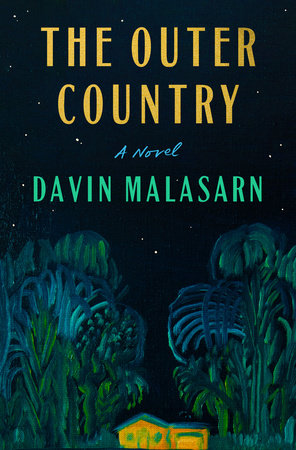
Download high-resolution image Look inside
Listen to a clip from the audiobook
audio pause button
0:00
0:00
This tender, elegant debut examines the struggle of holding a family together when secrets threaten to unravel it.

"Both a book of demons and a book of uncommon grace; an instant classic in the queer canon. Davin Malasarn is an exquisite writer of the heart.”—Justin Torres, author of Blackouts


Sisters Manda and Siripon have been divided by continents for years, estranged since their parents decided to send just one of their daughters from Phet Buri to America—the foreign land they call “the Outer Country.” As the eldest, Manda assumed she would be the first to go. When their parents chose Siripon, the more obedient second daughter, the decision sparked a lifetime of rivalry.

The birth of Siripon’s son brings the sisters back together. Despite the disorientation of Los Angeles and the difficulty of sharing her sister’s home, Manda becomes a second mother to Ben, a precocious only child who fills her with fierce joy. But as Ben grows increasingly effeminate, her joy transforms to fear. Believing that the spirit of a dead girl has possessed her beloved nephew—and that her sister won’t do anything to fix matters—Manda and Ben’s father, Kamron, secretly arrange a Buddhist exorcism. The ceremony sets off a decade of anxiety-induced illness and bullying, even as the ritual burrows beyond Ben’s memory.

For Ben to grow into his authentic self, he must accept his queerness and confront the scars of his past. He attempts to navigate his family’s tense relationships and live amidst the damage. But how long can they all go on before the truths are uncovered?

From the mangrove forests of Thailand to a modest stucco house in Los Angeles to the sandstone quadrangles of Stanford, The Outer Country is at once epic and intimate in scope, a breathtaking journey across cultures and generations.
© Troy Nethercott
Davin Malasarn was born and raised in Southern California. After completing his PhD in biology at the California Institute of Technology, he earned his MFA in creative writing from Bennington College and completed the Queens University of Charlotte Book Development Program. He was a PEN America Emerging Voices Fellow, a Plympton Writing Downtown Fellow, and a Bennington Alumni Fellow. He co-founded The Granum Foundation, a non-profit dedicated to supporting writers, and hosts The Artist’s Statement podcast. View titles by Davin Malasarn
1

The son died. The daughter lived. The second daughter lived. The second son died. The mother’s skin turned to clay, hardened by mourning and the heat of Phet Buri. The father had been hardened by war and spent each dawn meditating in Khao Na Khwang Cave as he searched for enlightenment. The third daughter lived. The third son lived, but he shattered the mother’s pelvis during delivery. This was the latest incarnation of the Thrakoontong family.

2

Manda Thrakoontong arrived in the Outer Country on the same day her sister’s contractions began. She rushed with her brother-­in-­law through the maternity ward of White Memorial Medical Center, her senses overwhelmed by the foreign land, her clothes burdened with seeds she smuggled over from Phet Buri. She longed to see her sister even more than she longed to return home.

Manda’s arrival and the baby’s delivery—­their timing was a coincidence, but she didn’t believe in coincidences. Life was an infinite karmic equation. If she landed in America on the same day her nephew was to be born, then their past must have brought them together. Maybe they had been coupled for multiple reincarnations. Maybe they had been friends or siblings or lovers or termites from the same colony. Maybe something between them was left unfinished and they had been offered another opportunity to resolve it.

In the dim, buzzing hospital room, she found her sister folding in pain. Siripon’s contractions had begun at sunrise, while Manda was still in the air. The sisters clasped nervous hands. They were the eldest children in their family, the living daughters who had replaced the dead sons.

“I’m here now. You have nothing to worry about,” Manda whispered, though she hesitated as she spoke. She didn’t know how much relief she could offer. The two hadn’t parted on friendly terms, and neither one was used to letting go of grudges. No one in their family was.

“Did you have a safe journey?” Siripon asked, huffing and straining.

“That’s not important, Noi,” Manda said. “Worry about yourself for once.”

Siripon’s face had matured since the last time the sisters saw each other. Her cheekbones were fuller, helping her large, watery eyes seem less frightened. Their neighbors in Phet Buri agreed she was the prettiest of the Thrakoontong daughters, unlike Manda, whose eyes were dark and wooden, whose nose was upturned, and whose body resembled a yam. A contraction came, and Siripon’s body tensed. Manda rose from the bed and turned away. She reminded herself that her nephew was not arriving for the first time. He had been born successfully more than once. After this life, whenever it came to an end, he would be born again. “It will be over quickly, Noi,” she said.

Siripon huffed. “Pi Neung, if anything goes wrong, you will help Kamron raise the baby, na?”

“Don’t think like that, Sister. Believe that you will both be all right. Pray that you will both be all right.” Manda turned to her brother-­in-­law, hoping he would do more to comfort his wife. Kamron only stood by the window, rigid.

Nurses rushed in. They ordered Manda out to the dull purgatory of the waiting room. She found a seat away from the crowd and rested her head against the wall. Her body still lurched from the undulations of flight, that unexpected weightlessness that accompanied her first time on a plane. Three years had passed since Manda and Siripon were last together. The night in 1975 when Siripon departed, Manda hadn’t gone to see her off. Her annoyance at not being chosen first to go to America had still pulsed at her temples. For weeks, she had been forced to hear about the preparations: their mother hunting throughout the city for winter clothes, their father pedaling to the local temples to acquire amulets blessed by the monks. The family hoarded containers of Tiger Balm and Takabb Anti-­Cough Pills, stuffing them into the pockets of Siripon’s suitcases. They filled her shoes with doughy sweets, giving her strict instructions not to eat them all at once but to ration them out so that she would have something to comfort her when she missed home.

Now the sisters were together again. Manda had given up her job and her colleagues and her friends. Her only new acquaintance was someone she met on the plane, a religious older woman who had introduced herself only as “Aunt Seamstress.” If she was correct, the two would be living less than an hour apart from each other, almost a straight shot on one of the main roads, though Manda couldn’t remember which one. She shook her head, wondering why she had come. Across from her, the second hand of a clock lurched. She prepared to pray again, but Kamron entered the waiting room with a startled expression on his face. Manda hadn’t yet inspected him properly, the news of the delivery too pressing when he found her at the airport. She had been frightened to be alone with him during their ride to the hospital, not certain of who he was or where he was taking her. But there had been no choice but to trust him—­trust him or turn around. She glanced up. He was a brutish man. His face looked like it had been carved out of stone. The muscles of his shoulders stretched his denim shirt, and thick veins branched over his forearms.

“I have no place in there,” he said, pressing his palms to his eyes. His hands were covered with hundreds of tiny hardened blisters. They looked like powerful hands. They looked like hands that could wring out the world. “I regret ever touching her.”

“You can’t return a mango to its tree,” Manda replied. She considered trying to comfort him, but she held back, unsure if she approved of him. She was disappointed he came out to the waiting room instead of staying with Siripon. The sisters’ father had been present for the births of all his children. Manda herself was delivered by him in the home of an aunt, as there hadn’t been time to get to the hospital. Her mother, Gimjaa, had been sick with a fever, and Pradit took it as a point of pride that he was the one who sealed his mouth over Manda’s nose and mouth to remove the mucus that plugged her airways. He sometimes recounted the story between lashes of a switch, as if he regretted allowing her to take her first breath. Manda’s siblings were all born in the hospital, but her father was there, emerging after the delivery with a smile each time except for the last. After their brother Kiet’s birth, when their mother was so badly injured, Pradit simply told the girls to be grateful everyone survived.

Kamron pulled out a rolled magazine from the pocket of his jeans before sitting. He wrote around the advertisement on the back cover, printing Siripon’s name and, beside it, feminine variations: Sarai, Sroy, Ampon.

“You think the baby’s going to be a girl,” Manda said, looking down at his tentative scrawl. He didn’t seem like a man who was used to handling a pen.

“And why are you so sure it won’t be?” he asked, his voice darkening with a tinge of irritation.

Manda didn’t answer. She closed her eyes and prayed.

3

Siripon was grateful she had gotten some sleep before her contractions began. She adjusted herself in the bed, already spent, knowing several more hours might pass before the delivery was over. The nurses stepped in and out, checking her vital signs, lifting the sheets to examine her. She surrendered to the idea that a crowd would see her vulnerable and exposed. Sometimes the wildness of the body was unavoidable. Everyone eventually became an animal again.

Earlier that morning, when the labor pains twisted Siripon out of sleep, she had known Kamron wouldn’t be able to help her. He fumbled with the lamp, and she reached out to stop him, thinking that if she could remain undisturbed, if she could be alone with her pain, her body could tolerate it, even accept it. But he had turned the light on; the terrain of twisted sheets had emerged around her.

“Is it time?” Alcohol fumes puffed out with Kamron’s soft words. His voice was always more tender after a night of heavy drinking. He attempted to stand but fell back onto the mattress, his legs jutting comically into the air.

“It’s nothing, ja. Go back to sleep.” Siripon pushed aside her uniforms and found a loose dress. She hurried out into the hallway, aware that Kamron was approaching behind her. He spilled out of the bedroom and bumped against the wall. Her body moved automatically, propelled by adrenaline and instinct. Coat, shoes, bag, keys. She had prepared weeks ahead of time for this. A part of her had always been prepared for this.
The Outer Country is about family and migration, which is to say it's about haunting, and betrayal, and love, and dedication, and the vast distances the heart must travel to reach, and keep, a sense of home. Haunting, gentle, gorgeously composed, here is both a book of demons and a book of uncommon grace; an instant classic in the queer canon. Davin Malasarn is an exquisite writer of the heart.”—Justin Torres, author of Blackouts

“With tenderness and empathy, The Outer Country weaves an intricate and delicate tapestry of lives across space and time, plumbing the complexity of familial relationships, the choices we grapple with, and the stories that precede and shape us. Malasarn’s gorgeous novel is multifaceted, wise, and teeming with light and shadow.”—K-Ming Chang, author of Bestiary

“The ritual at the heart of this story reveals the complex nature of love that we are all capable of giving, receiving, and shunning. Nourishing gardens, dark family secrets, and an intense coming-of-age are elegantly crafted in Malasarn’s evocative and emotionally precise debut.”—Marytza Rubio, author of Maria, Maria: And Other Stories

“The opening pages of Malasarn’s debut promise an empathetic read about siblings, place, and queer identity. He writes with lush prose that wraps readers up.”—Debutiful

The Outer Country is a moving exploration of love’s imperfect paths. Malasarn turns the immigrant's tale inside out. Yes, from struggle can come success, but this book lays bare the truth: the capitalist wormhole simply sucks. The acts of survival in this story rupture the lives of its characters, by stifling the human experience. Malasarn captures all of these tribulations with tremendous heart and beautiful prose. He is a writer to follow.”—Alejandro Varela, author of Middle Spoon

“From its stark opening to its pitch-perfect ending, Malasarn’s empathetic yet unsentimental novel follows the members of an immigrant family in their attempts to negotiate both life in America and their conflicting needs for love. . . . An impressively sure-handed debut.”—David Gates, author of Jernigan

“Malasarn, a Thai American writer, deftly explores divergent cultural norms in Thailand and the U.S. (aka ‘the Outer Country’), especially when it comes to sexuality . . . The book is more winningly subtle when it comes to matters of spirituality, exploring how religious conviction can have powerful and long-lasting physical effects. That’s true of Ben’s vomiting affliction—which Malasarn handles with remarkable restraint—as well as his family. A well-structured debut about a moment’s long-lasting aftereffects.”Kirkus Reviews

“Affecting . . . Malasarn delicately explores the theme of leading a double life . . . an accomplished family drama.”Publishers Weekly

“[A] stunning debut . . . Malasarn’s spellbinding novel contemplates what it means to be family, even when secrets threaten to tear you apart.”Booklist

About

This tender, elegant debut examines the struggle of holding a family together when secrets threaten to unravel it.

"Both a book of demons and a book of uncommon grace; an instant classic in the queer canon. Davin Malasarn is an exquisite writer of the heart.”—Justin Torres, author of Blackouts


Sisters Manda and Siripon have been divided by continents for years, estranged since their parents decided to send just one of their daughters from Phet Buri to America—the foreign land they call “the Outer Country.” As the eldest, Manda assumed she would be the first to go. When their parents chose Siripon, the more obedient second daughter, the decision sparked a lifetime of rivalry.

The birth of Siripon’s son brings the sisters back together. Despite the disorientation of Los Angeles and the difficulty of sharing her sister’s home, Manda becomes a second mother to Ben, a precocious only child who fills her with fierce joy. But as Ben grows increasingly effeminate, her joy transforms to fear. Believing that the spirit of a dead girl has possessed her beloved nephew—and that her sister won’t do anything to fix matters—Manda and Ben’s father, Kamron, secretly arrange a Buddhist exorcism. The ceremony sets off a decade of anxiety-induced illness and bullying, even as the ritual burrows beyond Ben’s memory.

For Ben to grow into his authentic self, he must accept his queerness and confront the scars of his past. He attempts to navigate his family’s tense relationships and live amidst the damage. But how long can they all go on before the truths are uncovered?

From the mangrove forests of Thailand to a modest stucco house in Los Angeles to the sandstone quadrangles of Stanford, The Outer Country is at once epic and intimate in scope, a breathtaking journey across cultures and generations.

Author

© Troy Nethercott
Davin Malasarn was born and raised in Southern California. After completing his PhD in biology at the California Institute of Technology, he earned his MFA in creative writing from Bennington College and completed the Queens University of Charlotte Book Development Program. He was a PEN America Emerging Voices Fellow, a Plympton Writing Downtown Fellow, and a Bennington Alumni Fellow. He co-founded The Granum Foundation, a non-profit dedicated to supporting writers, and hosts The Artist’s Statement podcast. View titles by Davin Malasarn

Excerpt

1

The son died. The daughter lived. The second daughter lived. The second son died. The mother’s skin turned to clay, hardened by mourning and the heat of Phet Buri. The father had been hardened by war and spent each dawn meditating in Khao Na Khwang Cave as he searched for enlightenment. The third daughter lived. The third son lived, but he shattered the mother’s pelvis during delivery. This was the latest incarnation of the Thrakoontong family.

2

Manda Thrakoontong arrived in the Outer Country on the same day her sister’s contractions began. She rushed with her brother-­in-­law through the maternity ward of White Memorial Medical Center, her senses overwhelmed by the foreign land, her clothes burdened with seeds she smuggled over from Phet Buri. She longed to see her sister even more than she longed to return home.

Manda’s arrival and the baby’s delivery—­their timing was a coincidence, but she didn’t believe in coincidences. Life was an infinite karmic equation. If she landed in America on the same day her nephew was to be born, then their past must have brought them together. Maybe they had been coupled for multiple reincarnations. Maybe they had been friends or siblings or lovers or termites from the same colony. Maybe something between them was left unfinished and they had been offered another opportunity to resolve it.

In the dim, buzzing hospital room, she found her sister folding in pain. Siripon’s contractions had begun at sunrise, while Manda was still in the air. The sisters clasped nervous hands. They were the eldest children in their family, the living daughters who had replaced the dead sons.

“I’m here now. You have nothing to worry about,” Manda whispered, though she hesitated as she spoke. She didn’t know how much relief she could offer. The two hadn’t parted on friendly terms, and neither one was used to letting go of grudges. No one in their family was.

“Did you have a safe journey?” Siripon asked, huffing and straining.

“That’s not important, Noi,” Manda said. “Worry about yourself for once.”

Siripon’s face had matured since the last time the sisters saw each other. Her cheekbones were fuller, helping her large, watery eyes seem less frightened. Their neighbors in Phet Buri agreed she was the prettiest of the Thrakoontong daughters, unlike Manda, whose eyes were dark and wooden, whose nose was upturned, and whose body resembled a yam. A contraction came, and Siripon’s body tensed. Manda rose from the bed and turned away. She reminded herself that her nephew was not arriving for the first time. He had been born successfully more than once. After this life, whenever it came to an end, he would be born again. “It will be over quickly, Noi,” she said.

Siripon huffed. “Pi Neung, if anything goes wrong, you will help Kamron raise the baby, na?”

“Don’t think like that, Sister. Believe that you will both be all right. Pray that you will both be all right.” Manda turned to her brother-­in-­law, hoping he would do more to comfort his wife. Kamron only stood by the window, rigid.

Nurses rushed in. They ordered Manda out to the dull purgatory of the waiting room. She found a seat away from the crowd and rested her head against the wall. Her body still lurched from the undulations of flight, that unexpected weightlessness that accompanied her first time on a plane. Three years had passed since Manda and Siripon were last together. The night in 1975 when Siripon departed, Manda hadn’t gone to see her off. Her annoyance at not being chosen first to go to America had still pulsed at her temples. For weeks, she had been forced to hear about the preparations: their mother hunting throughout the city for winter clothes, their father pedaling to the local temples to acquire amulets blessed by the monks. The family hoarded containers of Tiger Balm and Takabb Anti-­Cough Pills, stuffing them into the pockets of Siripon’s suitcases. They filled her shoes with doughy sweets, giving her strict instructions not to eat them all at once but to ration them out so that she would have something to comfort her when she missed home.

Now the sisters were together again. Manda had given up her job and her colleagues and her friends. Her only new acquaintance was someone she met on the plane, a religious older woman who had introduced herself only as “Aunt Seamstress.” If she was correct, the two would be living less than an hour apart from each other, almost a straight shot on one of the main roads, though Manda couldn’t remember which one. She shook her head, wondering why she had come. Across from her, the second hand of a clock lurched. She prepared to pray again, but Kamron entered the waiting room with a startled expression on his face. Manda hadn’t yet inspected him properly, the news of the delivery too pressing when he found her at the airport. She had been frightened to be alone with him during their ride to the hospital, not certain of who he was or where he was taking her. But there had been no choice but to trust him—­trust him or turn around. She glanced up. He was a brutish man. His face looked like it had been carved out of stone. The muscles of his shoulders stretched his denim shirt, and thick veins branched over his forearms.

“I have no place in there,” he said, pressing his palms to his eyes. His hands were covered with hundreds of tiny hardened blisters. They looked like powerful hands. They looked like hands that could wring out the world. “I regret ever touching her.”

“You can’t return a mango to its tree,” Manda replied. She considered trying to comfort him, but she held back, unsure if she approved of him. She was disappointed he came out to the waiting room instead of staying with Siripon. The sisters’ father had been present for the births of all his children. Manda herself was delivered by him in the home of an aunt, as there hadn’t been time to get to the hospital. Her mother, Gimjaa, had been sick with a fever, and Pradit took it as a point of pride that he was the one who sealed his mouth over Manda’s nose and mouth to remove the mucus that plugged her airways. He sometimes recounted the story between lashes of a switch, as if he regretted allowing her to take her first breath. Manda’s siblings were all born in the hospital, but her father was there, emerging after the delivery with a smile each time except for the last. After their brother Kiet’s birth, when their mother was so badly injured, Pradit simply told the girls to be grateful everyone survived.

Kamron pulled out a rolled magazine from the pocket of his jeans before sitting. He wrote around the advertisement on the back cover, printing Siripon’s name and, beside it, feminine variations: Sarai, Sroy, Ampon.

“You think the baby’s going to be a girl,” Manda said, looking down at his tentative scrawl. He didn’t seem like a man who was used to handling a pen.

“And why are you so sure it won’t be?” he asked, his voice darkening with a tinge of irritation.

Manda didn’t answer. She closed her eyes and prayed.

3

Siripon was grateful she had gotten some sleep before her contractions began. She adjusted herself in the bed, already spent, knowing several more hours might pass before the delivery was over. The nurses stepped in and out, checking her vital signs, lifting the sheets to examine her. She surrendered to the idea that a crowd would see her vulnerable and exposed. Sometimes the wildness of the body was unavoidable. Everyone eventually became an animal again.

Earlier that morning, when the labor pains twisted Siripon out of sleep, she had known Kamron wouldn’t be able to help her. He fumbled with the lamp, and she reached out to stop him, thinking that if she could remain undisturbed, if she could be alone with her pain, her body could tolerate it, even accept it. But he had turned the light on; the terrain of twisted sheets had emerged around her.

“Is it time?” Alcohol fumes puffed out with Kamron’s soft words. His voice was always more tender after a night of heavy drinking. He attempted to stand but fell back onto the mattress, his legs jutting comically into the air.

“It’s nothing, ja. Go back to sleep.” Siripon pushed aside her uniforms and found a loose dress. She hurried out into the hallway, aware that Kamron was approaching behind her. He spilled out of the bedroom and bumped against the wall. Her body moved automatically, propelled by adrenaline and instinct. Coat, shoes, bag, keys. She had prepared weeks ahead of time for this. A part of her had always been prepared for this.

Praise

The Outer Country is about family and migration, which is to say it's about haunting, and betrayal, and love, and dedication, and the vast distances the heart must travel to reach, and keep, a sense of home. Haunting, gentle, gorgeously composed, here is both a book of demons and a book of uncommon grace; an instant classic in the queer canon. Davin Malasarn is an exquisite writer of the heart.”—Justin Torres, author of Blackouts

“With tenderness and empathy, The Outer Country weaves an intricate and delicate tapestry of lives across space and time, plumbing the complexity of familial relationships, the choices we grapple with, and the stories that precede and shape us. Malasarn’s gorgeous novel is multifaceted, wise, and teeming with light and shadow.”—K-Ming Chang, author of Bestiary

“The ritual at the heart of this story reveals the complex nature of love that we are all capable of giving, receiving, and shunning. Nourishing gardens, dark family secrets, and an intense coming-of-age are elegantly crafted in Malasarn’s evocative and emotionally precise debut.”—Marytza Rubio, author of Maria, Maria: And Other Stories

“The opening pages of Malasarn’s debut promise an empathetic read about siblings, place, and queer identity. He writes with lush prose that wraps readers up.”—Debutiful

The Outer Country is a moving exploration of love’s imperfect paths. Malasarn turns the immigrant's tale inside out. Yes, from struggle can come success, but this book lays bare the truth: the capitalist wormhole simply sucks. The acts of survival in this story rupture the lives of its characters, by stifling the human experience. Malasarn captures all of these tribulations with tremendous heart and beautiful prose. He is a writer to follow.”—Alejandro Varela, author of Middle Spoon

“From its stark opening to its pitch-perfect ending, Malasarn’s empathetic yet unsentimental novel follows the members of an immigrant family in their attempts to negotiate both life in America and their conflicting needs for love. . . . An impressively sure-handed debut.”—David Gates, author of Jernigan

“Malasarn, a Thai American writer, deftly explores divergent cultural norms in Thailand and the U.S. (aka ‘the Outer Country’), especially when it comes to sexuality . . . The book is more winningly subtle when it comes to matters of spirituality, exploring how religious conviction can have powerful and long-lasting physical effects. That’s true of Ben’s vomiting affliction—which Malasarn handles with remarkable restraint—as well as his family. A well-structured debut about a moment’s long-lasting aftereffects.”Kirkus Reviews

“Affecting . . . Malasarn delicately explores the theme of leading a double life . . . an accomplished family drama.”Publishers Weekly

“[A] stunning debut . . . Malasarn’s spellbinding novel contemplates what it means to be family, even when secrets threaten to tear you apart.”Booklist

Books for National Poetry Month

For National Poetry Month in April, we’re highlighting a selection of classic and contemporary poetry collections and novels-in-verse.   Poetry Month – Middle School Titles Poetry Month – High School Titles   Download free thematic educator guides:  Middle School Guide on Teaching Poetry High School Guide on Teaching Poetry

Read more

Books for LGBTQIA+ Pride Month

In June we celebrate Pride Month, which honors the 1969 Stonewall riots in Manhattan and highlights the accomplishments of those in the Lesbian, Gay, Bisexual, Transgender, Queer, Intersex, and Asexual + (LGBTQIA+) community. Browse our titles that celebrate LGBTQIA+ history, creators, and stories. LGBTQIA+ Fiction & Literature LGBTQIA+ History & Memoir

Read more