
Download high-resolution image Look inside
Listen to a clip from the audiobook
audio pause button
0:00
0:00

Radiant

Look inside
Listen to a clip from the audiobook
audio pause button
0:00
0:00
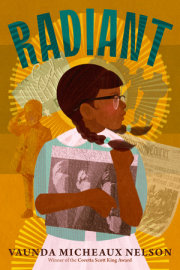
A historical middle-grade novel in verse from multiple Coretta Scott King winner Vaunda Micheaux Nelson.

As school begins in 1963, Cooper Dale wrestles with what it means to “shine” for a black girl in a predominantly white community near Pittsburgh. Set against the historic backdrop of the Birmingham church bombing, the Kennedy assassination, and Beatlemania, Radiant is a finely crafted novel in verse about race, class, faith, and finding your place in a loving family and a complicated world.  

Cooper’s primary concern is navigating fifth grade, where she faces both an extra-strict teacher and the bullying of Wade Carter, the only child of a well-to-do white family, whose home Cooper’s mother cleans for extra income. How can she shine when her mother works for the meanest boy in school? To make matters worse, Cooper quietly wishes she could be someone else.

It’s not all bad, though. Cooper and her beloved older sister have fallen for the Beatles, and Cooper is thrilled to have something special they can share. And what she learns about her British idols adds new complexity to Cooper’s feelings about race.
© Drew Nelson
Vaunda Micheaux Nelson is the author of many books for children, including Almost to Freedom, a Coretta Scott King Illustrator Honor Book. She was the winner of the Coretta Scott King Award and Gelett Burgess Children’s Book Award for Bad News for Outlaws: The Remarkable Life of Bass Reeves, Deputy U.S. Marshal. She works as a librarian in New Mexico, where she lives with her husband. View titles by Vaunda Micheaux Nelson
Sometimes

Sometimes
I want to be white.
White—
like new snow
or angel wings.
White—
like fresh milk
or cumulous clouds.
White—
like just-washed sheets
dancing on the clothesline.
White—
a full moon
on a clear night.


Fred

“That’s dumb.”
My big brother, Fred,
laughs at me.
“Nobody’s that white,
except maybe Dracula.
You wouldn’t use a white crayon
to color a white person
in a coloring book,
would you?”

“No.
So why are they called white?
Why not beige or peach?”

Fred shakes his head.
“Don’t know.
They just are.
So why do you want
to be white?”

“I said
sometimes.”

“Okay, okay,
why do you want to be white
sometimes?”

“Mama says
I might have to do better
than the smartest white person.
She says
I have to study harder.
I have to shine brighter.
It’s not fair.”

Fred shrugs.
“She tells me that, too.
I think she just wants us
to do our best.
But, girl,
you need to grow up.
Life isn’t fair.
Who said it was?
And you better not
let Ma and Pop hear you
talking about wanting to be white.”

Mama says
it’s sinful
to want to be something you’re not.
Well, I don’t always,
and I do want to shine,
but sometimes,
sometimes,
I just want to be
white.


Cooper

Fred’s real name is Fredrick.
He was named after Grampa Dale,
Daddy’s dad.
Pap Cooper wanted
to name me James,
after him.
But I was born a girl,
so they gave me Pap’s last name:
Cooper.
Pap says
he likes that even better.
I love my name.
Nobody else I know
has it.
I love my name.
I love my pap.
And I know
Pap loves me, too.

He loves me
just the way I am.
So I would never tell him
that, sometimes,
I want to be white.
White—
Like
the
kids
at
school.


The Queen of Darkness

All the kids call
Mrs. Keating
the Queen of Darkness.
Just my luck
to be in fifth grade this year
and get the meanest teacher
in the school.
Dag!

Kids say
she’ll whack your hand
with a ruler
if you make her mad,
even if you didn’t mean to.

If I can really shine,
maybe they’ll let me skip
the fifth grade
and go straight on to sixth
where I’d have Mrs. Hibbs,
the Queen of Lightness,
the Queen of Niceness.

If only I could shine.


Maxine

Sometimes
I wish I was my sister.
Maxine is so pretty
(everybody says so)
and she can wear white pants
and not get them dirty.
She’s a wonder.

She taught me
to read
and write
and add
and subtract
before I even started school.
She used to make a plate
with apple slices
or peanut butter crackers
to put beside our bed.
I would have my snack
while Mama sat
on the top step and read
us Uncle Wiggily stories
or Daddy told us
poems he knows by heart.

Maxine would make sure
I didn’t forget
to brush my teeth
again
before we went to sleep.

She’s fourteen now.
She’s still nice,
but she doesn’t play with me
as much
since she’s a teenager.

When Fred became one,
it was the same.

I don’t want to be a teenager
if it means
I won’t want to play
anymore.

Maybe I should be like Peter Pan
and never grow up.
★ "Nelson deftly weaves in major events from the 1960s, such as President Kennedy’s assassination, the Birmingham church bombing, and The Beatles playing on The Ed Sullivan Show, along with themes from The Wizard of Oz, into a story that reminds readers, 'A star can’t shine without a black night sky.' VERDICT This gentle yet thought-provoking historical novel in verse is perfect for anyone who has wished to be somewhere or someone else."—School Library Journal, starred review

"Sweet, soft, and moving, this is a novel that feels like a hug for Black readers and young girls who want to be their best self. The historical setting grounds the narrative, but it will still resonate loudly with readers of today. A natural choice for older fans of Carol Boston Weatherford and readers of Christopher Paul Curtis."—Booklist

"This verse novel examines complex themes of identity, forgiveness, self-love, and self-actualization through writing that’s accessible to young readers. Nelson intentionally and deftly uses details to situate the novel with history, and she’s crafted an endearing, three-dimensional protagonist in Cooper, whose voice and authentic struggle to make sense of her experiences will resonate in a work that presents fertile ground for discussion. A complex yet accessible exploration of self-actualization, presented in full color."—Kirkus Reviews

"Nelson presents an emotive glimpse into the civil rights era via Cooper’s careful internal monologue and nuanced characterization."—Publishers Weekly

"Effectively examines what it means to forgive along with the importance of family."—The Horn Book

About

A historical middle-grade novel in verse from multiple Coretta Scott King winner Vaunda Micheaux Nelson.

As school begins in 1963, Cooper Dale wrestles with what it means to “shine” for a black girl in a predominantly white community near Pittsburgh. Set against the historic backdrop of the Birmingham church bombing, the Kennedy assassination, and Beatlemania, Radiant is a finely crafted novel in verse about race, class, faith, and finding your place in a loving family and a complicated world.  

Cooper’s primary concern is navigating fifth grade, where she faces both an extra-strict teacher and the bullying of Wade Carter, the only child of a well-to-do white family, whose home Cooper’s mother cleans for extra income. How can she shine when her mother works for the meanest boy in school? To make matters worse, Cooper quietly wishes she could be someone else.

It’s not all bad, though. Cooper and her beloved older sister have fallen for the Beatles, and Cooper is thrilled to have something special they can share. And what she learns about her British idols adds new complexity to Cooper’s feelings about race.

Author

© Drew Nelson
Vaunda Micheaux Nelson is the author of many books for children, including Almost to Freedom, a Coretta Scott King Illustrator Honor Book. She was the winner of the Coretta Scott King Award and Gelett Burgess Children’s Book Award for Bad News for Outlaws: The Remarkable Life of Bass Reeves, Deputy U.S. Marshal. She works as a librarian in New Mexico, where she lives with her husband. View titles by Vaunda Micheaux Nelson

Excerpt

Sometimes

Sometimes
I want to be white.
White—
like new snow
or angel wings.
White—
like fresh milk
or cumulous clouds.
White—
like just-washed sheets
dancing on the clothesline.
White—
a full moon
on a clear night.


Fred

“That’s dumb.”
My big brother, Fred,
laughs at me.
“Nobody’s that white,
except maybe Dracula.
You wouldn’t use a white crayon
to color a white person
in a coloring book,
would you?”

“No.
So why are they called white?
Why not beige or peach?”

Fred shakes his head.
“Don’t know.
They just are.
So why do you want
to be white?”

“I said
sometimes.”

“Okay, okay,
why do you want to be white
sometimes?”

“Mama says
I might have to do better
than the smartest white person.
She says
I have to study harder.
I have to shine brighter.
It’s not fair.”

Fred shrugs.
“She tells me that, too.
I think she just wants us
to do our best.
But, girl,
you need to grow up.
Life isn’t fair.
Who said it was?
And you better not
let Ma and Pop hear you
talking about wanting to be white.”

Mama says
it’s sinful
to want to be something you’re not.
Well, I don’t always,
and I do want to shine,
but sometimes,
sometimes,
I just want to be
white.


Cooper

Fred’s real name is Fredrick.
He was named after Grampa Dale,
Daddy’s dad.
Pap Cooper wanted
to name me James,
after him.
But I was born a girl,
so they gave me Pap’s last name:
Cooper.
Pap says
he likes that even better.
I love my name.
Nobody else I know
has it.
I love my name.
I love my pap.
And I know
Pap loves me, too.

He loves me
just the way I am.
So I would never tell him
that, sometimes,
I want to be white.
White—
Like
the
kids
at
school.


The Queen of Darkness

All the kids call
Mrs. Keating
the Queen of Darkness.
Just my luck
to be in fifth grade this year
and get the meanest teacher
in the school.
Dag!

Kids say
she’ll whack your hand
with a ruler
if you make her mad,
even if you didn’t mean to.

If I can really shine,
maybe they’ll let me skip
the fifth grade
and go straight on to sixth
where I’d have Mrs. Hibbs,
the Queen of Lightness,
the Queen of Niceness.

If only I could shine.


Maxine

Sometimes
I wish I was my sister.
Maxine is so pretty
(everybody says so)
and she can wear white pants
and not get them dirty.
She’s a wonder.

She taught me
to read
and write
and add
and subtract
before I even started school.
She used to make a plate
with apple slices
or peanut butter crackers
to put beside our bed.
I would have my snack
while Mama sat
on the top step and read
us Uncle Wiggily stories
or Daddy told us
poems he knows by heart.

Maxine would make sure
I didn’t forget
to brush my teeth
again
before we went to sleep.

She’s fourteen now.
She’s still nice,
but she doesn’t play with me
as much
since she’s a teenager.

When Fred became one,
it was the same.

I don’t want to be a teenager
if it means
I won’t want to play
anymore.

Maybe I should be like Peter Pan
and never grow up.

Praise

★ "Nelson deftly weaves in major events from the 1960s, such as President Kennedy’s assassination, the Birmingham church bombing, and The Beatles playing on The Ed Sullivan Show, along with themes from The Wizard of Oz, into a story that reminds readers, 'A star can’t shine without a black night sky.' VERDICT This gentle yet thought-provoking historical novel in verse is perfect for anyone who has wished to be somewhere or someone else."—School Library Journal, starred review

"Sweet, soft, and moving, this is a novel that feels like a hug for Black readers and young girls who want to be their best self. The historical setting grounds the narrative, but it will still resonate loudly with readers of today. A natural choice for older fans of Carol Boston Weatherford and readers of Christopher Paul Curtis."—Booklist

"This verse novel examines complex themes of identity, forgiveness, self-love, and self-actualization through writing that’s accessible to young readers. Nelson intentionally and deftly uses details to situate the novel with history, and she’s crafted an endearing, three-dimensional protagonist in Cooper, whose voice and authentic struggle to make sense of her experiences will resonate in a work that presents fertile ground for discussion. A complex yet accessible exploration of self-actualization, presented in full color."—Kirkus Reviews

"Nelson presents an emotive glimpse into the civil rights era via Cooper’s careful internal monologue and nuanced characterization."—Publishers Weekly

"Effectively examines what it means to forgive along with the importance of family."—The Horn Book

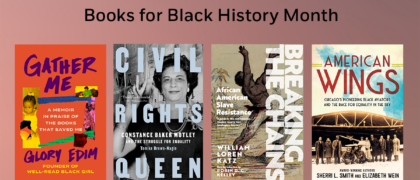
Books for Black History Month

In honor of Black History Month this February and beyond, we are highlighting essential fiction and nonfiction for students, teachers, and parents to share and discuss. Join Penguin Random House Education in celebrating the contributions of Black authors and illustrators by exploring the titles here: Black History – Middle School Black History – High School

Read more