
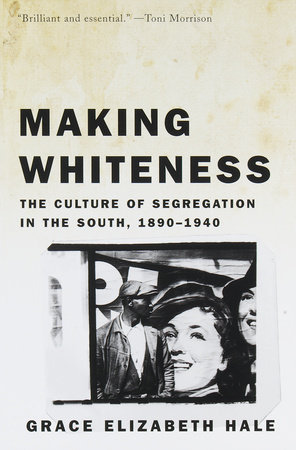
Hale examines the roots of American racial mythology and ideology, showing how, in the wake of Reconstruction and the active citizenship of their ex-slaves, white southerners chose to establish their identity through a cultural system of violence and physical separation based on skin color. This culture of segregation, Hale argues, created a modern notion of whiteness that was eventually taken up by the rest of the nation and that continues to shape--and disfigure--American society in unacknowledged ways. In a brilliantly original analysis of segregation and its role in our nation's history--including stinging dissections of the myth of the "Black Mammy" and lynching as a modern spectacle--Hale makes clear how American whiteness was invented, and how it was used to assert a self-delusional dominance otherwise denied by the forces of modernity and enlightenment.

"Scholarship, even when thorough, doesn't always enlighten. For that one needs the kind of surgical insight Grace Hale has applied to her impeccable research. Making Whiteness is both brilliant and essential."--Toni Morrison

"Making Whiteness shows us that the racism we think is timeless is a modern creation for which not only the South but the entire nation is responsible.  This brilliant study also tells us how we may begin to reimagine integration, not as an elusive dream but as an everyday practice."    
--Jan Lewis, author of Pursuit of Happiness: Families and Values in Jefferson's Virginia

"Grace Elizabeth Hale's brilliant and original analysis of our post-slavery concept of race just might be the richly hued book that will point the way out of the white-black wilderness in which we need not be trapped."
--William S. McFeely, author of Frederick Douglass
Grace Elizabeth Hale is an assistant professor of American history at the University of Virginia. She lives in Charlottesville, Virginia. View titles by Grace Elizabeth Hale

About

Hale examines the roots of American racial mythology and ideology, showing how, in the wake of Reconstruction and the active citizenship of their ex-slaves, white southerners chose to establish their identity through a cultural system of violence and physical separation based on skin color. This culture of segregation, Hale argues, created a modern notion of whiteness that was eventually taken up by the rest of the nation and that continues to shape--and disfigure--American society in unacknowledged ways. In a brilliantly original analysis of segregation and its role in our nation's history--including stinging dissections of the myth of the "Black Mammy" and lynching as a modern spectacle--Hale makes clear how American whiteness was invented, and how it was used to assert a self-delusional dominance otherwise denied by the forces of modernity and enlightenment.

"Scholarship, even when thorough, doesn't always enlighten. For that one needs the kind of surgical insight Grace Hale has applied to her impeccable research. Making Whiteness is both brilliant and essential."--Toni Morrison

"Making Whiteness shows us that the racism we think is timeless is a modern creation for which not only the South but the entire nation is responsible.  This brilliant study also tells us how we may begin to reimagine integration, not as an elusive dream but as an everyday practice."    
--Jan Lewis, author of Pursuit of Happiness: Families and Values in Jefferson's Virginia

"Grace Elizabeth Hale's brilliant and original analysis of our post-slavery concept of race just might be the richly hued book that will point the way out of the white-black wilderness in which we need not be trapped."
--William S. McFeely, author of Frederick Douglass

Author

Grace Elizabeth Hale is an assistant professor of American history at the University of Virginia. She lives in Charlottesville, Virginia. View titles by Grace Elizabeth Hale

Books for National Poetry Month

For National Poetry Month in April, we’re highlighting a selection of classic and contemporary poetry collections and novels-in-verse.   Poetry Month – Middle School Titles Poetry Month – High School Titles   Download free thematic educator guides:  Middle School Guide on Teaching Poetry High School Guide on Teaching Poetry
Read more