
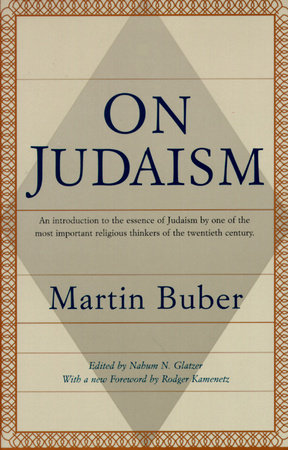

On Judaism

An Introduction to the Essence of Judaism by One of the Most Important ReligiousThinkers of the Twentieth Century

Look inside
Paperback
$21.00 US
5.2"W x 7.95"H x 0.6"D  
On sale Jan 13, 1996 | 272 Pages | 9780805210507
Grades 9-12 + AP/IB

See Additional Formats
With his book On Judaism, Buber takes us on a journey into the heart of Judaism--its spirit, vision, and relevance to modern life.

"To read Martin Buber is to encounter an extraordinary soul--and to risk changing your life...Unique, exhilarating, profound."--David Wolpe, author of Why Be Jewish?

"How good it is to be reminded of the richness of Martin Buber's early thought, of his passion, of his power as a teacher, even as a prophet. This collection, with Rodger Kamenetz's foreword, will be of great value to all concerned with the revitalization of Judaism today."--Jonathan Omer-Man, Metivta Institute

Contents

Foreword by Rodger Kamenetz
Publisher's Note

The Early Addresses (1909-1918)
Preface to the 1923 Edition
1. Judaism and the Jews
2. Judaism and Mankind
3. Renewal of Judaism
4. The Spirit of the Orient and Judaism
5. Jewish Religiosity
6. Myth in Judaism
7. The Holy Way: A Word to the Jews and to the Nations
8. Herut: On Youth and Religion

The Later Addresses (1939-1951)
Preface
1. The Spirit of Israel and the World of Today
2. Judaism and Civilization
3. The Silent Question
4. The Dialogue between Heaven and Earth
Martin Buber (1878–1965), one of the paramount spiritual leaders of the twentieth century, is best known as the author of I and Thou—the basic formulation of his philosophy of dialogue—and for his appreciation of Hasidim, which made a deep impact on Christian as well as Jewish thinkers. Born in Vienna, and raised in Lemberg, Buber studied philosophy at the University of Berlin. Fleeing Nazi Germany in 1938, he emigrated to Israel, where he taught social philosophy at the Hebrew University until his retirement in 1951. He lived in Jerusalem until his death in 1965.

Also published by Schocken Books, Martin Buber’s work include: Israel and the World, The Legend of the Baal-Shem, The Letters Of Martin Buber, On the Bible, On Judaism, On Zion, Tales of the Hasidim, Ten Rungs, and Way of Response. View titles by Martin Buber
“To read Martin Buber is to encounter an extraordinary soul—and to rish changing your life . . . Unique, exhilarating, profound.”
—David Wolpe, author of Why Be Jewish?
 
“When as an adult I first found myself wrestling with God, Torah, and Judaism, someone handed me these essays of Martin Buber. I found them, and subsequently all of Buber’s work, speaking deeply and wisely to my life-situation, inviting me into a conversation that has continued through the quarter-century since. To anyone who is newly attracted to, or deeply involved in, Jewish renewal, I recommend them for at least a quarter-century’s worth of wonderful exploration.”
—Arthur Waskow, author of Down-to-Earth Judaism
 
“How good it is to be reminded of the richness of Martin Buber’s early thought, of his passion, of his power as a teacher, even as a prophet. This collection, with Rodger Kamenetz’s foreword, will be of great value to all concerned with the revitalization of Judaism today.”
—Jonathan Omer-man, Metivta Institute

About

With his book On Judaism, Buber takes us on a journey into the heart of Judaism--its spirit, vision, and relevance to modern life.

"To read Martin Buber is to encounter an extraordinary soul--and to risk changing your life...Unique, exhilarating, profound."--David Wolpe, author of Why Be Jewish?

"How good it is to be reminded of the richness of Martin Buber's early thought, of his passion, of his power as a teacher, even as a prophet. This collection, with Rodger Kamenetz's foreword, will be of great value to all concerned with the revitalization of Judaism today."--Jonathan Omer-Man, Metivta Institute

Contents

Foreword by Rodger Kamenetz
Publisher's Note

The Early Addresses (1909-1918)
Preface to the 1923 Edition
1. Judaism and the Jews
2. Judaism and Mankind
3. Renewal of Judaism
4. The Spirit of the Orient and Judaism
5. Jewish Religiosity
6. Myth in Judaism
7. The Holy Way: A Word to the Jews and to the Nations
8. Herut: On Youth and Religion

The Later Addresses (1939-1951)
Preface
1. The Spirit of Israel and the World of Today
2. Judaism and Civilization
3. The Silent Question
4. The Dialogue between Heaven and Earth

Author

Martin Buber (1878–1965), one of the paramount spiritual leaders of the twentieth century, is best known as the author of I and Thou—the basic formulation of his philosophy of dialogue—and for his appreciation of Hasidim, which made a deep impact on Christian as well as Jewish thinkers. Born in Vienna, and raised in Lemberg, Buber studied philosophy at the University of Berlin. Fleeing Nazi Germany in 1938, he emigrated to Israel, where he taught social philosophy at the Hebrew University until his retirement in 1951. He lived in Jerusalem until his death in 1965.

Also published by Schocken Books, Martin Buber’s work include: Israel and the World, The Legend of the Baal-Shem, The Letters Of Martin Buber, On the Bible, On Judaism, On Zion, Tales of the Hasidim, Ten Rungs, and Way of Response. View titles by Martin Buber

Praise

“To read Martin Buber is to encounter an extraordinary soul—and to rish changing your life . . . Unique, exhilarating, profound.”
—David Wolpe, author of Why Be Jewish?
 
“When as an adult I first found myself wrestling with God, Torah, and Judaism, someone handed me these essays of Martin Buber. I found them, and subsequently all of Buber’s work, speaking deeply and wisely to my life-situation, inviting me into a conversation that has continued through the quarter-century since. To anyone who is newly attracted to, or deeply involved in, Jewish renewal, I recommend them for at least a quarter-century’s worth of wonderful exploration.”
—Arthur Waskow, author of Down-to-Earth Judaism
 
“How good it is to be reminded of the richness of Martin Buber’s early thought, of his passion, of his power as a teacher, even as a prophet. This collection, with Rodger Kamenetz’s foreword, will be of great value to all concerned with the revitalization of Judaism today.”
—Jonathan Omer-man, Metivta Institute