Download high-resolution image Look inside
Listen to a clip from the audiobook
audio pause button
0:00
0:00

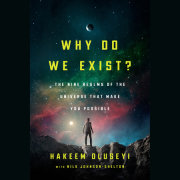
Why Do We Exist?

The Nine Realms of Universe that Make You Possible

Look inside
Listen to a clip from the audiobook
audio pause button
0:00
0:00
Hardcover
$32.00 US
5.75"W x 8.55"H x 0.91"D  
On sale Apr 21, 2026 | 256 Pages | 9781984819123
Grades 9-12 + AP/IB

See Additional Formats
A boundary-breaking astrophysicist reimagines the universe—and our place within it—in this audacious journey through the Nine Realms of the cosmos.

“This book explains the universe and then quietly explains you. Which is unfair, because I was just trying to read about space. . . . Smart, funny, and unexpectedly moving.”—Sarah Silverman, comedian

The universe gave rise to everything: stars and cells, minds and memories, purpose and pain. But it doesn’t care about us. It follows its own rules. And now, according to Dr. Hakeem Oluseyi, we finally understand enough about those rules to ask the big questions like we mean it: Why do we exist? Are we alone? How did we get here? What comes next? And—perhaps most urgently—is there reason to hope?

Heck yeah, there is!

Dr. Oluseyi is no ordinary scientist. A former street kid turned world-renowned cosmologist, he realized something bold: The story of existence can be told as a passage through nine interwoven realms—each revealing a new layer of cosmic truth.

There’s the Middle Realm, where we live; the Realm of Life, where organisms flourish across the vastness of space; the Cosmological Realm, where galaxies dance and collide; the Dark Realm, dominated by unseen energy and invisible forces; the Quantum Realm, where reality defies intuition; the Temporal Realm, where time begins, flows, and perhaps ends; the Multiverse Realm, where our universe may be one among many; the Realm Beyond Horizons, where observation breaks down; and the Realm of Imagination, where insight, curiosity, and creativity shape our understanding of it all.

In Why Do We Exist?, Dr. Oluseyi cracks open these realms with clarity, humor, and radical honesty, bridging cutting-edge physics, personal narrative, and philosophy. The result is a blueprint for understanding reality itself and a surprising case for human potential in an indifferent cosmos.

This isn’t just a science book. It’s a survival manual for the universally curious.
© Freddie Claire
Hakeem Oluseyi is an American astrophysicist, cosmologist, inventor, educator, television personality, and public speaker. Since 2007, he has been a professor of physics and space sciences at the Florida Institute of Technology, and has served at Science Mission Directorate at NASA Headquarters in Washington, D.C. He appears regularly on the Science Channel's highly popular program, Outrageous Acts of Science, as well as other science shows produced by Discovery, Inc. View titles by Hakeem Oluseyi
Middle Realm

It ain’t what you don’t know that gets you into trouble. It’s what you know for sure that just ain’t so. —credited to Mark Twain (but we ain’t sure if that’s so)

Humans used to believe Earth—and we humans—were at the center of everything. Then we learned that Earth orbits the Sun, which orbits the center of the Milky Way, which just kind of floats weightlessly among a swarm of hundreds of billions of other galaxies connected by a colossal invisible superstructure.

The universe definitely does not revolve around us. We were mistaken.

But here’s the thing about the universe: Size matters. And while we may not reside at the universe’s center, we are in the middle of it—at least in terms of scale.

Our starting realm is the one in which we live—the only realm where life is possible—a place I call the Middle Realm. In terms of scale, the Middle Realm includes everything larger than an atom to the full length and breadth of a galaxy’s arm. I call it the Middle Realm not to be cheeky or to suggest that it is “just right” for life (by volume, practically all of the Middle Realm is uninhabitable), but because humans are in the middle of the largest and smallest known physical distances in the entire observable universe.

The greatest perceptible distance is the size of the observable universe itself, which is 1026 meters across (a 1 followed by 26 zeros). The least perceptible distance is the size of the smallest known physical entity, a subatomic particle called the neutrino, which measures 10–26 meters (a 1 preceded by 25 zeros and a decimal point). By chance, humans are at the scale of 100 meters, slapdab in the middle!

The most critical structures of the Middle Realm are stars and their gigantic nurseries. The most essential building block of the Middle Realm is the humble hydrogen molecule, H2. Neither you nor I would exist without these components.

How are they related, and how do they come together to create things like solar systems and asteroid belts and moons? And how the heck do they produce a planet like Earth, the only planet we know of that is capable of hosting complex, intelligent life? We will answer these questions as we journey from the largest to the most minuscule structures of the Middle Realm, and eventually to us.

•••

Before we get started, we have to overcome a problem.

Most of us hold incorrect assumptions about how the universe works that can hinder our understanding of the Nine Realms. So, let’s start by deprogramming our minds to overcome what I call normal deceptions. These deceptions aren’t lies told with bad intent; rather, they are misunderstandings we pick up simply by being human. They arise from intuition, language, cultural assumptions, our everyday observations, schoolyard myths, even well-meaning teachers. The kicker? They feel true. That’s what makes them so effective.

These deceptions influence our understanding of how the universe functions. They are not merely trivial errors; they cause us to overlook complexity, misinterpret cause and effect, and mistakenly believe that things are separate when they are, in fact, deeply interconnected. By actively addressing these deceptions, we can enhance our comprehension of the universe and appreciate the intricate relationships that define it.

Before we map the physics of everyday life, let’s pull back the curtain on a few everyday normal deceptions. Not because you need to memorize them, but to show you how deep the rabbit hole goes. Part of this book’s mission is to dismantle these illusions, because only by seeing clearly can we start asking the right questions—like why do we exist?

Let’s begin by looking at a science story everyone knows: Isaac Newton watching an apple fall from a tree. It is a common enough experience—things fall all the time. But Isaac—one of the greatest scientific minds the world has ever seen—had questions: Why does the apple fall? Why does it fall straight down? Why doesn’t it float away? Why doesn’t it go sideways?

Isaac eventually concluded that some invisible, all-encompassing force must be acting on the apple, pulling it straight to the ground and, once settled, keeping it there. He called this force gravity. He further concluded that gravity acted on all objects on the planet—including the apple tree, Isaac himself, his chair, and his quill. He also intuited that gravity is the same force that keeps the Moon orbiting Earth and both of these orbiting the Sun.

This tale has stood the test of time because it is relatable. You don’t need to be a scientist to understand what Isaac was getting at. Our experience of reality—our normal deception—neatly conforms with the fact that things fall (and often break). Releasing an object from some height and observing it travel toward the ground is as commonplace and reliable an earthly phenomenon as the Sun rising. Falling objects and our rising Sun are not strange at all. They are normal. Yet they are both deceptions.

It would be strange if I released an object and it just hovered above the ground. If that happened, how would you react? Shock? Wonder? A pinch of dread? Maybe you’d go into full-on freak-out mode? I probably would. It would mean something is not right.

But here’s the thing: Falling isn’t normal. Not on a cosmic scale. Watching an apple plummet to the ground might feel mundane, but it’s actually weird. The real question is this: Why does it fall at all?

Let’s reframe Newton’s apple moment. Imagine an apple tree floating in deep space. If an apple detaches, it doesn’t fall; it just hangs there, motionless. In most places in the universe, there’s nothing nearby to pull it in. And without a nearby object, the default state is coasting, drifting, doing nothing. If stillness and constancy are the norm, then accelerated motion—the kind that happens to the apple—should be what surprises us.

This brings us to something that trips up many people: orbiting. A satellite circling Earth isn’t flying like a plane; it’s falling. Constantly. But it’s also moving sideways so fast that, as it falls, the ground curves away beneath it at the same rate. That’s what orbiting really is: falling with just enough horizontal motion to keep missing Earth.

Here’s the part people may miss: An orbiting satellite is weightless, just like the people inside. So is everything else that’s falling. That includes Earth, the Moon, the Sun—heck, the entire Milky Way. If you’ve ever wondered, “What does Earth weigh?”—well, it’s in free fall around the Sun, so the answer is nothing. Weight is what you feel when something resists your fall. But when everything is falling together, there’s nothing to push back.

So Chicken Little was right. The sky is falling!

Let’s take another look at Isaac’s falling apple. Our everyday intuition tells us that once the apple is free from its branch, the distance between it and the ground will decrease at an ever-increasing rate. The apple is decreasing its potential energy (a measure of its energy relative to its position to the ground). At the same time, it increases its kinetic energy (a measure of its energy associated with movement as it hurtles toward the ground). We call this falling rate the gravitational acceleration of Earth. Some of you may remember this constant from high school physics—9.8 meters per second squared. But how do you distinguish between the apple falling to the ground and the ground pushing up toward the apple?

This may sound like a ridiculous question. Clearly, our planet isn’t expanding outward to meet all falling objects, from a feather to the Moon. More apparent still, the apple doesn’t sit in place while the ground nudges toward it. Yet, our modern understanding of gravity maintains that the ground does, in fact, accelerate up toward the apple.

Here’s why. About two hundred years after Newton, another genius came along and refined our knowledge of gravity: Albert Einstein. In Einstein’s general theory of relativity—general relativity, or GR for short—gravity is seen not as a force pulling objects down but as the curvature of space-time caused by mass and energy. This leads to a different interpretation of what it means to “fall.”

If that sounds perplexing, don’t worry, I’ll explain space-time in detail in the Cosmological Realm. All you need to know for now is that whenever an object is released anywhere in the universe, it follows a straight path through space-time. We call this path a geodesic. If space-time is curved, as it is near massive objects like Earth, the geodesic appears to us as “falling.” The object isn’t experiencing a force; it’s simply following the most natural, “straight” path through curved space-time.

A somewhat familiar analogue for this geodesic can be found in children’s museums, amusement parks, and science centers worldwide. (Places that always need funding, by the way!) You’ve probably seen one of those coin funnels where you drop a quarter in and it rolls around in an ever-tightening spiral before vanishing into a hole at the bottom. The quarter isn’t actively “seeking” the hole; it’s simply moving along a curved surface shaped by the funnel. Its motion appears circular because of the shape of the surface it’s rolling along.
“This book explains the universe and then quietly explains you. Which is unfair, because I was just trying to read about space. . . . Smart, funny, and unexpectedly moving.”—Sarah Silverman, comedian

“Full of surprises on every page, Why Do We Exist? explores how the cosmic dance of physics—on a scale from the smallest subatomic particles to the sweep of the universe—makes our existence possible. Chatty and charming, this book feels like a science lesson from a friendly physicist over a cup of coffee. Oluseyi makes physics fun, transforming a subject that often seems impenetrable into a grand story accessible to all.”—Steve Brusatte, paleontologist and New York Times bestselling author of The Rise and Fall of the Dinosaurs

“An incredible journey by a master guide, Why Do We Exist? explores the mysteries of the cosmos with wit, warmth, and clarity. Oluseyi’s chatty, deeply human voice turns counterintuitive ideas into moments of insight—and invites readers to see the universe anew.”—Sara Seager, astrophysicist and author of The Smallest Lights in the Universe

“A sweeping, lively tour of the cosmos that makes life feel like a miracle . . . [Oluseyi] offers exceedingly clear explanations of the science as he goes, from the origin of fusion in protostars to black holes to quantum tunneling. The wonderfully dizzying result is that it places us, viscerally, in the scheme of things. Energy flows through these nested realms, and there, in the middle, is us: knots of energy tying together the largest and smallest scales. . . . Propulsive from start to finish.”Kirkus Reviews

About

A boundary-breaking astrophysicist reimagines the universe—and our place within it—in this audacious journey through the Nine Realms of the cosmos.

“This book explains the universe and then quietly explains you. Which is unfair, because I was just trying to read about space. . . . Smart, funny, and unexpectedly moving.”—Sarah Silverman, comedian

The universe gave rise to everything: stars and cells, minds and memories, purpose and pain. But it doesn’t care about us. It follows its own rules. And now, according to Dr. Hakeem Oluseyi, we finally understand enough about those rules to ask the big questions like we mean it: Why do we exist? Are we alone? How did we get here? What comes next? And—perhaps most urgently—is there reason to hope?

Heck yeah, there is!

Dr. Oluseyi is no ordinary scientist. A former street kid turned world-renowned cosmologist, he realized something bold: The story of existence can be told as a passage through nine interwoven realms—each revealing a new layer of cosmic truth.

There’s the Middle Realm, where we live; the Realm of Life, where organisms flourish across the vastness of space; the Cosmological Realm, where galaxies dance and collide; the Dark Realm, dominated by unseen energy and invisible forces; the Quantum Realm, where reality defies intuition; the Temporal Realm, where time begins, flows, and perhaps ends; the Multiverse Realm, where our universe may be one among many; the Realm Beyond Horizons, where observation breaks down; and the Realm of Imagination, where insight, curiosity, and creativity shape our understanding of it all.

In Why Do We Exist?, Dr. Oluseyi cracks open these realms with clarity, humor, and radical honesty, bridging cutting-edge physics, personal narrative, and philosophy. The result is a blueprint for understanding reality itself and a surprising case for human potential in an indifferent cosmos.

This isn’t just a science book. It’s a survival manual for the universally curious.

Author

© Freddie Claire
Hakeem Oluseyi is an American astrophysicist, cosmologist, inventor, educator, television personality, and public speaker. Since 2007, he has been a professor of physics and space sciences at the Florida Institute of Technology, and has served at Science Mission Directorate at NASA Headquarters in Washington, D.C. He appears regularly on the Science Channel's highly popular program, Outrageous Acts of Science, as well as other science shows produced by Discovery, Inc. View titles by Hakeem Oluseyi

Excerpt

Middle Realm

It ain’t what you don’t know that gets you into trouble. It’s what you know for sure that just ain’t so. —credited to Mark Twain (but we ain’t sure if that’s so)

Humans used to believe Earth—and we humans—were at the center of everything. Then we learned that Earth orbits the Sun, which orbits the center of the Milky Way, which just kind of floats weightlessly among a swarm of hundreds of billions of other galaxies connected by a colossal invisible superstructure.

The universe definitely does not revolve around us. We were mistaken.

But here’s the thing about the universe: Size matters. And while we may not reside at the universe’s center, we are in the middle of it—at least in terms of scale.

Our starting realm is the one in which we live—the only realm where life is possible—a place I call the Middle Realm. In terms of scale, the Middle Realm includes everything larger than an atom to the full length and breadth of a galaxy’s arm. I call it the Middle Realm not to be cheeky or to suggest that it is “just right” for life (by volume, practically all of the Middle Realm is uninhabitable), but because humans are in the middle of the largest and smallest known physical distances in the entire observable universe.

The greatest perceptible distance is the size of the observable universe itself, which is 1026 meters across (a 1 followed by 26 zeros). The least perceptible distance is the size of the smallest known physical entity, a subatomic particle called the neutrino, which measures 10–26 meters (a 1 preceded by 25 zeros and a decimal point). By chance, humans are at the scale of 100 meters, slapdab in the middle!

The most critical structures of the Middle Realm are stars and their gigantic nurseries. The most essential building block of the Middle Realm is the humble hydrogen molecule, H2. Neither you nor I would exist without these components.

How are they related, and how do they come together to create things like solar systems and asteroid belts and moons? And how the heck do they produce a planet like Earth, the only planet we know of that is capable of hosting complex, intelligent life? We will answer these questions as we journey from the largest to the most minuscule structures of the Middle Realm, and eventually to us.

•••

Before we get started, we have to overcome a problem.

Most of us hold incorrect assumptions about how the universe works that can hinder our understanding of the Nine Realms. So, let’s start by deprogramming our minds to overcome what I call normal deceptions. These deceptions aren’t lies told with bad intent; rather, they are misunderstandings we pick up simply by being human. They arise from intuition, language, cultural assumptions, our everyday observations, schoolyard myths, even well-meaning teachers. The kicker? They feel true. That’s what makes them so effective.

These deceptions influence our understanding of how the universe functions. They are not merely trivial errors; they cause us to overlook complexity, misinterpret cause and effect, and mistakenly believe that things are separate when they are, in fact, deeply interconnected. By actively addressing these deceptions, we can enhance our comprehension of the universe and appreciate the intricate relationships that define it.

Before we map the physics of everyday life, let’s pull back the curtain on a few everyday normal deceptions. Not because you need to memorize them, but to show you how deep the rabbit hole goes. Part of this book’s mission is to dismantle these illusions, because only by seeing clearly can we start asking the right questions—like why do we exist?

Let’s begin by looking at a science story everyone knows: Isaac Newton watching an apple fall from a tree. It is a common enough experience—things fall all the time. But Isaac—one of the greatest scientific minds the world has ever seen—had questions: Why does the apple fall? Why does it fall straight down? Why doesn’t it float away? Why doesn’t it go sideways?

Isaac eventually concluded that some invisible, all-encompassing force must be acting on the apple, pulling it straight to the ground and, once settled, keeping it there. He called this force gravity. He further concluded that gravity acted on all objects on the planet—including the apple tree, Isaac himself, his chair, and his quill. He also intuited that gravity is the same force that keeps the Moon orbiting Earth and both of these orbiting the Sun.

This tale has stood the test of time because it is relatable. You don’t need to be a scientist to understand what Isaac was getting at. Our experience of reality—our normal deception—neatly conforms with the fact that things fall (and often break). Releasing an object from some height and observing it travel toward the ground is as commonplace and reliable an earthly phenomenon as the Sun rising. Falling objects and our rising Sun are not strange at all. They are normal. Yet they are both deceptions.

It would be strange if I released an object and it just hovered above the ground. If that happened, how would you react? Shock? Wonder? A pinch of dread? Maybe you’d go into full-on freak-out mode? I probably would. It would mean something is not right.

But here’s the thing: Falling isn’t normal. Not on a cosmic scale. Watching an apple plummet to the ground might feel mundane, but it’s actually weird. The real question is this: Why does it fall at all?

Let’s reframe Newton’s apple moment. Imagine an apple tree floating in deep space. If an apple detaches, it doesn’t fall; it just hangs there, motionless. In most places in the universe, there’s nothing nearby to pull it in. And without a nearby object, the default state is coasting, drifting, doing nothing. If stillness and constancy are the norm, then accelerated motion—the kind that happens to the apple—should be what surprises us.

This brings us to something that trips up many people: orbiting. A satellite circling Earth isn’t flying like a plane; it’s falling. Constantly. But it’s also moving sideways so fast that, as it falls, the ground curves away beneath it at the same rate. That’s what orbiting really is: falling with just enough horizontal motion to keep missing Earth.

Here’s the part people may miss: An orbiting satellite is weightless, just like the people inside. So is everything else that’s falling. That includes Earth, the Moon, the Sun—heck, the entire Milky Way. If you’ve ever wondered, “What does Earth weigh?”—well, it’s in free fall around the Sun, so the answer is nothing. Weight is what you feel when something resists your fall. But when everything is falling together, there’s nothing to push back.

So Chicken Little was right. The sky is falling!

Let’s take another look at Isaac’s falling apple. Our everyday intuition tells us that once the apple is free from its branch, the distance between it and the ground will decrease at an ever-increasing rate. The apple is decreasing its potential energy (a measure of its energy relative to its position to the ground). At the same time, it increases its kinetic energy (a measure of its energy associated with movement as it hurtles toward the ground). We call this falling rate the gravitational acceleration of Earth. Some of you may remember this constant from high school physics—9.8 meters per second squared. But how do you distinguish between the apple falling to the ground and the ground pushing up toward the apple?

This may sound like a ridiculous question. Clearly, our planet isn’t expanding outward to meet all falling objects, from a feather to the Moon. More apparent still, the apple doesn’t sit in place while the ground nudges toward it. Yet, our modern understanding of gravity maintains that the ground does, in fact, accelerate up toward the apple.

Here’s why. About two hundred years after Newton, another genius came along and refined our knowledge of gravity: Albert Einstein. In Einstein’s general theory of relativity—general relativity, or GR for short—gravity is seen not as a force pulling objects down but as the curvature of space-time caused by mass and energy. This leads to a different interpretation of what it means to “fall.”

If that sounds perplexing, don’t worry, I’ll explain space-time in detail in the Cosmological Realm. All you need to know for now is that whenever an object is released anywhere in the universe, it follows a straight path through space-time. We call this path a geodesic. If space-time is curved, as it is near massive objects like Earth, the geodesic appears to us as “falling.” The object isn’t experiencing a force; it’s simply following the most natural, “straight” path through curved space-time.

A somewhat familiar analogue for this geodesic can be found in children’s museums, amusement parks, and science centers worldwide. (Places that always need funding, by the way!) You’ve probably seen one of those coin funnels where you drop a quarter in and it rolls around in an ever-tightening spiral before vanishing into a hole at the bottom. The quarter isn’t actively “seeking” the hole; it’s simply moving along a curved surface shaped by the funnel. Its motion appears circular because of the shape of the surface it’s rolling along.

Praise

“This book explains the universe and then quietly explains you. Which is unfair, because I was just trying to read about space. . . . Smart, funny, and unexpectedly moving.”—Sarah Silverman, comedian

“Full of surprises on every page, Why Do We Exist? explores how the cosmic dance of physics—on a scale from the smallest subatomic particles to the sweep of the universe—makes our existence possible. Chatty and charming, this book feels like a science lesson from a friendly physicist over a cup of coffee. Oluseyi makes physics fun, transforming a subject that often seems impenetrable into a grand story accessible to all.”—Steve Brusatte, paleontologist and New York Times bestselling author of The Rise and Fall of the Dinosaurs

“An incredible journey by a master guide, Why Do We Exist? explores the mysteries of the cosmos with wit, warmth, and clarity. Oluseyi’s chatty, deeply human voice turns counterintuitive ideas into moments of insight—and invites readers to see the universe anew.”—Sara Seager, astrophysicist and author of The Smallest Lights in the Universe

“A sweeping, lively tour of the cosmos that makes life feel like a miracle . . . [Oluseyi] offers exceedingly clear explanations of the science as he goes, from the origin of fusion in protostars to black holes to quantum tunneling. The wonderfully dizzying result is that it places us, viscerally, in the scheme of things. Energy flows through these nested realms, and there, in the middle, is us: knots of energy tying together the largest and smallest scales. . . . Propulsive from start to finish.”Kirkus Reviews