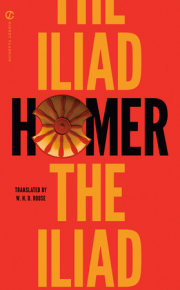
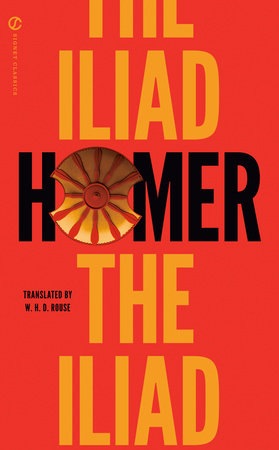
Humans and gods wrestling with towering emotions. Men fighting to the death amid devastation and destruction. Perhaps the Western world’s first and best storyteller, Homer draws the reader in with bated breath. His masterful tale contains some of the most famous episodes in all of literature: the curse on the prophet Cassandra; the siege of Troy; the battle between Hector and Achilles; the face that launched a thousand ships; and of course, the deception of the Trojan Horse. To this day, the heroism and adventure of The Iliad have remained unmatched in song and story.
In his “plain English” translation, W.H.D. Rouse makes a point to keep the language as colloquial as Homer’s original was, never pedantic, high-flown, or clichéd. In fact, it is the nearest contemporary English equivalent to the epic Homer’s audience heard at their banquets.
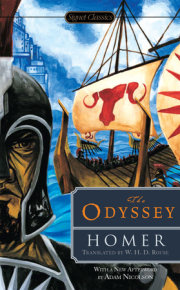
Homer was a Greek poet, recognized as the author of the great epics, the Iliad, the story of the siege of Troy, and the Odyssey, the tale of Ulysses’s wanderings.
View titles by Homer
“A great poem cannot be fully translated unless by a poet almost as great as its original author…W.H.D. Rouse…retells the story in fast, modern, colloquial prose. It is the first version I have ever seen which drives on as rapidly as the original and therefore it makes an excellent introduction to Homer. This is the translation to read first, if you have never read The Iliad.”—The New York Times Book Review
Humans and gods wrestling with towering emotions. Men fighting to the death amid devastation and destruction. Perhaps the Western world’s first and best storyteller, Homer draws the reader in with bated breath. His masterful tale contains some of the most famous episodes in all of literature: the curse on the prophet Cassandra; the siege of Troy; the battle between Hector and Achilles; the face that launched a thousand ships; and of course, the deception of the Trojan Horse. To this day, the heroism and adventure of The Iliad have remained unmatched in song and story.
In his “plain English” translation, W.H.D. Rouse makes a point to keep the language as colloquial as Homer’s original was, never pedantic, high-flown, or clichéd. In fact, it is the nearest contemporary English equivalent to the epic Homer’s audience heard at their banquets.
Author
Homer was a Greek poet, recognized as the author of the great epics, the Iliad, the story of the siege of Troy, and the Odyssey, the tale of Ulysses’s wanderings.
View titles by Homer
Praise
“A great poem cannot be fully translated unless by a poet almost as great as its original author…W.H.D. Rouse…retells the story in fast, modern, colloquial prose. It is the first version I have ever seen which drives on as rapidly as the original and therefore it makes an excellent introduction to Homer. This is the translation to read first, if you have never read The Iliad.”—The New York Times Book Review