Download high-resolution image
Listen to a clip from the audiobook
audio pause button
0:00
0:00

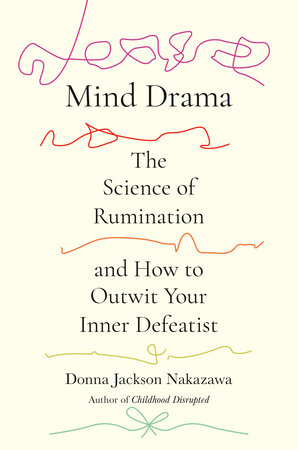
Mind Drama

The Science of Rumination and How to Outwit Your Inner Defeatist

Listen to a clip from the audiobook
audio pause button
0:00
0:00
An acclaimed science writer explains why we so often become lost in our most self-defeating thoughts and how to transform this brooding energy into something empowering and productive.

“If you’ve ever wondered why your mind sometimes gets the best of you, and you are hungry for science-based tools to stop overthinking, this book is for you.”—Ethan Kross, bestselling author of Shift and Chatter

Why’d I do that? He’s such a jerk! I’m such an idiot! What did she mean by that comment? Ideally, our thought spirals help us process difficult situations and emotions. When they become repetitive, however, they can be highly problematic: your brain is ruminating. And science has shown the degree to which we ruminate, perhaps more than any other mental act, determines our life-long well-being.

In Mind Drama, veteran science writer Donna Jackson Nakazawa gets inside the strange magnetism of rumination, explains why we're all doing it now more than ever, and shares the new science for decoding, outwitting, and repurposing this dark mental habit. Using her own ruminative mind as a test case, she walks us through the actionable neuro-hacks that can help us escape unhealthy brooding, like:

  • A checklist of questions to pinpoint how your own brain works; this is how to begin to train it in a new direction.
  • How to crack your personal rumination code by assigning names to the images, emotions, and sensations that accompany your downward spirals. Personalizing language this way becomes your portal to escape.
  • Why your patterns of rumination have something profound to tell you: they are signal fires from your past; once you understand the messages they’re sending you, you can use that insight to begin to heal.
  • How to use ballistic interruptions—words with emotional powerto exit your ruminating thoughts and rewire your mind.
  • Why you overthink about relationships, with actionable tools to circumvent that negative thinking and find emotional freedom.
  • How to reverse engineer your ruminative thoughts and spiral up: How to cultivate an "opposite feeling,” and “let fear be your friend” to gain perspective.

A deeply helpful roadmap to the anatomy of self-criticism and unproductive worry, Mind Drama shows us that with practice we can tame our thoughts and repurpose our ruminative tendencies to access our mind’s higher potential for creativity, ingenuity, and insight.
© Marshall Clarke
Donna Jackson Nakazawa is the author of four books that explore the intersection of neuroscience, immunology, and emotion, including The Angel and the Assassin, named one of the best books of 2020 by Wired magazine, and Childhood Disrupted, which was a finalist for the Books for a Better Life Award. Her work has appeared in Wired, Stat, The Boston Globe, The Washington Post, Health Affairs, Parenting, AARP Magazine, and Glamour, and has been featured on the cover of Parade and in Time; she has appeared on Today, NPR, NBC News, and ABC News. Jackson Nakazawa is also the creator and founder of the narrative writing-to-heal program Your Healing Narrative: Write-to-Heal with Neural Re-Narrating.™ She is a regular speaker at universities, including the Harvard Division of Science Library Series, Johns Hopkins University, and the University of Arizona. She lives with her family in Maryland. View titles by Donna Jackson Nakazawa
One

The Power and Peril of Rumination

I’m sitting in a small, dark room, half-office, half-lab, staring at a computer screen showing what looks like a bright red cyclone barreling across scans of my brain. Next to me sits clinical neuroscientist Mark Trullinger, PhD, who uses AI, fMRI-like brain scans, and electrical brain waves to read an individual’s brain state as if he’s reading their personal biography. Without knowing much about my current life, he’s certainly doing a great job of reading mine.

“What is that?” I point to the ominous red swirl on the scans of my brain he’d taken at our previous appointment.

“These are little earthquakes of rumination that are erupting all the time in your brain.” Trullinger moves his cursor over the scarlet blob. “See here? Some sort of long-standing emotional stress is triggering regular spurts of rumination.” He moves the cursor slightly to the right. “And here, I can see that chronic health conditions are triggering more little explosions of rumination.” He sits back in his chair and turns to look at me. “The problem is that once this area of the brain becomes hyper-primed, it’s very hard for your brain to toggle back out of your ruminating thoughts”—those recursive and distressing thought loops in which so many of us become entangled.

“What area of the brain are we looking at here?”

“The default mode network. This network is the seat of your sense of self. It’s also your brain’s storyteller, where you spin stories about who you are, how you got here, what’s happened to you in your life—and who you can become. Think of it as the birthplace of all the self-referential thoughts that shape how you judge yourself and others.” As its name implies, the default mode network is a network. It’s made up of three brain areas that, together, generate our ruminations: the posterior cingulate cortex, which helps us recall our memories; the dorsal medial prefrontal cortex, which brings forth our difficult emotions; and the parietal lobe, which generates our physical sensations.

Trullinger is a neuroscientist who also practices psychology, which makes him a unicorn in the field. He can examine our brain activity to gain a unique perspective on our hidden emotional life, past, present, and future. Trullinger also serves as the director of NeuroThrive, a clinical practice that assesses individuals’ brain function and how to improve it, and sits on the advisory board of the research advocacy group BrainFutures (which, in full disclosure, I also sit on).

The problem, Trullinger continues, is that “when chronic stress levels stay elevated, the brain can shift into prolonged bouts of rumination and get stuck there. And that’s not good, because over time this heavy pattern of rumination can lead to anxiety, mood changes, mental fatigue, and years from now, when you’re older, memory issues.”

Trullinger seems to be reading the tea leaves of my life right now. I stifle the urge to tell him that despite my increased episodes of ruminating, I am a normal person, a get-it-done, practical person, someone who has a career I love, and loving relationships with my husband, children, and friends.

Perhaps he sees the consternation fall over my face, because before I can speak, he adds, “You also show some beautiful strengths in your brain.” His cursor slides toward another area of my brain, to the posterior cingulate cortex, the part of my default mode network that plays a role in higher-level cognitive functions, including awareness, perception, social cognition, and information integration. “I can see you have an acute ability to make complex associations between abstract ideas in a very deep way—here, your brain is functioning more optimally than the norm. And your perceptual awareness about everything happening around you is unusual. You are probably one of the first people in any room to sense how people are feeling; the first to know when something is off, or if there is danger, if someone needs help. You also show a heightened ability to switch into a positive, productive type of ruminating and mind-wandering—creativity, imagination, ideation.”

Because I’ve become so acutely aware of the ways in which rumination has been draining me, I’m thrilled to hear that there is a positive form of rumination, one that could potentially feed my creativity and yield more moments of insight.

“But once you get stuck in negative recursive thoughts, your brain becomes tired and anxious,” he adds. “And it drifts away, shutting out everything but those darker storylines.”

Now I’m really worried. “Are you saying I ruminate more than other people?”

“Well, that’s a tricky question.” Trullinger exits out of the images we’ve been looking at and pulls up several recent research papers. “When we compare people’s brains from five years ago, before the pandemic, to today, we can see that people are, in general, more likely to become locked in unhealthy, ruminating thoughts.” There are, he says, notable alterations in the default mode network that correlate to our collective hyper-ruminative state. “The pandemic is unlikely to be the only cause, but we do know that something significant has changed.”

I consider the overall apocalyptic feel of the world right now. Ideological and political divides that feel uglier, more volatile, and more impassable than ever. A yearslong pandemic that was terrifying only slightly in the rearview mirror. A growing epidemic of loneliness. Too much Zooming, too little in-person connection. The barrage of negative news and discord blaring our way morning, noon, and night. Mass shootings, an unprecedented mental health crisis, the growing disaster of climate change, and several hate-fueled wars. Even traffic fatalities are at their highest levels in decades thanks to unprecedented bouts of road rage. Then there’s the dark, addictive rabbit hole of social media, spewing such a fire hose of news and opinions about political events and social turmoil that it requires a constant and exhausting effort to distinguish the real from the fake. The same week I was in Trullinger’s office, Oxford University Press had announced that after analyzing language data and holding a public vote in which thirty-seven thousand people participated, their word of the year was brain rot, referring to the deleterious effect of consuming too much “low-quality” online content, especially on social media.

It does seem some days like it would be best to pull the covers over one’s head or move to an island off Fiji. Could this vitriolic world in which we live be making it harder than ever to stop ruminating about both external events and the problems that plague us in our personal lives?

I share with Trullinger that I already meditate every day, do yoga, take long walks in nature, exercise, see my therapist. “But none of it seems to be quite enough anymore.”

“These are excellent things to do. Imagine how much worse it would be if you weren’t doing them!” He laughs. “But research shows that as beneficial and important as these are, they may not be enough. People often need additional tools that more directly target rumination.”

“Such as?”

“That’s one of the hottest topics in neuroscience.” During my subsequent meetings with Trullinger, as well as other neuroscientists and psychologists, this was one of the subjects we would explore.

As I leave Trullinger’s office that day, I’m even more curious and determined to understand the damage rumination does to our mental health and cognitive clarity, and how we can wrest ourselves free from it. Having heard Trullinger say that rumination can offer something positive, fueling our imagination and our creativity, I also want to know how we can flip the switch and transform our dark ruminative energy into something empowering and purposeful. What can science tell us about the upside of rumination, the creative state of ideation and ingenuity that fills us with joy and an intense, palpable feeling of interior well-being? Clearly the ruminators among us, and apparently there are more of us than ever, need better tactics and strategies to escape our looping thoughts and exchange them for something creative and insightful.

This gives rise to other questions on my mind: How big a problem is rumination, really, for everyone? Is it as widespread as I think, or is it just that I don’t want to feel so alone?

When I get home, a search of the recent literature on the National Library of Medicine corroborates what Trullinger already told me. Compared to prior to the pandemic, our brains today are a lot more likely to show not only markers of increased emotional distress but “alterations” in activity in the default mode network—the seat of our ruminating thoughts. And yup, most of us appear to be ruminating more than we did five years ago.
“Deeply personal and scientifically grounded, Mind Drama explores why we ruminate and—most importantly—how to stop ruminating. If you’ve ever wondered why your mind sometimes gets the best of you, and you are hungry for science-based tools to stop overthinking, this book is for you.”—Ethan Kross, bestselling author of Shift and Chatter

“This is a true masterpiece—a beacon of hope in an age marked by uncertainty, fragmentation, and overwhelm. Jackson Nakazawa leads us out of desperation and anguish toward resilience, meaning, and lasting transformation.”—Ruth A. Lanius, MD, PhD

“I cannot overemphasize the value, the pure relief, I found in Mind Drama. With clarity and compassion, science journalist Donna Jackson Nakazawa explains why we ruminate now more than ever, how it undermines our well-being, and how to transform its defeatism into something productive and, ultimately, liberating. A fascinating read as well as supremely helpful, this is a rare book I will return to again and again.”—Peggy Orenstein, New York Times bestselling author of Girls and Sex and Boys and Sex

“This magnificent book offers both cutting-edge scientific insights and practical suggestions for understanding and reducing how ruminations so frequently dominate our lives and block our sense of everyday joy. Donna Jackson Nakazawa offers both personal reflections and captivating stories that invite us to dive into our own mental sea and learn how to bring more calm and clarity into what may have been a stormy way of living. These are neuroscience-rich and immediately useful practices that anyone can master.”—Daniel J. Siegel, MD, New York Times bestselling author of Mind, Mindsight, and Aware

“Between the news and social media, there is plenty of negative energy bombarding us at every level, and Nakazawa’s book is a gentle guide to working through the noise toward self-awareness.”—Booklist

About

An acclaimed science writer explains why we so often become lost in our most self-defeating thoughts and how to transform this brooding energy into something empowering and productive.

“If you’ve ever wondered why your mind sometimes gets the best of you, and you are hungry for science-based tools to stop overthinking, this book is for you.”—Ethan Kross, bestselling author of Shift and Chatter

Why’d I do that? He’s such a jerk! I’m such an idiot! What did she mean by that comment? Ideally, our thought spirals help us process difficult situations and emotions. When they become repetitive, however, they can be highly problematic: your brain is ruminating. And science has shown the degree to which we ruminate, perhaps more than any other mental act, determines our life-long well-being.

In Mind Drama, veteran science writer Donna Jackson Nakazawa gets inside the strange magnetism of rumination, explains why we're all doing it now more than ever, and shares the new science for decoding, outwitting, and repurposing this dark mental habit. Using her own ruminative mind as a test case, she walks us through the actionable neuro-hacks that can help us escape unhealthy brooding, like:

  • A checklist of questions to pinpoint how your own brain works; this is how to begin to train it in a new direction.
  • How to crack your personal rumination code by assigning names to the images, emotions, and sensations that accompany your downward spirals. Personalizing language this way becomes your portal to escape.
  • Why your patterns of rumination have something profound to tell you: they are signal fires from your past; once you understand the messages they’re sending you, you can use that insight to begin to heal.
  • How to use ballistic interruptions—words with emotional powerto exit your ruminating thoughts and rewire your mind.
  • Why you overthink about relationships, with actionable tools to circumvent that negative thinking and find emotional freedom.
  • How to reverse engineer your ruminative thoughts and spiral up: How to cultivate an "opposite feeling,” and “let fear be your friend” to gain perspective.

A deeply helpful roadmap to the anatomy of self-criticism and unproductive worry, Mind Drama shows us that with practice we can tame our thoughts and repurpose our ruminative tendencies to access our mind’s higher potential for creativity, ingenuity, and insight.

Author

© Marshall Clarke
Donna Jackson Nakazawa is the author of four books that explore the intersection of neuroscience, immunology, and emotion, including The Angel and the Assassin, named one of the best books of 2020 by Wired magazine, and Childhood Disrupted, which was a finalist for the Books for a Better Life Award. Her work has appeared in Wired, Stat, The Boston Globe, The Washington Post, Health Affairs, Parenting, AARP Magazine, and Glamour, and has been featured on the cover of Parade and in Time; she has appeared on Today, NPR, NBC News, and ABC News. Jackson Nakazawa is also the creator and founder of the narrative writing-to-heal program Your Healing Narrative: Write-to-Heal with Neural Re-Narrating.™ She is a regular speaker at universities, including the Harvard Division of Science Library Series, Johns Hopkins University, and the University of Arizona. She lives with her family in Maryland. View titles by Donna Jackson Nakazawa

Excerpt

One

The Power and Peril of Rumination

I’m sitting in a small, dark room, half-office, half-lab, staring at a computer screen showing what looks like a bright red cyclone barreling across scans of my brain. Next to me sits clinical neuroscientist Mark Trullinger, PhD, who uses AI, fMRI-like brain scans, and electrical brain waves to read an individual’s brain state as if he’s reading their personal biography. Without knowing much about my current life, he’s certainly doing a great job of reading mine.

“What is that?” I point to the ominous red swirl on the scans of my brain he’d taken at our previous appointment.

“These are little earthquakes of rumination that are erupting all the time in your brain.” Trullinger moves his cursor over the scarlet blob. “See here? Some sort of long-standing emotional stress is triggering regular spurts of rumination.” He moves the cursor slightly to the right. “And here, I can see that chronic health conditions are triggering more little explosions of rumination.” He sits back in his chair and turns to look at me. “The problem is that once this area of the brain becomes hyper-primed, it’s very hard for your brain to toggle back out of your ruminating thoughts”—those recursive and distressing thought loops in which so many of us become entangled.

“What area of the brain are we looking at here?”

“The default mode network. This network is the seat of your sense of self. It’s also your brain’s storyteller, where you spin stories about who you are, how you got here, what’s happened to you in your life—and who you can become. Think of it as the birthplace of all the self-referential thoughts that shape how you judge yourself and others.” As its name implies, the default mode network is a network. It’s made up of three brain areas that, together, generate our ruminations: the posterior cingulate cortex, which helps us recall our memories; the dorsal medial prefrontal cortex, which brings forth our difficult emotions; and the parietal lobe, which generates our physical sensations.

Trullinger is a neuroscientist who also practices psychology, which makes him a unicorn in the field. He can examine our brain activity to gain a unique perspective on our hidden emotional life, past, present, and future. Trullinger also serves as the director of NeuroThrive, a clinical practice that assesses individuals’ brain function and how to improve it, and sits on the advisory board of the research advocacy group BrainFutures (which, in full disclosure, I also sit on).

The problem, Trullinger continues, is that “when chronic stress levels stay elevated, the brain can shift into prolonged bouts of rumination and get stuck there. And that’s not good, because over time this heavy pattern of rumination can lead to anxiety, mood changes, mental fatigue, and years from now, when you’re older, memory issues.”

Trullinger seems to be reading the tea leaves of my life right now. I stifle the urge to tell him that despite my increased episodes of ruminating, I am a normal person, a get-it-done, practical person, someone who has a career I love, and loving relationships with my husband, children, and friends.

Perhaps he sees the consternation fall over my face, because before I can speak, he adds, “You also show some beautiful strengths in your brain.” His cursor slides toward another area of my brain, to the posterior cingulate cortex, the part of my default mode network that plays a role in higher-level cognitive functions, including awareness, perception, social cognition, and information integration. “I can see you have an acute ability to make complex associations between abstract ideas in a very deep way—here, your brain is functioning more optimally than the norm. And your perceptual awareness about everything happening around you is unusual. You are probably one of the first people in any room to sense how people are feeling; the first to know when something is off, or if there is danger, if someone needs help. You also show a heightened ability to switch into a positive, productive type of ruminating and mind-wandering—creativity, imagination, ideation.”

Because I’ve become so acutely aware of the ways in which rumination has been draining me, I’m thrilled to hear that there is a positive form of rumination, one that could potentially feed my creativity and yield more moments of insight.

“But once you get stuck in negative recursive thoughts, your brain becomes tired and anxious,” he adds. “And it drifts away, shutting out everything but those darker storylines.”

Now I’m really worried. “Are you saying I ruminate more than other people?”

“Well, that’s a tricky question.” Trullinger exits out of the images we’ve been looking at and pulls up several recent research papers. “When we compare people’s brains from five years ago, before the pandemic, to today, we can see that people are, in general, more likely to become locked in unhealthy, ruminating thoughts.” There are, he says, notable alterations in the default mode network that correlate to our collective hyper-ruminative state. “The pandemic is unlikely to be the only cause, but we do know that something significant has changed.”

I consider the overall apocalyptic feel of the world right now. Ideological and political divides that feel uglier, more volatile, and more impassable than ever. A yearslong pandemic that was terrifying only slightly in the rearview mirror. A growing epidemic of loneliness. Too much Zooming, too little in-person connection. The barrage of negative news and discord blaring our way morning, noon, and night. Mass shootings, an unprecedented mental health crisis, the growing disaster of climate change, and several hate-fueled wars. Even traffic fatalities are at their highest levels in decades thanks to unprecedented bouts of road rage. Then there’s the dark, addictive rabbit hole of social media, spewing such a fire hose of news and opinions about political events and social turmoil that it requires a constant and exhausting effort to distinguish the real from the fake. The same week I was in Trullinger’s office, Oxford University Press had announced that after analyzing language data and holding a public vote in which thirty-seven thousand people participated, their word of the year was brain rot, referring to the deleterious effect of consuming too much “low-quality” online content, especially on social media.

It does seem some days like it would be best to pull the covers over one’s head or move to an island off Fiji. Could this vitriolic world in which we live be making it harder than ever to stop ruminating about both external events and the problems that plague us in our personal lives?

I share with Trullinger that I already meditate every day, do yoga, take long walks in nature, exercise, see my therapist. “But none of it seems to be quite enough anymore.”

“These are excellent things to do. Imagine how much worse it would be if you weren’t doing them!” He laughs. “But research shows that as beneficial and important as these are, they may not be enough. People often need additional tools that more directly target rumination.”

“Such as?”

“That’s one of the hottest topics in neuroscience.” During my subsequent meetings with Trullinger, as well as other neuroscientists and psychologists, this was one of the subjects we would explore.

As I leave Trullinger’s office that day, I’m even more curious and determined to understand the damage rumination does to our mental health and cognitive clarity, and how we can wrest ourselves free from it. Having heard Trullinger say that rumination can offer something positive, fueling our imagination and our creativity, I also want to know how we can flip the switch and transform our dark ruminative energy into something empowering and purposeful. What can science tell us about the upside of rumination, the creative state of ideation and ingenuity that fills us with joy and an intense, palpable feeling of interior well-being? Clearly the ruminators among us, and apparently there are more of us than ever, need better tactics and strategies to escape our looping thoughts and exchange them for something creative and insightful.

This gives rise to other questions on my mind: How big a problem is rumination, really, for everyone? Is it as widespread as I think, or is it just that I don’t want to feel so alone?

When I get home, a search of the recent literature on the National Library of Medicine corroborates what Trullinger already told me. Compared to prior to the pandemic, our brains today are a lot more likely to show not only markers of increased emotional distress but “alterations” in activity in the default mode network—the seat of our ruminating thoughts. And yup, most of us appear to be ruminating more than we did five years ago.

Praise

“Deeply personal and scientifically grounded, Mind Drama explores why we ruminate and—most importantly—how to stop ruminating. If you’ve ever wondered why your mind sometimes gets the best of you, and you are hungry for science-based tools to stop overthinking, this book is for you.”—Ethan Kross, bestselling author of Shift and Chatter

“This is a true masterpiece—a beacon of hope in an age marked by uncertainty, fragmentation, and overwhelm. Jackson Nakazawa leads us out of desperation and anguish toward resilience, meaning, and lasting transformation.”—Ruth A. Lanius, MD, PhD

“I cannot overemphasize the value, the pure relief, I found in Mind Drama. With clarity and compassion, science journalist Donna Jackson Nakazawa explains why we ruminate now more than ever, how it undermines our well-being, and how to transform its defeatism into something productive and, ultimately, liberating. A fascinating read as well as supremely helpful, this is a rare book I will return to again and again.”—Peggy Orenstein, New York Times bestselling author of Girls and Sex and Boys and Sex

“This magnificent book offers both cutting-edge scientific insights and practical suggestions for understanding and reducing how ruminations so frequently dominate our lives and block our sense of everyday joy. Donna Jackson Nakazawa offers both personal reflections and captivating stories that invite us to dive into our own mental sea and learn how to bring more calm and clarity into what may have been a stormy way of living. These are neuroscience-rich and immediately useful practices that anyone can master.”—Daniel J. Siegel, MD, New York Times bestselling author of Mind, Mindsight, and Aware

“Between the news and social media, there is plenty of negative energy bombarding us at every level, and Nakazawa’s book is a gentle guide to working through the noise toward self-awareness.”—Booklist

Mental Health Awareness Month Resources

May is Mental Health Awareness Month and educators are increasingly aware that integrating social-emotional learning into the curriculum is critical if we want students to succeed both in and out of the classroom. Download the thematic educator guides on Teaching About Anxiety and Mindfulness and Teaching About Student Wellness. Explore our specially curated collections on

Read more

Books for Asian American, Native Hawaiian, and Pacific Islander Heritage Month

Each May, we honor the stories, histories, and cultures of Asian Americans, Native Hawaiians, and Pacific Islanders. Below is a selection of acclaimed fiction and nonfiction books by AANHPI creators to share with your students this month and throughout the year. AANHPI Creators – Middle School titles AANHPI Creators – High School titles .

Read more