

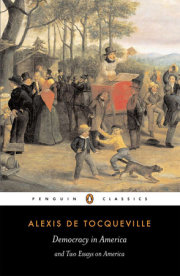


French nobleman Alexis de Tocqueville's classic treatise on the American way of life.

Over 175 years ago, Alexis de Tocqueville, an astute political scientist, came to the United States to evaluate the meaning and actual functioning of democracy. Here, Tocqueville discusses the advantages and dangers of majority rule—which he thought could be as tyrannical as the rule of a monarchy. He analyzes the influence of political parties and the press on the government and the effect of equality on the social, political, and economic life of the American people. He also offers some startling predictions about world politics, which history has borne out. So brilliant and penetrating are his comments and criticisms, they have vital meaning today for all who are interested in democracy.

Abridged and with an Introduction by Richard D. Heffner
and an Afterword by Vartan Gregorian
Alexis de Tocqueville was born in 1805 to a noble French family that had survived the French Revolution. His father gained some political power under the reign of the Bourbons, and after the July Revolution of 1830, the family was exiled along with the king. Tocqueville, then twenty-five years old, stayed in France, swearing allegiance to the new government. Shortly thereafter he and a friend, Gustave de Beaumont, sought and received a government assignment to study the prison system of the United States. They arrived in America in 1831. After extensive travels across the young nation, Tocqueville wrote Democracy in America (published in two volumes in 1835 and 1840). The publication of the first volume made Tocqueville a well-known figure, but he led a quiet life, accepting modest governmental posts, traveling around Europe, and marrying an Englishwoman. In 1848, Tocqueville once again rose to political prominence after a prescient speech that foretold of revolution. After serving through the massive upheavals and overthrows of government, Tocqueville retired from political life in 1849. Always weak in health, his lung disease grew progressively worse from that period on. Moving south several times on doctor’s recommendations, Tocqueville succumbed to death in 1859, in Cannes. View titles by Alexis de Tocqueville
“No better study of a nation’s institutions and culture than Tocqueville’s Democracy in America has ever been written by a foreign observer.”—The New York Times

“An extremely skillful job which gives us the essence of Tocqueville’s great commentary.”—Richard Hofstadter

About

French nobleman Alexis de Tocqueville's classic treatise on the American way of life.

Over 175 years ago, Alexis de Tocqueville, an astute political scientist, came to the United States to evaluate the meaning and actual functioning of democracy. Here, Tocqueville discusses the advantages and dangers of majority rule—which he thought could be as tyrannical as the rule of a monarchy. He analyzes the influence of political parties and the press on the government and the effect of equality on the social, political, and economic life of the American people. He also offers some startling predictions about world politics, which history has borne out. So brilliant and penetrating are his comments and criticisms, they have vital meaning today for all who are interested in democracy.

Abridged and with an Introduction by Richard D. Heffner
and an Afterword by Vartan Gregorian

Author

Alexis de Tocqueville was born in 1805 to a noble French family that had survived the French Revolution. His father gained some political power under the reign of the Bourbons, and after the July Revolution of 1830, the family was exiled along with the king. Tocqueville, then twenty-five years old, stayed in France, swearing allegiance to the new government. Shortly thereafter he and a friend, Gustave de Beaumont, sought and received a government assignment to study the prison system of the United States. They arrived in America in 1831. After extensive travels across the young nation, Tocqueville wrote Democracy in America (published in two volumes in 1835 and 1840). The publication of the first volume made Tocqueville a well-known figure, but he led a quiet life, accepting modest governmental posts, traveling around Europe, and marrying an Englishwoman. In 1848, Tocqueville once again rose to political prominence after a prescient speech that foretold of revolution. After serving through the massive upheavals and overthrows of government, Tocqueville retired from political life in 1849. Always weak in health, his lung disease grew progressively worse from that period on. Moving south several times on doctor’s recommendations, Tocqueville succumbed to death in 1859, in Cannes. View titles by Alexis de Tocqueville

Praise

“No better study of a nation’s institutions and culture than Tocqueville’s Democracy in America has ever been written by a foreign observer.”—The New York Times

“An extremely skillful job which gives us the essence of Tocqueville’s great commentary.”—Richard Hofstadter

Mental Health Awareness Month Resources

May is Mental Health Awareness Month and educators are increasingly aware that integrating social-emotional learning into the curriculum is critical if we want students to succeed both in and out of the classroom. Download the thematic educator guides on Teaching About Anxiety and Mindfulness and Teaching About Student Wellness. Explore our specially curated collections on


Read more

Books for Asian American, Native Hawaiian, and Pacific Islander Heritage Month

Each May, we honor the stories, histories, and cultures of Asian Americans, Native Hawaiians, and Pacific Islanders. Below is a selection of acclaimed fiction and nonfiction books by AANHPI creators to share with your students this month and throughout the year. AANHPI Creators – Middle School titles AANHPI Creators – High School titles .

Read more