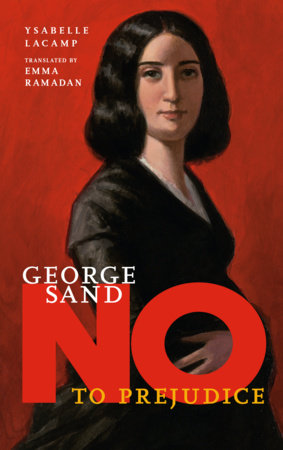
George Sand

No to Prejudice

Part of They Said No

Translated by Emma Ramadan
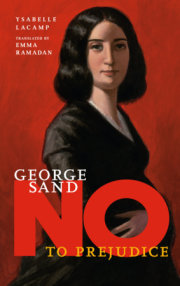
The only YA book to tell the story of George Sand and the courageous fight for women’s rights in the 19th century.

George Sand was the most popular novelist of the mid-19th century, and the pen name of Amandine Aurore Dupin. Sand wasn’t looking for scandal or subterfuge by using a pseudonym, but for freedom to live and to write, which she found by dressing as a man, writing under a man’s name, and loving who and how she chose. Her actions were an affront to the prejudices of the 19th century and a formidable lesson in courage.

Young Aurore grew up torn between two women and two worlds: the conventional and narrow bourgeoisie of her paternal grandmother, who raised her in the countryside, and the modest, Parisian environment of her whimsical mother. Refusing to become the stereotype of femininity, she dreams of another world, where she can breathe, uncorseted, away from the strictures of social expectation. She ignores the slander and rumors that follow her, and builds a free woman's life, deeply respected by friends and contemporaries like Victor Hugo, Honore de Balzac, Gustave Flaubert and many others. Using her fame as a writer, she fights for women’s and workers’ rights. She is the model of an emancipated woman.
YSABELLE LACAMP is an actress and the author of several books in French. She has written two books in the They Said No series in French: George Sand, No to Prejudice and Marie Durand, No to Religious Intolerance.

Emma Ramadan is a translator based in Brooklyn, NY. She’s the recipient of an NEA fellowship, a Fulbright grant, and the 2018 Albertine Prize. Among her translations are Anne Garréta’s Sphinx and Not One Day, Virginie Despentes’s Pretty Things, Ahmed Bouanani’s The Shutters, Barbara Molinard’s Panics, and Abdellah Taïa’s A Country for Dying, for which she won the 2021 PEN Translation Prize.

About

The only YA book to tell the story of George Sand and the courageous fight for women’s rights in the 19th century.

George Sand was the most popular novelist of the mid-19th century, and the pen name of Amandine Aurore Dupin. Sand wasn’t looking for scandal or subterfuge by using a pseudonym, but for freedom to live and to write, which she found by dressing as a man, writing under a man’s name, and loving who and how she chose. Her actions were an affront to the prejudices of the 19th century and a formidable lesson in courage.

Young Aurore grew up torn between two women and two worlds: the conventional and narrow bourgeoisie of her paternal grandmother, who raised her in the countryside, and the modest, Parisian environment of her whimsical mother. Refusing to become the stereotype of femininity, she dreams of another world, where she can breathe, uncorseted, away from the strictures of social expectation. She ignores the slander and rumors that follow her, and builds a free woman's life, deeply respected by friends and contemporaries like Victor Hugo, Honore de Balzac, Gustave Flaubert and many others. Using her fame as a writer, she fights for women’s and workers’ rights. She is the model of an emancipated woman.

Author

YSABELLE LACAMP is an actress and the author of several books in French. She has written two books in the They Said No series in French: George Sand, No to Prejudice and Marie Durand, No to Religious Intolerance.

Emma Ramadan is a translator based in Brooklyn, NY. She’s the recipient of an NEA fellowship, a Fulbright grant, and the 2018 Albertine Prize. Among her translations are Anne Garréta’s Sphinx and Not One Day, Virginie Despentes’s Pretty Things, Ahmed Bouanani’s The Shutters, Barbara Molinard’s Panics, and Abdellah Taïa’s A Country for Dying, for which she won the 2021 PEN Translation Prize.

Mental Health Awareness Month Resources

May is Mental Health Awareness Month and educators are increasingly aware that integrating social-emotional learning into the curriculum is critical if we want students to succeed both in and out of the classroom. Download the thematic educator guides on Teaching About Anxiety and Mindfulness and Teaching About Student Wellness. Explore our specially curated collections on

Read more

Books for Asian American, Native Hawaiian, and Pacific Islander Heritage Month

Each May, we honor the stories, histories, and cultures of Asian Americans, Native Hawaiians, and Pacific Islanders. Below is a selection of acclaimed fiction and nonfiction books by AANHPI creators to share with your students this month and throughout the year. AANHPI Creators – Middle School titles AANHPI Creators – High School titles .

Read more