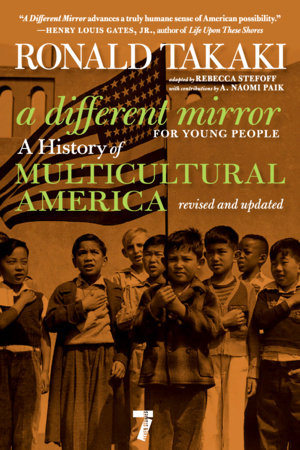
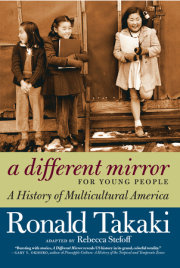
A Different Mirror for Young People

A History of Multicultural America

Adapted by Rebecca Stefoff
Revised by A. Naomi Paik
Ebook
On sale Jun 30, 2026 | 512 Pages | 9781644215975
Grades 6-12

See Additional Formats
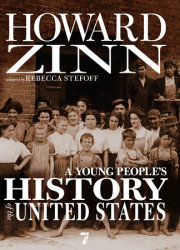
A longtime professor of Ethnic Studies at the University of California at Berkeley, Ronald Takaki was recognized as one of the foremost scholars of American ethnic history and diversity. When the first edition of A Different Mirror was published in 1993, Publishers Weekly called it "a brilliant revisionist history of America that is likely to become a classic of multicultural studies" and named it one of the ten best books of the year. Now Rebecca Stefoff, who adapted Howard Zinn's best-selling A People's History of the United States for younger readers, turns the updated 2008 edition of Takaki's multicultural masterwork into A Different Mirror for Young People.

Drawing on Takaki's vast array of primary sources, and staying true to his own words whenever possible, A Different Mirror for Young People brings ethnic history alive through the words of people, including teenagers, who recorded their experiences in letters, diaries, and poems. Like Zinn's A People's History, Takaki's A Different Mirror offers a rich and rewarding "people's view" perspective on the American story.
RONALD TAKAKI (1939–2009) was recognized as one of the foremost scholars of American ethnic history. Born and raised in Oahu, Hawaii, the descendent of Japanese immigrant field workers, Takaki became the first member of his family to receive higher education, attending The College of Wooster in Wooster, Ohio, and later receiving a doctorate in history from the University of California, Berkeley. Takaki has said that he was “born intellectually and politically” during this period in Berkeley in the 1960s. His PhD dissertation was on the subject of slavery in America, and he went on to teach the first black history course at the University of California, Los Angeles, in the aftermath of the Watts riots.  Returning to Berkeley, Takaki helped found the nation’s first ethnic studies department and rose to national prominence publishing works on the history of immigration and the understanding of ethnicity in the Americas. His 1989 title Strangers from a Different Shore: A History of Asian Americans was nominated for a Pulitzer Prize. Takaki died in 2009. View titles by Ronald Takaki
Contents

A Note on This Edition

Introduction
My Story, Our Story

Introduction by A. Naomi Paik
Getting Free of the Master Narrative

Chapter One
Why a Different Mirror?

Chapter Two
Removing the “Savages”

Chapter Three
The Hidden Origins of Slavery

Chapter Four
The Road to the Reservation

Chapter Five
Life in Slavery

Chapter Six
The Flight from Ireland

Chapter Seven
The War Against Mexico

Chapter Eight
From China to Gold Mountain

Chapter Nine
Dealing with the Natives

Chapter Ten
The Japanese and “Money Trees”

Chapter Eleven
Jewish People Are Pushed from Russia

Chapter Twelve
Up from Mexico

Chapter Thirteen
Black Communities Form in Northern Cities

Chapter Fourteen
World War II and America’s Ethnic Problem

Chapter Fifteen
Calls for Change

Chapter Sixteen
Rising Inequality

Chapter Seventeen
New Waves of Newcomers

Chapter Eighteen
Forever Wars Over There and Right Here

Chapter Nineteen
“We Will All Be Minorities”

Chapter Twenty
An Ongoing Struggle for Justice

Notes
Glossary
Photograph and Illustration Credits
Index
Introduction
 
My Story, Our Story
 
I was going to be a surfer, not a scholar.
 
I was born and grew up in Hawaii, the son of a Japanese immigrant father and a Japanese-American mother who had been born on a sugarcane plantation. We lived in a working-class neighborhood where my playmates were Japanese, Chinese, Portuguese, Korean, and Hawaiian. We did not use the word multicultural, but that’s what we were: a community of people from many cultural, national, and racial backgrounds.
 
My father died when I was five, and my mother remarried a Chinese cook. She had gone to school only through the eighth grade, and my stepfather had very little education, but they were determined to give me a chance to go to college. My passion as a teenager, though, was surfing. My nickname was “Ten Toes Takaki,” and when I sat on my board and gazed at rainbows over the mountains and the spectacular sunsets over the Pacific, I wanted to be a surfer forever.
 
Then, during my senior year in high school, a teacher inspired me to think about the problems of the world and of being human and to ask, “How do you know what you know?” In other words, how do you know if something is true? The same teacher inspired me to attend college outside Hawaii, which is how I found myself at the College of Wooster in Ohio in 1957.
 
College was a culture shock for me. The student body was not very diverse, and my fellow students asked me, “How long have you been in this country? Where did you learn to speak English?” To them, I did not look like an American or have an American-sounding name. When I fell in love with one of those students, Carol Rankin, she told me that her parents would never approve of our relationship, because of my race.
 
Carol was right. Her parents were furious. Still, we decided to do what was right for us. When we got married, her parents reluctantly attended. Four years later, when our first child was born, her parents came to visit us in California. After I said, “Let me help you with the luggage, Mr. Rankin,” Carol’s father replied, “You can call me Dad.” His racist attitudes, it turned out, were not frozen. He had changed.
 
By that time I was working on my Ph.D. degree in American history. I became a college professor at the University of California in Los Angeles and taught the school’s first course in African American history. In 1971, I moved to the University of California at Berkeley to teach in a new Department of Ethnic Studies. In the decades that followed, I developed courses and degree programs in comparative ethnic studies, and I wrote several books about America’s multicultural history. My extended family, too, became a multicultural, mixed-race group that now includes people of Japanese, Vietnamese, English, Chinese, Taiwanese, Jewish, and Mexican heritage.
 
I have come to see that my story reflects the story of multicultural America—a story of disappointments and dreams, struggles and triumphs, and identities that are separate but also shared. We must remember the histories of every group, for together they tell the story of a nation peopled by the world. As the time approaches when all Americans will be minorities, we face a challenge: not just to understand the world, but to make it better. A Different Mirror studies the past for the sake of the future.

Educator Guide for A Different Mirror for Young People

Classroom-based guides appropriate for schools and colleges provide pre-reading and classroom activities, discussion questions connected to the curriculum, further reading, and resources.

(Please note: the guide displayed here is the most recently uploaded version; while unlikely, any page citation discrepancies between the guide and book is likely due to pagination differences between a book’s different formats.)

“[A Different Mirror is] a splendid achievement, a bold and refreshing new approach to our national history. The research is meticulous, the writing powerful and eloquent, with what can only be called an epic sweep across time and cultures.” —Howard Zinn

“This 375-page book would be an excellent way to include multi-ethnic materials in the classroom as a way to ensure that your students see their unique identities reflected in their coursework.”Skipping Stones

A Different Mirror advances a truly humane sense of American possibility.” —Henry Louis Gates, Jr.

"The 'mirror' that Ronald Takaki holds up to the United States reflects a multicultural history of oppression and exploitation, but also struggle, solidarity, and community. In the most profound sense, this is a people's history of our country. Takaki shows what has torn us apart, yet what knits us together. This young people's version of A Different Mirror will introduce a new generation to Takaki's pathbreaking scholarship." —Bill Bigelow, curriculum editor, Rethinking Schools, and co-director, Zinn Education Project

About

A longtime professor of Ethnic Studies at the University of California at Berkeley, Ronald Takaki was recognized as one of the foremost scholars of American ethnic history and diversity. When the first edition of A Different Mirror was published in 1993, Publishers Weekly called it "a brilliant revisionist history of America that is likely to become a classic of multicultural studies" and named it one of the ten best books of the year. Now Rebecca Stefoff, who adapted Howard Zinn's best-selling A People's History of the United States for younger readers, turns the updated 2008 edition of Takaki's multicultural masterwork into A Different Mirror for Young People.

Drawing on Takaki's vast array of primary sources, and staying true to his own words whenever possible, A Different Mirror for Young People brings ethnic history alive through the words of people, including teenagers, who recorded their experiences in letters, diaries, and poems. Like Zinn's A People's History, Takaki's A Different Mirror offers a rich and rewarding "people's view" perspective on the American story.

Author

RONALD TAKAKI (1939–2009) was recognized as one of the foremost scholars of American ethnic history. Born and raised in Oahu, Hawaii, the descendent of Japanese immigrant field workers, Takaki became the first member of his family to receive higher education, attending The College of Wooster in Wooster, Ohio, and later receiving a doctorate in history from the University of California, Berkeley. Takaki has said that he was “born intellectually and politically” during this period in Berkeley in the 1960s. His PhD dissertation was on the subject of slavery in America, and he went on to teach the first black history course at the University of California, Los Angeles, in the aftermath of the Watts riots.  Returning to Berkeley, Takaki helped found the nation’s first ethnic studies department and rose to national prominence publishing works on the history of immigration and the understanding of ethnicity in the Americas. His 1989 title Strangers from a Different Shore: A History of Asian Americans was nominated for a Pulitzer Prize. Takaki died in 2009. View titles by Ronald Takaki

Table of Contents

Contents

A Note on This Edition

Introduction
My Story, Our Story

Introduction by A. Naomi Paik
Getting Free of the Master Narrative

Chapter One
Why a Different Mirror?

Chapter Two
Removing the “Savages”

Chapter Three
The Hidden Origins of Slavery

Chapter Four
The Road to the Reservation

Chapter Five
Life in Slavery

Chapter Six
The Flight from Ireland

Chapter Seven
The War Against Mexico

Chapter Eight
From China to Gold Mountain

Chapter Nine
Dealing with the Natives

Chapter Ten
The Japanese and “Money Trees”

Chapter Eleven
Jewish People Are Pushed from Russia

Chapter Twelve
Up from Mexico

Chapter Thirteen
Black Communities Form in Northern Cities

Chapter Fourteen
World War II and America’s Ethnic Problem

Chapter Fifteen
Calls for Change

Chapter Sixteen
Rising Inequality

Chapter Seventeen
New Waves of Newcomers

Chapter Eighteen
Forever Wars Over There and Right Here

Chapter Nineteen
“We Will All Be Minorities”

Chapter Twenty
An Ongoing Struggle for Justice

Notes
Glossary
Photograph and Illustration Credits
Index

Excerpt

Introduction
 
My Story, Our Story
 
I was going to be a surfer, not a scholar.
 
I was born and grew up in Hawaii, the son of a Japanese immigrant father and a Japanese-American mother who had been born on a sugarcane plantation. We lived in a working-class neighborhood where my playmates were Japanese, Chinese, Portuguese, Korean, and Hawaiian. We did not use the word multicultural, but that’s what we were: a community of people from many cultural, national, and racial backgrounds.
 
My father died when I was five, and my mother remarried a Chinese cook. She had gone to school only through the eighth grade, and my stepfather had very little education, but they were determined to give me a chance to go to college. My passion as a teenager, though, was surfing. My nickname was “Ten Toes Takaki,” and when I sat on my board and gazed at rainbows over the mountains and the spectacular sunsets over the Pacific, I wanted to be a surfer forever.
 
Then, during my senior year in high school, a teacher inspired me to think about the problems of the world and of being human and to ask, “How do you know what you know?” In other words, how do you know if something is true? The same teacher inspired me to attend college outside Hawaii, which is how I found myself at the College of Wooster in Ohio in 1957.
 
College was a culture shock for me. The student body was not very diverse, and my fellow students asked me, “How long have you been in this country? Where did you learn to speak English?” To them, I did not look like an American or have an American-sounding name. When I fell in love with one of those students, Carol Rankin, she told me that her parents would never approve of our relationship, because of my race.
 
Carol was right. Her parents were furious. Still, we decided to do what was right for us. When we got married, her parents reluctantly attended. Four years later, when our first child was born, her parents came to visit us in California. After I said, “Let me help you with the luggage, Mr. Rankin,” Carol’s father replied, “You can call me Dad.” His racist attitudes, it turned out, were not frozen. He had changed.
 
By that time I was working on my Ph.D. degree in American history. I became a college professor at the University of California in Los Angeles and taught the school’s first course in African American history. In 1971, I moved to the University of California at Berkeley to teach in a new Department of Ethnic Studies. In the decades that followed, I developed courses and degree programs in comparative ethnic studies, and I wrote several books about America’s multicultural history. My extended family, too, became a multicultural, mixed-race group that now includes people of Japanese, Vietnamese, English, Chinese, Taiwanese, Jewish, and Mexican heritage.
 
I have come to see that my story reflects the story of multicultural America—a story of disappointments and dreams, struggles and triumphs, and identities that are separate but also shared. We must remember the histories of every group, for together they tell the story of a nation peopled by the world. As the time approaches when all Americans will be minorities, we face a challenge: not just to understand the world, but to make it better. A Different Mirror studies the past for the sake of the future.

Guides

Educator Guide for A Different Mirror for Young People

Classroom-based guides appropriate for schools and colleges provide pre-reading and classroom activities, discussion questions connected to the curriculum, further reading, and resources.

(Please note: the guide displayed here is the most recently uploaded version; while unlikely, any page citation discrepancies between the guide and book is likely due to pagination differences between a book’s different formats.)

Praise

“[A Different Mirror is] a splendid achievement, a bold and refreshing new approach to our national history. The research is meticulous, the writing powerful and eloquent, with what can only be called an epic sweep across time and cultures.” —Howard Zinn

“This 375-page book would be an excellent way to include multi-ethnic materials in the classroom as a way to ensure that your students see their unique identities reflected in their coursework.”Skipping Stones

A Different Mirror advances a truly humane sense of American possibility.” —Henry Louis Gates, Jr.

"The 'mirror' that Ronald Takaki holds up to the United States reflects a multicultural history of oppression and exploitation, but also struggle, solidarity, and community. In the most profound sense, this is a people's history of our country. Takaki shows what has torn us apart, yet what knits us together. This young people's version of A Different Mirror will introduce a new generation to Takaki's pathbreaking scholarship." —Bill Bigelow, curriculum editor, Rethinking Schools, and co-director, Zinn Education Project

Books for LGBTQIA+ Pride Month

In June we celebrate Pride Month, which honors the 1969 Stonewall riots in Manhattan and highlights the accomplishments of those in the Lesbian, Gay, Bisexual, Transgender, Queer, Intersex, and Asexual + (LGBTQIA+) community. Browse our titles that celebrate LGBTQIA+ history, creators, and stories. LGBTQIA+ Fiction & Literature LGBTQIA+ History & Memoir

Read more