Download high-resolution image
Listen to a clip from the audiobook
audio pause button
0:00
0:00

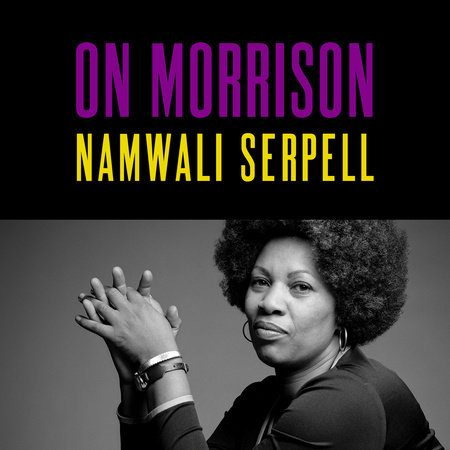
On Morrison

Listen to a clip from the audiobook
audio pause button
0:00
0:00
Audiobook Download
On sale Feb 17, 2026 | 12 Hours and 55 Minutes | 9798217159291
Grades 9-12 + AP/IB

See Additional Formats
NATIONAL BESTSELLER • An illuminating, electrifying exploration of the work of Toni Morrison by an award-winning novelist and Harvard professor—“a revelatory encounter with the Nobel laureate’s oeuvre” (The New York Times Book Review, Editors’ Choice)

“A landmark appraisal of the great novelist’s work . . . I have waited years for this book.”—Laila Lalami, The Guardian

“Thrilling . . . ingenious.”—Wesley Morris, The New York Times

“In this lavish yet clear-eyed study, Serpell shows how Morrison breathed new life into the novel. This is literary criticism at its finest.”—Time

“Revelatory . . . will captivate everyone from newcomers to [Morrison’s] most devoted fans.”—Vulture

“Invigorating . . . an informed, accessible literary analysis.”—The Wall Street Journal

“Resplendent . . . fresh and smart . . . [a] work of swaggering genius.”—Bookforum

“As gripping as it is intellectually brilliant . . . a classic.”—Cathy Park Hong

ONE OF THE MOST ANTICIPATED BOOKS OF THE YEAR: The New York Times, Time, The Today Show, Los Angeles Times, Harper's Bazaar, Ms., Esquire, Vulture, The Millions, Well-Read Black Girl, Electric Lit, Kirkus Reviews, Literary Hub, Book Riot

Toni Morrison, Nobel Laureate and one of our most beloved writers, has inspired generations of readers. But her artistic genius is often overshadowed by her monumental public persona, perhaps because, as Namwali Serpell puts it, “she is our only truly canonical black female writer—and her work is highly complex.” In On Morrison, Serpell brings her unique experience as both an award-winning writer and a professor who teaches a course on Morrison to illuminate her masterful experiments with literary form.

This is Morrison as you’ve never encountered her before, a journey through her oeuvre—her fiction and criticism, as well as her lesser-known dramatic works and poetry—with contextual guidance and original close readings. At once accessible and uncompromisingly rigorous, On Morrison is a primer not only on how to read one of the most significant American authors of all time but also on how to read great works of literature in general. This dialogue on the page between two black women artist-readers is stylish, edifying, and thrilling in its scope and intelligence.
© Jordan Kines Photography
Namwali Serpell was born in Lusaka and lives in New York. Her debut novel, The Old Drift, won an Anisfield-Wolf Book Award, the Arthur C. Clarke Award for Science Fiction, and the Los Angeles Times’s Art Seidenbaum Award for First Fiction. Her second novel, The Furrows, was a finalist for a National Book Critics Circle Award for Fiction and was selected as one of The New York Times Ten Best Books of the Year. Her book of essays, Stranger Faces, was a finalist for a National Book Critics Circle Award for Criticism. She is a recipient of the Windham-Campbell Prize for Fiction, the Caine Prize for African Writing, and a Rona Jaffe Foundation Award. She is a professor of English at Harvard University. View titles by Namwali Serpell
On Difficulty

There are many ways to be difficult in this world. You can be demanding, inconvenient, stubborn, complicated, troublesome, baffling, illegible. Black womanhood is one place where all these forms of difficulty overlap. I have always known this; I have been called difficult more times in my life than I can count. But I only began to understand, to discover the meanings and uses of my own difficulty, because of Toni Morrison.

Morrison has shaped the way we think about everything from literature to politics to criticism to ethics to the responsibilities of making art. But the facts remain: She is difficult to read. She is difficult to teach. Notwithstanding the voluminous train of profiles, reviews, and scholarly analysis that she drags behind her, she is difficult to write about. More to the point, she is our only truly canonical black, female writer—and her work is highly complex. This, it seems, is difficult to swallow.

The very fact of Morrison—a black woman and a genius—has been, to some people, simply an affront. In 1979, she was interviewed for two major profiles, one in The New York Times and one in Vogue. At that point in her career, she was the author of three novels, her most recent, Song of Solomon, having won the National Book Critics Circle Award for 1977.

One might expect an aura of celebration, but the Times profile instead had this oddly truculent tone:


She is, at 48, a big, handsome woman with beginning-to-gray hair. She is often breathless, often running, often (I was to learn) late. . . . Her defensiveness was palpable. I would soon learn that she is a woman of many moods. Not just ordinary moods: abrupt, seismic shifts, as if the energy within were caught between opposite poles—the need to express and the need to defend. She will often put on an act. In conversation, she might suddenly “get down” and be very chicken-and-ribs, sucking her teeth, poking a finger into her scalp and scratching—a strange, primitive gesture that makes her hairdo rock back and forth on her scalp like a wig. It’s not difficult to get the impression that she’s putting you on, at times, taking pleasure in watching you try to figure her out.


Putting aside the casual racism of the time (and the Times), what strikes me is the interviewer’s palpable resentment about the myriad ways in which Morrison was difficult: late, defensive, moody, abrupt, performative, “strange,” “primitive,” manipulative, implicitly sadistic. What seems to have irked the interviewer most of all was her impression that Morrison actively enjoyed being difficult.

In the other profile, in Vogue, Morrison spoke of a white American reader who had “told her how difficult it was to understand black culture in her books—it was so removed from his experience.” She had responded: “Boy, you must have had a hell of a time with Beowulf !” The Vogue interviewer, missing the wit in this retort, went on to comment: “Morrison has no patience with people who plead ignorance; but then, she does not pride herself on being a patient woman. ‘I find myself being more and more difficult,’ she says. ‘It’s something I really relish.’ ” Even Morrison’s literary difficulty and the pleasure she took in it was translated here into personal difficulty, a moral failing: How dare she be impatient! Well, wouldn’t you be?

One reason for Morrison’s air of pique was surely the strain of trying to balance the demands of multiple careers simultaneously. She was an editor, a professor, a writer, a critic, and a public intellectual. I have worked in these worlds as well, but not for nearly as long and rarely at the same time. To bolster my spirits, I often recite her words about how these professions are really all one thing: “I read books. I teach books. I write books. I think about books. It’s one job.”

But extending many branches is sometimes a way of distracting yourself from the exigency of the core vocation. The commitment to writing over all else is often viewed by detractors as selfish; when gender is factored into the equation, the charge can carry the stigma of illegitimacy. “For a woman to say, ‘I am a writer’ is difficult,” Morrison noted succinctly.

She struggled to accommodate these forms of often underpaid literary labor with the unpaid domestic labor of raising two sons as a single mother: “It was very difficult writing and rearing children because they deserve all your time, and you don’t have it.” This occupational difficulty was exacerbated not only by the fact that she was unique in her fields but also by the fact that she often chose to go it alone.

For example, she didn’t tell anyone at her first job in trade publishing that she was writing a novel until The Bluest Eye came out at another house. And it is notable that not one of Morrison’s sole-authored books has an acknowledgments page.

While autonomy was indispensable to Morrison’s success in her professional life, it was also a source of trouble within it. Her longtime editor, Robert Gottlieb, who is the person who gave her permission to be a writer when she grew up, as she put it, once said: “Toni appears to be such a formidable person, and is such a formidable person, that people assume that working with her could be difficult. It’s exactly the opposite.” But his view seems to have been the exception that proves the rule.

Dana A. Williams’s recent book Toni at Random, a fascinating overview of Morrison’s own editorial work, divulges the clashes Morrison had with her (mostly white) colleagues and her (mostly black) authors over the years. Williams generously refers to some of Morrison’s more cutting remarks as signifying, a black art form of insult that prizes accuracy over tact. But there’s no mistaking Morrison’s arch tone in her correspondence with her authors.

She wrote to one who had accused her of racism: “I will probably always be befuddled about what you imagine this publishing company to be and about your reasons for ascribing sinister motives to a copyediting mistake.” She teased a sculptor venturing into poetry for the first time, noting drily, “This is a commercial house historically unenchanted with 500 slim volumes of profound poetry that languish in stockrooms,” and writing more sharply in a follow-up letter draft: “If you wanted an anonymous, plain, uneventful recessive jacket you should never have come to this publisher. The only time that works is when the poet is very well known—as a poet. You are not.”

When it came to playing well with others as a critic, we need only consider the series of angry letters to the editor in The New York Times about Morrison’s review in 1971 of an anthology, To Be a Black Woman, which was edited by two men and which she had faulted for its sexism. And when it came to Morrison as a collaborator, there are the various slings and arrows of outrageous misunderstanding between her and the white producers of her play Dreaming Emmett.

As troublesome as it may have been for her professionally, she seemed genuinely to delight in the difficulty of other black women artists such as the black jazz pianist and composer Mary Lou Williams; for Morrison, it was a sign that they had insisted on being taken seriously. Being taken seriously is of course what most artists want, though for obvious reasons, it does not always need such insistence. Part of my project in this book is to show you how to read Morrison with the seriousness that she deserves. To do so requires that we account for the knot—or bind—of gender and race that she and I share.

It is not an easy one to untangle. As Morrison wrote in a 1971 New York Times op-ed, in order to recognize feminism’s elisions and delusions about race, “one must look very closely at the black woman herself—a difficult, inevitably doomed proposition, for if anything is true of black women, it is how consistently they have (deliberately, I suspect) defied classification.”

Let me begin by looking very closely at Morrison herself, at how her own deliberate difficulty—personal, political, and literary—defied classification . . . and made for brilliance. Difficult, doomed propositions are our forte, after all.
On Morrison is a perfect pairing of author and subject, a work of literary criticism that expands our understanding of Toni Morrison’s literary work and her cultural meaning. . . . An exhilarating read that also serves as a master class in how to blend scholarly analysis with deeply personal observations.”The Boston Globe

“An award-winning novelist and Harvard University professor delivers an illuminating exploration of the work of our beloved and brilliant Toni Morrison.”—Essence

“One reason On Morrison was such a joy to read is that I felt guided by a writer who shares both my admiration and my fear of lionising. . . . With On Morrison, Serpell has managed to deliver a book that works on many levels: as a study of craft, as a critical appraisal, and as a tribute to an artist who was difficult in all the right ways . . . a landmark appraisal.”—Laila Lalami, The Guardian

“[A] lavish yet clear-eyed study . . . literary criticism at its finest.”—Time

“Revelatory . . . will captivate everyone from newcomers to [Morrison’s] most devoted fans.”—Vulture

“Invigorating . . . an informed, accessible literary analysis.”—The Wall Street Journal

“Deeply pleasurable, rigorous, surprising, and often funny . . . How fortunate for all of us to have Serpell as [Morrison’s] reader.”—New York

“Resplendent . . . fresh and smart . . . [a] work of swaggering genius.”—Bookforum

“Decades in the making, On Morrison is [Serpell’s] breathtakingly comprehensive analysis of the Nobel laureate’s oeuvre.”—Book Page

“[A] book that will serve lovers of Morrison for years to come.”—BookRiot

On Morrison brings the reader on new journeys through [Morrison’s] famous fiction and her lesser-known plays and poetry. Serpell will make you want to read literature with fresh eyes and rediscover a love for reading.”—Electric Literature

“This is a book that rises to the challenge of extending and expanding a legacy by giving the person at the heart of that legacy time, rigor, and care.”—Hanif Abdurraqib, New York Times bestselling author of There’s Always This Year

“In On Morrison, Serpell applies her prodigious intellect, vast literary archive, and her own calling as a novelist to magnificent effect in this breathtaking, provocative, and refreshing engagement with Morrison as a thinker as well as an artist. Filled with unique analyses, deep dives, and an intellectual playfulness that Morrison herself so valued, this book will stand as one of the most important twenty-first-century works on the great American writer.”—Imani Perry, author of South to America

“Only Namwali Serpell could write a critical guide on Toni Morrison’s novels that is as gripping as it is intellectually brilliant. While On Morrison provides a lucid and revelatory close read of all of her work, it’s also a love letter to reading itself; to the virtues of difficulty; to Black literary inheritance; and to Morrison’s uncompromising vision in always bringing the center to the margins. On Morrison is a classic.”—Cathy Park Hong, author of Minor Feelings

“Dazzling . . . Serpell uses intellectual rigor alongside inventive flair to tackle Toni Morrison’s writing in ways that feel both fresh and deeply expanding. This book is an illuminating guide to understanding how best to read, understand, and admire one of American literature’s greatest voices.”—Isaac Fitzgerald, TODAY

“Graceful, exhilarating . . . Serpell deserves consideration for a major prize. Mostly she deserves our gratitude and admiration: On Morrison gives us, in precise yet supple prose, a close reading in action and an exemplar of literary criticism. . . . This book will spur you to pour over the master’s achievements.”On the Seawall

On Morrison is not simply a literary miracle; it is a cultural feat, a damn near perfect concoction made maybe once in a generation. It is what happens when a mind as curious as it is expansive explores the work of the greatest maker of novels in American history.”—Kiese Laymon, author of Heavy

“A thrilling, candid, and immersive study of one extraordinary mind by another . . . a necessary book and a brilliant achievement.”—Preti Taneja, author of We That Are Young

“An impressive, nuanced work of scholarship.”Kirkus Reviews, starred review

“An insightful and stimulating exploration of the work of Nobel Prize winner Toni Morrison. . . . Serpell puts Morrison's genius on full display. This will enthrall Morrison fans and cultivate new ones.”Publishers Weekly, starred review

“Illuminating and fascinating . . . [On Morrison] offers insight and fresh perspectives and will appeal to readers new to and deeply familiar with Morrison’s vital body of work.”Booklist, starred review

“A high-flying, fantastically erudite rendition of how Morrison wanted to be read, blending the scholarly and the personal response to her work with seamless flair and conviction.”—Diana Evans, author of A House for Alice

About

NATIONAL BESTSELLER • An illuminating, electrifying exploration of the work of Toni Morrison by an award-winning novelist and Harvard professor—“a revelatory encounter with the Nobel laureate’s oeuvre” (The New York Times Book Review, Editors’ Choice)

“A landmark appraisal of the great novelist’s work . . . I have waited years for this book.”—Laila Lalami, The Guardian

“Thrilling . . . ingenious.”—Wesley Morris, The New York Times

“In this lavish yet clear-eyed study, Serpell shows how Morrison breathed new life into the novel. This is literary criticism at its finest.”—Time

“Revelatory . . . will captivate everyone from newcomers to [Morrison’s] most devoted fans.”—Vulture

“Invigorating . . . an informed, accessible literary analysis.”—The Wall Street Journal

“Resplendent . . . fresh and smart . . . [a] work of swaggering genius.”—Bookforum

“As gripping as it is intellectually brilliant . . . a classic.”—Cathy Park Hong

ONE OF THE MOST ANTICIPATED BOOKS OF THE YEAR: The New York Times, Time, The Today Show, Los Angeles Times, Harper's Bazaar, Ms., Esquire, Vulture, The Millions, Well-Read Black Girl, Electric Lit, Kirkus Reviews, Literary Hub, Book Riot

Toni Morrison, Nobel Laureate and one of our most beloved writers, has inspired generations of readers. But her artistic genius is often overshadowed by her monumental public persona, perhaps because, as Namwali Serpell puts it, “she is our only truly canonical black female writer—and her work is highly complex.” In On Morrison, Serpell brings her unique experience as both an award-winning writer and a professor who teaches a course on Morrison to illuminate her masterful experiments with literary form.

This is Morrison as you’ve never encountered her before, a journey through her oeuvre—her fiction and criticism, as well as her lesser-known dramatic works and poetry—with contextual guidance and original close readings. At once accessible and uncompromisingly rigorous, On Morrison is a primer not only on how to read one of the most significant American authors of all time but also on how to read great works of literature in general. This dialogue on the page between two black women artist-readers is stylish, edifying, and thrilling in its scope and intelligence.

Author

© Jordan Kines Photography
Namwali Serpell was born in Lusaka and lives in New York. Her debut novel, The Old Drift, won an Anisfield-Wolf Book Award, the Arthur C. Clarke Award for Science Fiction, and the Los Angeles Times’s Art Seidenbaum Award for First Fiction. Her second novel, The Furrows, was a finalist for a National Book Critics Circle Award for Fiction and was selected as one of The New York Times Ten Best Books of the Year. Her book of essays, Stranger Faces, was a finalist for a National Book Critics Circle Award for Criticism. She is a recipient of the Windham-Campbell Prize for Fiction, the Caine Prize for African Writing, and a Rona Jaffe Foundation Award. She is a professor of English at Harvard University. View titles by Namwali Serpell

Excerpt

On Difficulty

There are many ways to be difficult in this world. You can be demanding, inconvenient, stubborn, complicated, troublesome, baffling, illegible. Black womanhood is one place where all these forms of difficulty overlap. I have always known this; I have been called difficult more times in my life than I can count. But I only began to understand, to discover the meanings and uses of my own difficulty, because of Toni Morrison.

Morrison has shaped the way we think about everything from literature to politics to criticism to ethics to the responsibilities of making art. But the facts remain: She is difficult to read. She is difficult to teach. Notwithstanding the voluminous train of profiles, reviews, and scholarly analysis that she drags behind her, she is difficult to write about. More to the point, she is our only truly canonical black, female writer—and her work is highly complex. This, it seems, is difficult to swallow.

The very fact of Morrison—a black woman and a genius—has been, to some people, simply an affront. In 1979, she was interviewed for two major profiles, one in The New York Times and one in Vogue. At that point in her career, she was the author of three novels, her most recent, Song of Solomon, having won the National Book Critics Circle Award for 1977.

One might expect an aura of celebration, but the Times profile instead had this oddly truculent tone:


She is, at 48, a big, handsome woman with beginning-to-gray hair. She is often breathless, often running, often (I was to learn) late. . . . Her defensiveness was palpable. I would soon learn that she is a woman of many moods. Not just ordinary moods: abrupt, seismic shifts, as if the energy within were caught between opposite poles—the need to express and the need to defend. She will often put on an act. In conversation, she might suddenly “get down” and be very chicken-and-ribs, sucking her teeth, poking a finger into her scalp and scratching—a strange, primitive gesture that makes her hairdo rock back and forth on her scalp like a wig. It’s not difficult to get the impression that she’s putting you on, at times, taking pleasure in watching you try to figure her out.


Putting aside the casual racism of the time (and the Times), what strikes me is the interviewer’s palpable resentment about the myriad ways in which Morrison was difficult: late, defensive, moody, abrupt, performative, “strange,” “primitive,” manipulative, implicitly sadistic. What seems to have irked the interviewer most of all was her impression that Morrison actively enjoyed being difficult.

In the other profile, in Vogue, Morrison spoke of a white American reader who had “told her how difficult it was to understand black culture in her books—it was so removed from his experience.” She had responded: “Boy, you must have had a hell of a time with Beowulf !” The Vogue interviewer, missing the wit in this retort, went on to comment: “Morrison has no patience with people who plead ignorance; but then, she does not pride herself on being a patient woman. ‘I find myself being more and more difficult,’ she says. ‘It’s something I really relish.’ ” Even Morrison’s literary difficulty and the pleasure she took in it was translated here into personal difficulty, a moral failing: How dare she be impatient! Well, wouldn’t you be?

One reason for Morrison’s air of pique was surely the strain of trying to balance the demands of multiple careers simultaneously. She was an editor, a professor, a writer, a critic, and a public intellectual. I have worked in these worlds as well, but not for nearly as long and rarely at the same time. To bolster my spirits, I often recite her words about how these professions are really all one thing: “I read books. I teach books. I write books. I think about books. It’s one job.”

But extending many branches is sometimes a way of distracting yourself from the exigency of the core vocation. The commitment to writing over all else is often viewed by detractors as selfish; when gender is factored into the equation, the charge can carry the stigma of illegitimacy. “For a woman to say, ‘I am a writer’ is difficult,” Morrison noted succinctly.

She struggled to accommodate these forms of often underpaid literary labor with the unpaid domestic labor of raising two sons as a single mother: “It was very difficult writing and rearing children because they deserve all your time, and you don’t have it.” This occupational difficulty was exacerbated not only by the fact that she was unique in her fields but also by the fact that she often chose to go it alone.

For example, she didn’t tell anyone at her first job in trade publishing that she was writing a novel until The Bluest Eye came out at another house. And it is notable that not one of Morrison’s sole-authored books has an acknowledgments page.

While autonomy was indispensable to Morrison’s success in her professional life, it was also a source of trouble within it. Her longtime editor, Robert Gottlieb, who is the person who gave her permission to be a writer when she grew up, as she put it, once said: “Toni appears to be such a formidable person, and is such a formidable person, that people assume that working with her could be difficult. It’s exactly the opposite.” But his view seems to have been the exception that proves the rule.

Dana A. Williams’s recent book Toni at Random, a fascinating overview of Morrison’s own editorial work, divulges the clashes Morrison had with her (mostly white) colleagues and her (mostly black) authors over the years. Williams generously refers to some of Morrison’s more cutting remarks as signifying, a black art form of insult that prizes accuracy over tact. But there’s no mistaking Morrison’s arch tone in her correspondence with her authors.

She wrote to one who had accused her of racism: “I will probably always be befuddled about what you imagine this publishing company to be and about your reasons for ascribing sinister motives to a copyediting mistake.” She teased a sculptor venturing into poetry for the first time, noting drily, “This is a commercial house historically unenchanted with 500 slim volumes of profound poetry that languish in stockrooms,” and writing more sharply in a follow-up letter draft: “If you wanted an anonymous, plain, uneventful recessive jacket you should never have come to this publisher. The only time that works is when the poet is very well known—as a poet. You are not.”

When it came to playing well with others as a critic, we need only consider the series of angry letters to the editor in The New York Times about Morrison’s review in 1971 of an anthology, To Be a Black Woman, which was edited by two men and which she had faulted for its sexism. And when it came to Morrison as a collaborator, there are the various slings and arrows of outrageous misunderstanding between her and the white producers of her play Dreaming Emmett.

As troublesome as it may have been for her professionally, she seemed genuinely to delight in the difficulty of other black women artists such as the black jazz pianist and composer Mary Lou Williams; for Morrison, it was a sign that they had insisted on being taken seriously. Being taken seriously is of course what most artists want, though for obvious reasons, it does not always need such insistence. Part of my project in this book is to show you how to read Morrison with the seriousness that she deserves. To do so requires that we account for the knot—or bind—of gender and race that she and I share.

It is not an easy one to untangle. As Morrison wrote in a 1971 New York Times op-ed, in order to recognize feminism’s elisions and delusions about race, “one must look very closely at the black woman herself—a difficult, inevitably doomed proposition, for if anything is true of black women, it is how consistently they have (deliberately, I suspect) defied classification.”

Let me begin by looking very closely at Morrison herself, at how her own deliberate difficulty—personal, political, and literary—defied classification . . . and made for brilliance. Difficult, doomed propositions are our forte, after all.

Praise

On Morrison is a perfect pairing of author and subject, a work of literary criticism that expands our understanding of Toni Morrison’s literary work and her cultural meaning. . . . An exhilarating read that also serves as a master class in how to blend scholarly analysis with deeply personal observations.”The Boston Globe

“An award-winning novelist and Harvard University professor delivers an illuminating exploration of the work of our beloved and brilliant Toni Morrison.”—Essence

“One reason On Morrison was such a joy to read is that I felt guided by a writer who shares both my admiration and my fear of lionising. . . . With On Morrison, Serpell has managed to deliver a book that works on many levels: as a study of craft, as a critical appraisal, and as a tribute to an artist who was difficult in all the right ways . . . a landmark appraisal.”—Laila Lalami, The Guardian

“[A] lavish yet clear-eyed study . . . literary criticism at its finest.”—Time

“Revelatory . . . will captivate everyone from newcomers to [Morrison’s] most devoted fans.”—Vulture

“Invigorating . . . an informed, accessible literary analysis.”—The Wall Street Journal

“Deeply pleasurable, rigorous, surprising, and often funny . . . How fortunate for all of us to have Serpell as [Morrison’s] reader.”—New York

“Resplendent . . . fresh and smart . . . [a] work of swaggering genius.”—Bookforum

“Decades in the making, On Morrison is [Serpell’s] breathtakingly comprehensive analysis of the Nobel laureate’s oeuvre.”—Book Page

“[A] book that will serve lovers of Morrison for years to come.”—BookRiot

On Morrison brings the reader on new journeys through [Morrison’s] famous fiction and her lesser-known plays and poetry. Serpell will make you want to read literature with fresh eyes and rediscover a love for reading.”—Electric Literature

“This is a book that rises to the challenge of extending and expanding a legacy by giving the person at the heart of that legacy time, rigor, and care.”—Hanif Abdurraqib, New York Times bestselling author of There’s Always This Year

“In On Morrison, Serpell applies her prodigious intellect, vast literary archive, and her own calling as a novelist to magnificent effect in this breathtaking, provocative, and refreshing engagement with Morrison as a thinker as well as an artist. Filled with unique analyses, deep dives, and an intellectual playfulness that Morrison herself so valued, this book will stand as one of the most important twenty-first-century works on the great American writer.”—Imani Perry, author of South to America

“Only Namwali Serpell could write a critical guide on Toni Morrison’s novels that is as gripping as it is intellectually brilliant. While On Morrison provides a lucid and revelatory close read of all of her work, it’s also a love letter to reading itself; to the virtues of difficulty; to Black literary inheritance; and to Morrison’s uncompromising vision in always bringing the center to the margins. On Morrison is a classic.”—Cathy Park Hong, author of Minor Feelings

“Dazzling . . . Serpell uses intellectual rigor alongside inventive flair to tackle Toni Morrison’s writing in ways that feel both fresh and deeply expanding. This book is an illuminating guide to understanding how best to read, understand, and admire one of American literature’s greatest voices.”—Isaac Fitzgerald, TODAY

“Graceful, exhilarating . . . Serpell deserves consideration for a major prize. Mostly she deserves our gratitude and admiration: On Morrison gives us, in precise yet supple prose, a close reading in action and an exemplar of literary criticism. . . . This book will spur you to pour over the master’s achievements.”On the Seawall

On Morrison is not simply a literary miracle; it is a cultural feat, a damn near perfect concoction made maybe once in a generation. It is what happens when a mind as curious as it is expansive explores the work of the greatest maker of novels in American history.”—Kiese Laymon, author of Heavy

“A thrilling, candid, and immersive study of one extraordinary mind by another . . . a necessary book and a brilliant achievement.”—Preti Taneja, author of We That Are Young

“An impressive, nuanced work of scholarship.”Kirkus Reviews, starred review

“An insightful and stimulating exploration of the work of Nobel Prize winner Toni Morrison. . . . Serpell puts Morrison's genius on full display. This will enthrall Morrison fans and cultivate new ones.”Publishers Weekly, starred review

“Illuminating and fascinating . . . [On Morrison] offers insight and fresh perspectives and will appeal to readers new to and deeply familiar with Morrison’s vital body of work.”Booklist, starred review

“A high-flying, fantastically erudite rendition of how Morrison wanted to be read, blending the scholarly and the personal response to her work with seamless flair and conviction.”—Diana Evans, author of A House for Alice