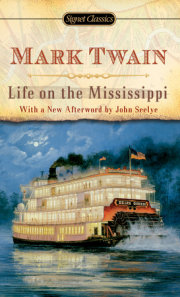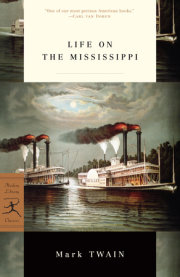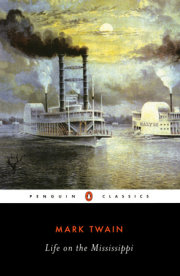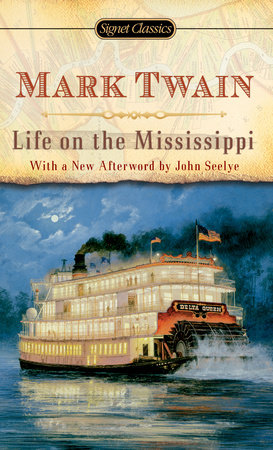

At once a romantic history of a mighty river, an autobiographical account of Twain's early steamboat days, and a storehouse of humorous anecdotes and sketches, here is the raw material from which Mark Twain wrote his finest novel, Adventures of Huckleberry Finn.

Hannibal, Missouri, on the banks of the Mississippi River, was host to riverboat travelers from around the world, providing a vigorous and variable atmosphere for the young Samuel Clemens to absorb. Clemens became a riverboat pilot and even chose his pen name—Mark Twain—from a term boatmen would call out signifying water depth at two fathoms, meaning safe clearance for travel. It was from this background that Life on the Mississippi emerged. It is an epochal record of America’s growth, a stirring remembrance of her vanished past. And it earned for its author his first recognition as a serious writer. 

With an Introduction by Justin Kaplan
and an Afterword by John Seelye
MARK TWAIN, considered one of the greatest writers in American literature, was born Samuel Clemens in Florida, Missouri, in 1835, and died in Redding, Connecticut in 1910. As a young child, he moved with his family to Hannibal, Missouri, on the banks of the Mississippi River, a setting that inspired his two best-known novels, The Adventures of Tom Sawyer and Adventures of Huckleberry Finn. In his person and in his pursuits, he was a man of extraordinary contrasts. Although he left school at 12 when his father died, he was eventually awarded honorary degrees from Yale University, the University of Missouri, and Oxford University. His career encompassed such varied occupations as printer, Mississippi riverboat pilot, journalist, travel writer, and publisher. He made fortunes from his writing but toward the end of his life he had to resort to lecture tours to pay his debts. He was hot-tempered, profane, and sentimental—and also pessimistic, cynical, and tortured by self-doubt. His nostalgia for the past helped produce some of his best books. He lives in American letters as a great artist, described by writer William Dean Howells as “the Lincoln of our literature.” Twain and his wife, Olivia Langdon Clemens, had four children—a son, Langdon, who died as an infant, and three daughters, Susy, Clara, and Jean. View titles by Mark Twain

About

At once a romantic history of a mighty river, an autobiographical account of Twain's early steamboat days, and a storehouse of humorous anecdotes and sketches, here is the raw material from which Mark Twain wrote his finest novel, Adventures of Huckleberry Finn.

Hannibal, Missouri, on the banks of the Mississippi River, was host to riverboat travelers from around the world, providing a vigorous and variable atmosphere for the young Samuel Clemens to absorb. Clemens became a riverboat pilot and even chose his pen name—Mark Twain—from a term boatmen would call out signifying water depth at two fathoms, meaning safe clearance for travel. It was from this background that Life on the Mississippi emerged. It is an epochal record of America’s growth, a stirring remembrance of her vanished past. And it earned for its author his first recognition as a serious writer. 

With an Introduction by Justin Kaplan
and an Afterword by John Seelye

Author

MARK TWAIN, considered one of the greatest writers in American literature, was born Samuel Clemens in Florida, Missouri, in 1835, and died in Redding, Connecticut in 1910. As a young child, he moved with his family to Hannibal, Missouri, on the banks of the Mississippi River, a setting that inspired his two best-known novels, The Adventures of Tom Sawyer and Adventures of Huckleberry Finn. In his person and in his pursuits, he was a man of extraordinary contrasts. Although he left school at 12 when his father died, he was eventually awarded honorary degrees from Yale University, the University of Missouri, and Oxford University. His career encompassed such varied occupations as printer, Mississippi riverboat pilot, journalist, travel writer, and publisher. He made fortunes from his writing but toward the end of his life he had to resort to lecture tours to pay his debts. He was hot-tempered, profane, and sentimental—and also pessimistic, cynical, and tortured by self-doubt. His nostalgia for the past helped produce some of his best books. He lives in American letters as a great artist, described by writer William Dean Howells as “the Lincoln of our literature.” Twain and his wife, Olivia Langdon Clemens, had four children—a son, Langdon, who died as an infant, and three daughters, Susy, Clara, and Jean. View titles by Mark Twain

Mental Health Awareness Month Resources

May is Mental Health Awareness Month and educators are increasingly aware that integrating social-emotional learning into the curriculum is critical if we want students to succeed both in and out of the classroom. Download the thematic educator guides on Teaching About Anxiety and Mindfulness and Teaching About Student Wellness. Explore our specially curated collections on

Read more

Books for Asian American, Native Hawaiian, and Pacific Islander Heritage Month

Each May, we honor the stories, histories, and cultures of Asian Americans, Native Hawaiians, and Pacific Islanders. Below is a selection of acclaimed fiction and nonfiction books by AANHPI creators to share with your students this month and throughout the year. AANHPI Creators – Middle School titles AANHPI Creators – High School titles .
Read more