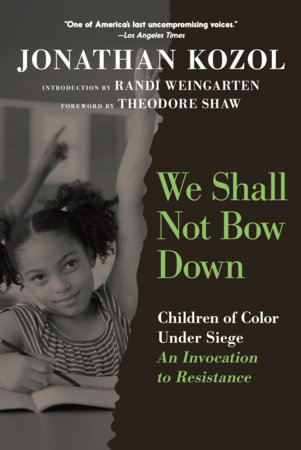

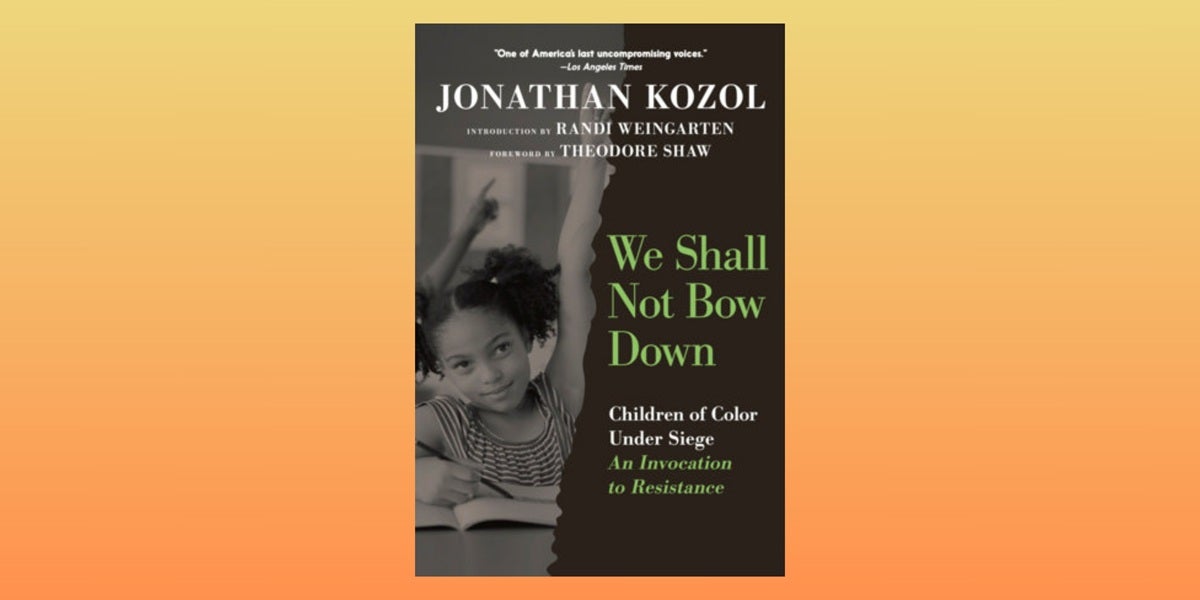
Interview in April 2026 by Claire Kelley, Seven Stories Press, with Jonathan Kozol author of We Shall Not Bow Down: Children of Color Under Siege, An Invocation to Resistance.
You have long argued that educational inequality is not inevitable but the result of political decisions. Why do you think the idea that inequality is “natural” or unavoidable continues to have such influence in American education debates?
The notion that inequality in educational outcomes is “natural” or “unavoidable” has had a persistent history in American education thinking. As long ago as in the first decades of the nineteen hundreds, which historians have sometimes called the Era of Eugenics, prominent educators argued that certain categories of the nation’s populations were cognitively deficient in comparison with others and, for this reason, less likely to contribute to the national prosperity. They were to be given a different, and a lesser, form of public education.
These views were widely held by influential people, including Andrew Carnegie and John D. Rockefeller, both of whom provided funding for eugenics studies, as well as Lewis Ternan of Stanford University and Edward Thorndike of Columbia. The eugenics movement fell out of favor by the early 1930s but resurfaced in the 1990s in the writings, for example, of Charles Murray among others. A subcurrent of this thinking has continued to be present in much of the hard-nosed, pedagogic policy that shapes the education of Black and Latino and immigrant children in America today. All of this is reinforced and reified by our system of school funding, which is based primarily on local property wealth and guarantees inequity between school districts. Funds that are additionally contributed by the states and federal government have seldom been sufficient to narrow this inequity.
The system was challenged in the 1970s in a famous case in Texas, Rodriguez v. San Antonio, in which a district court found the system to be unconstitutional, but the US Supreme Court overruled the district court and, in a decision written by Justice Lewis Powell, who had been appointed to the court by Richard Nixon, stated that education is not a protected right under the US Constitution. That decision has never been revisited. Unless the Powell decision can someday be reversed, we will remain a deeply flawed and incomplete democracy.
In this new edition of your book, the struggle for public education is closely tied to the health of democracy itself. Why do you believe public schools are so central to a democratic society?
I would amend that question slightly. It is not just “public education” that is essential in a democratic nation, but public education in which children are empowered to ask discerning questions about their day-to-day reality and their place in our society, to grow into the kind of future adult citizens who are capable of vigorous dissent and sensible irreverence in the face of devious inducements from demagogues and despots.
But the suppression of intelligent irreverence and the silencing of questions have come in recent years to be a common practice in far too many schools that I’ve been visiting. In a segregated elementary school that I visited in Boston’s Black community, if children asked importunate questions that threatened to disrupt the standardized rout-and-drill curriculum, and could not be silenced by the teacher’s admonitions, they were placed in a lockdown room—a storage closet in the hallway—that was called the “Calm-down Room.” The children often wet themselves and ended up sitting in a pool of urine on the floor and crying for their mothers. In other cities, as I learned, the lockdown rooms are sometimes called “Relaxation Rooms,” or “Reflection Rooms,” or “Quiet Rooms,” although the children who are crying for their mothers are obviously neither quiet nor relaxing.
This is only one of several forms of punitive control that have been used to guarantee compliance to an autocratic ethos that pervades large numbers of the schools that I’ve been visiting. This is particularly common in schools that serve low-income kids of color, but even less outrageously offensive methods of establishing compliance are familiar in schools that serve the mainstream of our student populations. In my newest book, We Shall Not Bow Down, I have argued that democracy cannot fully flourish so long as our students are denied the right to interrogate the status quo by which they are surrounded. The denial of this right will continue to deplete and imperil our democracy.
Teachers today are facing growing political pressure over what they can teach. What role do you believe teachers should play when education itself becomes a political battleground?
I will limit my answer to the challenge faced by teachers when efforts are made to ban the use of books, as well as class discussions, that address important issues of race, diversity, or gender. I always urge teachers to make clear that they are not attempting to indoctrinate their students, but to open up their classrooms to the fresh air of a dialogue that will stimulate their students to engage in independent thinking of their own. Even when they make this clear, they are still likely to be faced with intemperate critiques on the part of those who fervently oppose anything that smacks of “stimulating dialogue” in regard to issues they hold dear.
In these cases, teachers have no choice but to act and speak politically and to reach for alliances with teachers elsewhere who are facing the same pressures. In my books, I’ve described dozens of teachers who are not afraid to defy attempts at censorship, but I’ve also noted that the best of these teachers make it a point never to dismiss the need to be sure their students acquire the elemental skills expected of a student in the grade their teaching. Teachers who can do this are seldom likely to be chastised or dismissed by their superiors. I remember a teacher at a school I used to visit in the Bronx whose principal told me once, “The man is something of a radical—he’s always telling me I need to read Noam Chomsky!—but his students adore him and they’re doing better than the other fourth grade classes. So I leave him alone. I can’t afford to lose him.”
You have listened closely to children in under-resourced schools. What truths about inequality have students themselves helped you understand that policymakers still fail to see?
Children in underfunded and very old and physically decrepit schools, where paint is often peeling from the walls, cooling systems break down in hot weather, and rooms are cold in winter, are very much aware that other children in more favored districts do not have to undergo these grim conditions. “You have Clean Things. We do not have,” a third-grade student in the South Bronx told me in a letter that her teacher sent me. I later met this little girl when I visited her school. She was only eight years old, but she already had a vivid sense of the meaning of inequity.
Other children tell me that the bathrooms in their schools are squalid and disgusting places. They speak of sinks with no hot water, soap, or towels, and toilets that have broken seats and toilet stalls that have no doors. A child at a school in the old South End of Boston told me she avoided going to the bathrooms because they were so vile. She had taught herself a kind of game that she called “the pee dance”—rocking back and forth, lifting up one leg and shaking it in order to distract herself when she had to urinate.
At an elementary school in which there was no lunchroom, the children had to go down a narrow metal staircase into a basement room to have their meals. A child in a class I had been visiting told me that the basement room was “an ugly, smelly place” and it had no windows. She insisted that I go downstairs with her because she didn’t think I would believe her. She was right—it was a horrible and dreary place. I would never have wanted to sit down and eat a meal there.
Political officials sometimes wring their hands and claim that funds to meet these needs are simply not available. But some of them also question whether physical conditions actually make much difference in the education of a child. I strongly disagree. Beautiful and clean environments quietly convey a sense of dignity to children. Squalor and decrepitude soil their mentalities. Older children also sometimes speak to me of their racial isolation and their recognition that they were not waited in the mainstream of American society.
A teenage girl at a school in Harlem put it in these words: “It’s like we’re being hidden. It’s as if you’ve been put in a garage. If they don’t have room for something but aren’t sure if they should throw it out, they put it there where they don’t need to think if it again.” I asked if she really thought Americans do not “have room” for her or people like her. “Let’s think of it this way,” said a 16-year-old student who was her half-sister. “If people in New York woke up one day and learned that we were gone, that we had simply died or left for somewhere else, how would they feel?” “How do you think they’d feel?” I asked. “I think they’d be relieved,” she said. Political leaders frequently condemn me for repeating words like these. But I believe they need to hear the truths that children speak.
For teacher educators preparing future teachers today, what do you believe they must help their students understand about structural inequality before entering the classroom?
This is a difficult challenge for the teacher educators with whom I work, and whom I admire most, because delineating structural inequality is often perceived as potentially risky in view of the pressure from the Trump administration to steer away from issues of elemental justice that may stir the critical thinking of their students. But I nonetheless believe our future teachers need a thorough understanding of the archaic and undemocratic system of school finance in this nation (see my answer to Question 2), which guarantees inequities between more affluent and poorer districts.
I also believe they need to understand that racial segregation continues to be unbated in our public schools and that segregation, in and of itself, is a form of inequality, as the Warren Court observed in its ruling in Brown v. Board of Education. I hope our schools of education will do what they can to immerse our future teachers in these troubling realities and endow them with the courage to go into the classrooms as the fearless and unbroken allies of the children in this nation who have paid the greatest price for these persistent inequalities.
What made you decide to revisit and update The End of Inequality in this new form as We Shall Not Bow Down, and what new realities compelled you to return to this argument now?
What prompted me to write We Shall Not Bow Down was the reelection of Donald Trump in 2024 and his almost immediate assault on the U.S. Department of Education and, in particular, his dismissal of more than half of the attorneys in the Office of Civil Rights, the agency to which parents turn when they see their children denied the basic rights of education. It was also the sheer ugliness and viciousness in which he spoke of our most vulnerable people and especially of immigrants, of whom he said, “They are poisoning the blood” of American society.
These words are painfully reminiscent of words that Hitler used in speaking to his followers as he rose to power. I could not help thinking of those waning days of the Weimar Republic in Germany in the years that led up to 1933, when Hitler was elected Chancellor, and the parallel alarmed me. It alarms me still. At my age of 89, I don’t know how long I may have to live but I wanted to use whatever strength remains to me to strike a final blow against the loss of everything I love about America.
If a young teacher were to read your work in 10 or 20 years from now, what would you most want them to carry with them into their classrooms and their lives as educators?
I would want to tell young teachers never to genuflect before an autocratic ethos that robs them of autonomy and denies their students the right to learn for the joy that learning brings them. I would ask them to turn their backs on punitive agendas that atrophy the curiosity of children, to celebrate their sense of whim and wonderment, and create a feast of riches in their classrooms. Most of all, I would urge them to listen patiently to children, even when the questions they may ask us threaten to delay the pacing of our lessons and may bear no obvious connection to the standardized objective we’re pursuing.
My closest friend and mentor in my work in education was not a grim and data-driven academic icon laden with self-confident abstractions and statistics. It was a wise and gentle man whom I badly miss today. I’m speaking of Fred Rogers. When we went together into the classrooms of young children, he listened to them carefully and didn’t interrupt them when they told us stories that meandered without endings.
I’d like to think I’ve followed his example, and I’d hope that teachers 10 or 20 years from now would think of children’s learning as an act of exploration rather than a forced march to a goal or “outcome” that’s already been determined and allows no room for unexpected detours. It’s often in those unexpected detours that a child’s soul reveals itself.
JONATHAN KOZOL is a Rhodes Scholar, former fourth grade teacher, and a passionate advocate for child-centered learning. Kozol is one of the most widely read and highly honored education writers in the nation. His first book, Death at an Early Age (1967), a description of his first year as a teacher in a Black community of Boston, received the National Book Award in Science, Philosophy, and Religion.