Download high-resolution image Look inside
Listen to a clip from the audiobook
audio pause button
0:00
0:00

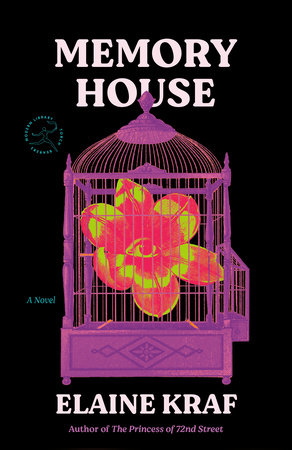
Memory House

A Novel

Introduction by Lauren Oyler
Look inside
Listen to a clip from the audiobook
audio pause button
0:00
0:00
The never-before-published final novel by cult feminist author Elaine Kraf, exploring what happens when a drained writer fakes her death and joins a mysterious club for failing artists

Once the darling of the literary world, Marlane Frack is fading into obscurity: her once-brilliant career seems over, her creativity feels nonexistent, and her demanding husband would prefer she spend her time caring for him instead of struggling to find inspiration. But one day, an enigmatic chauffeur arrives to spirit her away to Memory House, a secluded sanctuary where formerly successful artists of all kinds—writers, painters, musicians, and more—are spending the rest of their lives. They have all decided that fame in death is preferable to decline in real life.

Nestled in a remote, picturesque landscape, the house is a labyrinth of secrets and whispers, where time seems to flow differently and creativity is both a blessing and a curse. There, Marlane finds herself among a diverse group of residents, some of whom she knew in the outside world, all of them fighting with their own artistic demons—and with each other. As the line between reality and imagination blurs, and her past begins to manifest in startling ways, Marlane starts to question what is real and what is merely a figment of the house's influence.
Will Marlane find the redemption she seeks, or will the house consume her creative spirit entirely? In the last book she wrote before her death, which has never been published before, Elaine Kraf explores the challenges of being a female creator, the transformative power of art, and the enduring quest for self-discovery.
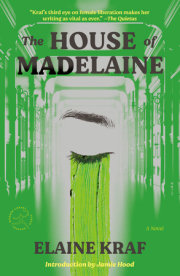
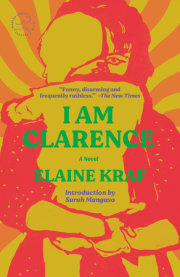
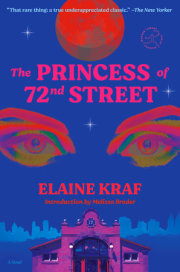
Elaine Kraf (1936-2013) was a writer and painter. She was the author of four published works of fiction: I Am Clarence (1969), The House of Madelaine (1971), Find Him! (1977), and The Princess of 72nd Street (1979)—as well as several unpublished novels, plays, and poetry collections. She was the recipient of two National Endowment for the Arts awards, a 1971 fellowship at the Broad Loaf Writers’ Conference, and a 1977 residency at Yaddo. She was born and lived in New York City.

Chapter 1

The Journey

I could not determine the age of the Japanese man who stood outside the maroon limousine; he might have been in his sixth or even seventh decade. He held a bouquet of white spider chrysanthemums in one hand and a book in the other. Except for the odd fact that his cap was bright red he was dressed in the formal, dark uniform of a chauffeur.


Smiling excitedly, he waved the bouquet of flowers as I approached. The smooth golden skin that covered his round face was crinkled only about the eyes and mouth, and his short, closely spaced teeth were perfectly even.

“Look!” he cried out, tapping the book, which I recognized as my second novel. He held it so that the photograph on the dust jacket was exposed.

“You must be the novelist Marlane Frack. I know your face from this cover.”

“It was taken ages ago,” I protested, annoyed to see it.

“You look exactly the same. Here is a small token of welcome. I wish it to be all that you hoped for.”

“What?”

“Memory House, of course.”

“Thank you for the flowers,” I said, looking down into their centers.

“I know absolutely nothing about Memory House, and I’m terrified,” I whispered.

He smiled.

“I understand,” he said, opening the back door and motioning for me to enter.

“A certain amount of fear is normal in circumstances such as these!”

“I don’t know if I really want to do this,” I said, peering into the limousine.

“Of course you want to do this, Ms. Frack, or you wouldn’t be here.” He smiled.

“Does it really exist? Are there painters, writers, and composers as creatively dead as I am? And why would someone endow an estate to rehabilitate us? The whole thing is incomprehensible!”

He giggled nervously.

“Of course there are other artists whose excellent work has deteriorated or ceased! Memory House can be all too real at times,” he added as he belted himself into the front seat. “As for the bequest, and its author’s peculiar generosity, there are as many theories as there are residents.”

“I may not go after all,” I said, fidgeting with my seat belt.

“I need a few more weeks to think about it. This is too abrupt for me. I’ve left my husband without a word!”

He ignored my words and continued. “There is a small Frigidaire with drinks and sandwiches. It’s down below, right in front of your knees. No bathroom, I’m sorry to say. We will stop whenever you wish. I have a thermos of tea and one of hot coffee if you like. I want you to be comfortable. Life is uncomfortable enough as it is. It would have been better to have dispensed with the whole thing in my humble opinion.”

I stared at him. “Do you mean the entire creation? Or just Memory House?”

The man let out a forced giggle. “I am not going to pressure you or intrude upon your private thoughts, or bore you with inane conversation. I’m sure you’ve had enough of that. It is best, Ms. Frack, to remain calm.”

“How can I be calm? The whole thing is preposterous!”

“Listen to me, Ms. Frack! Don’t try to predict what is unpredictable. When one travels out of the moment, one conjures up dragons. In time you will understand everything and become acclimated to Memory House.”

“I may ask you to stop and turn back a little later,” I said.

“It’s never happened before,” he said, sighing. “It is always the same; somehow the journey begins, and the Welcomers wait with their signs.”

“What signs?” I asked.

“Just placards. Nothing of importance.”

“The windows are so dark!” I exclaimed.

“Yes. You won’t see much. In front of you, to the right inside the small cabinet, is a television set, a radio, and a CD player, as well as a selection of tapes, discs, and videos. I have the complete works of Kawabata up front with me, as well as two volumes of À la recherche du temps perdu.”

I looked at his face through his rearview mirror. He must be crazy, I thought, to imagine that I’d be interested in discs, videos, or Kawabata at a time like this. (It was all I could do to remain seated.)

“Is it possible for you to tell me what state it is located in?”

“A state of perpetual lethargy,” he said softly.

“What did you say?”

“I’m so sorry, but that information is forbidden to all residents except those designated as chauffeurs. That is the reason for the heavily tinted windows. I am also forced to take circuitous routes to keep new residents from guessing.”

Just then the limousine began to move.

“Oh no! I’m not ready!” I exclaimed, but he didn’t seem to hear me.

“Sometimes I sing or hum just to help the time pass; if it gets on your nerves, just tell me. I’m particularly fond of American show tunes and songs of the World War Two era. You know, When Johnny comes marching home again, hurrah, hurrah . . . et cetera. I can shut off the speaker system if my singing gets to you.”

His giggling began again—a sound light, dry, and slightly musical. It seemed to be coming from a younger man.

“Sing all you want! I live with two birds, a macaw named Conrad and a conure named Jimmy. I endure them daily. I must be mad to travel to a place I’ve never seen. And what of my husband? Suppose he finds the separation unbearable and becomes desperate? Who will he turn to?”

The man giggled and pulled up the window that separated us.

“Suppose, Ms. Frack, that he takes a two-headed lover? Your husband’s fate is completely out of your control. You’ve made your decision and now you must accept it.”

“I’m an accepting person. I’ve accepted Lenny’s erratic behavior for years.”


On a nasty October day laden with icy pumpkin grins and the loosening of multicolored leaves (that very day when I was told about Memory House, by Boris Steinhummer), I lost the ability to endure my husband and the birds. The wind hurt my ears. Even the midday sun or voices rising into the air unhinged me.

I was walking to the door, tiptoeing. . . .

“Where are you going, Marlie?” my husband shouted.

I hesitated.

“Hey! What’s this—the silent treatment? Come on, Marl, even I deserve an answer.”

“Can’t you wait a second? Why does everything have to happen the instant you demand it?” I snapped.

“I irritate you, don’t I? You can’t fool me!” he exclaimed as he came toward me down the long corridor. He looked like a mad saint with his long, bony face and upturned, beseeching eyes. A white beard had begun to sprout from his chin.

“No, it’s the rejections, the death of my imagination.”

“You think I’m shit. It’s so obvious. Marl, pick up my meds and a few bags of Fritos. It’s the only thing I ain’t lost my taste for. And you didn’t feed your birds. You only got two left. How could you do that, Marlie? How could you have given away all those beautiful parrots I bought you? You don’t know how it hurt me and now you don’t care if these two starve.”

“Twenty birds were just too much. Can’t you see that?”

“I thought you would be thrilled. I always meant the best for you and you give me attitudes lately. I’m crying in here. Nothing, even in ’Nam, was as bad as this pain!” He put his hand over his heart.

“I’m sorry. I don’t know what’s wrong with me. I did feed the macaw and Jimmy this morning. I always do. I’ll be back soon. I need some air.”

“You didn’t even give him a name. Your goddamn macaw needs a name like everyone else!”

“Bye, Lenny, bye, Lenny,” said the bird.

“That bird is real smart. I teach him! See?”

I walked toward the door.

“Don’t I even get a kiss on the cheek?”

“Sorry.”

“Sorry, shit. You’re mad as hell ’cause the meds make my cock limp. I can’t help it. It ain’t my fault. I’m dying to throw that shit into the wastebasket. Just say the word!”
“An arresting posthumous novel . . . An eerie dreamlike logic expands Marlane’s struggle for creative agency into a hypnotic consideration of how memories can distort or shape reality. In this funhouse narrative, meaning slips away into an accelerating spiral of bizarre events. Readers will find it an impressive exploration of an artist’s inner life.”Publishers Weekly

About

The never-before-published final novel by cult feminist author Elaine Kraf, exploring what happens when a drained writer fakes her death and joins a mysterious club for failing artists

Once the darling of the literary world, Marlane Frack is fading into obscurity: her once-brilliant career seems over, her creativity feels nonexistent, and her demanding husband would prefer she spend her time caring for him instead of struggling to find inspiration. But one day, an enigmatic chauffeur arrives to spirit her away to Memory House, a secluded sanctuary where formerly successful artists of all kinds—writers, painters, musicians, and more—are spending the rest of their lives. They have all decided that fame in death is preferable to decline in real life.

Nestled in a remote, picturesque landscape, the house is a labyrinth of secrets and whispers, where time seems to flow differently and creativity is both a blessing and a curse. There, Marlane finds herself among a diverse group of residents, some of whom she knew in the outside world, all of them fighting with their own artistic demons—and with each other. As the line between reality and imagination blurs, and her past begins to manifest in startling ways, Marlane starts to question what is real and what is merely a figment of the house's influence.

Will Marlane find the redemption she seeks, or will the house consume her creative spirit entirely? In the last book she wrote before her death, which has never been published before, Elaine Kraf explores the challenges of being a female creator, the transformative power of art, and the enduring quest for self-discovery.

Author

Elaine Kraf (1936-2013) was a writer and painter. She was the author of four published works of fiction: I Am Clarence (1969), The House of Madelaine (1971), Find Him! (1977), and The Princess of 72nd Street (1979)—as well as several unpublished novels, plays, and poetry collections. She was the recipient of two National Endowment for the Arts awards, a 1971 fellowship at the Broad Loaf Writers’ Conference, and a 1977 residency at Yaddo. She was born and lived in New York City.

Excerpt

Chapter 1

The Journey

I could not determine the age of the Japanese man who stood outside the maroon limousine; he might have been in his sixth or even seventh decade. He held a bouquet of white spider chrysanthemums in one hand and a book in the other. Except for the odd fact that his cap was bright red he was dressed in the formal, dark uniform of a chauffeur.

Smiling excitedly, he waved the bouquet of flowers as I approached. The smooth golden skin that covered his round face was crinkled only about the eyes and mouth, and his short, closely spaced teeth were perfectly even.

“Look!” he cried out, tapping the book, which I recognized as my second novel. He held it so that the photograph on the dust jacket was exposed.

“You must be the novelist Marlane Frack. I know your face from this cover.”

“It was taken ages ago,” I protested, annoyed to see it.

“You look exactly the same. Here is a small token of welcome. I wish it to be all that you hoped for.”

“What?”

“Memory House, of course.”

“Thank you for the flowers,” I said, looking down into their centers.

“I know absolutely nothing about Memory House, and I’m terrified,” I whispered.

He smiled.

“I understand,” he said, opening the back door and motioning for me to enter.

“A certain amount of fear is normal in circumstances such as these!”

“I don’t know if I really want to do this,” I said, peering into the limousine.

“Of course you want to do this, Ms. Frack, or you wouldn’t be here.” He smiled.

“Does it really exist? Are there painters, writers, and composers as creatively dead as I am? And why would someone endow an estate to rehabilitate us? The whole thing is incomprehensible!”

He giggled nervously.

“Of course there are other artists whose excellent work has deteriorated or ceased! Memory House can be all too real at times,” he added as he belted himself into the front seat. “As for the bequest, and its author’s peculiar generosity, there are as many theories as there are residents.”

“I may not go after all,” I said, fidgeting with my seat belt.

“I need a few more weeks to think about it. This is too abrupt for me. I’ve left my husband without a word!”

He ignored my words and continued. “There is a small Frigidaire with drinks and sandwiches. It’s down below, right in front of your knees. No bathroom, I’m sorry to say. We will stop whenever you wish. I have a thermos of tea and one of hot coffee if you like. I want you to be comfortable. Life is uncomfortable enough as it is. It would have been better to have dispensed with the whole thing in my humble opinion.”

I stared at him. “Do you mean the entire creation? Or just Memory House?”

The man let out a forced giggle. “I am not going to pressure you or intrude upon your private thoughts, or bore you with inane conversation. I’m sure you’ve had enough of that. It is best, Ms. Frack, to remain calm.”

“How can I be calm? The whole thing is preposterous!”

“Listen to me, Ms. Frack! Don’t try to predict what is unpredictable. When one travels out of the moment, one conjures up dragons. In time you will understand everything and become acclimated to Memory House.”

“I may ask you to stop and turn back a little later,” I said.

“It’s never happened before,” he said, sighing. “It is always the same; somehow the journey begins, and the Welcomers wait with their signs.”

“What signs?” I asked.

“Just placards. Nothing of importance.”

“The windows are so dark!” I exclaimed.

“Yes. You won’t see much. In front of you, to the right inside the small cabinet, is a television set, a radio, and a CD player, as well as a selection of tapes, discs, and videos. I have the complete works of Kawabata up front with me, as well as two volumes of À la recherche du temps perdu.”

I looked at his face through his rearview mirror. He must be crazy, I thought, to imagine that I’d be interested in discs, videos, or Kawabata at a time like this. (It was all I could do to remain seated.)

“Is it possible for you to tell me what state it is located in?”

“A state of perpetual lethargy,” he said softly.

“What did you say?”

“I’m so sorry, but that information is forbidden to all residents except those designated as chauffeurs. That is the reason for the heavily tinted windows. I am also forced to take circuitous routes to keep new residents from guessing.”

Just then the limousine began to move.

“Oh no! I’m not ready!” I exclaimed, but he didn’t seem to hear me.

“Sometimes I sing or hum just to help the time pass; if it gets on your nerves, just tell me. I’m particularly fond of American show tunes and songs of the World War Two era. You know, When Johnny comes marching home again, hurrah, hurrah . . . et cetera. I can shut off the speaker system if my singing gets to you.”

His giggling began again—a sound light, dry, and slightly musical. It seemed to be coming from a younger man.

“Sing all you want! I live with two birds, a macaw named Conrad and a conure named Jimmy. I endure them daily. I must be mad to travel to a place I’ve never seen. And what of my husband? Suppose he finds the separation unbearable and becomes desperate? Who will he turn to?”

The man giggled and pulled up the window that separated us.

“Suppose, Ms. Frack, that he takes a two-headed lover? Your husband’s fate is completely out of your control. You’ve made your decision and now you must accept it.”

“I’m an accepting person. I’ve accepted Lenny’s erratic behavior for years.”


On a nasty October day laden with icy pumpkin grins and the loosening of multicolored leaves (that very day when I was told about Memory House, by Boris Steinhummer), I lost the ability to endure my husband and the birds. The wind hurt my ears. Even the midday sun or voices rising into the air unhinged me.

I was walking to the door, tiptoeing. . . .

“Where are you going, Marlie?” my husband shouted.

I hesitated.

“Hey! What’s this—the silent treatment? Come on, Marl, even I deserve an answer.”

“Can’t you wait a second? Why does everything have to happen the instant you demand it?” I snapped.

“I irritate you, don’t I? You can’t fool me!” he exclaimed as he came toward me down the long corridor. He looked like a mad saint with his long, bony face and upturned, beseeching eyes. A white beard had begun to sprout from his chin.

“No, it’s the rejections, the death of my imagination.”

“You think I’m shit. It’s so obvious. Marl, pick up my meds and a few bags of Fritos. It’s the only thing I ain’t lost my taste for. And you didn’t feed your birds. You only got two left. How could you do that, Marlie? How could you have given away all those beautiful parrots I bought you? You don’t know how it hurt me and now you don’t care if these two starve.”

“Twenty birds were just too much. Can’t you see that?”

“I thought you would be thrilled. I always meant the best for you and you give me attitudes lately. I’m crying in here. Nothing, even in ’Nam, was as bad as this pain!” He put his hand over his heart.

“I’m sorry. I don’t know what’s wrong with me. I did feed the macaw and Jimmy this morning. I always do. I’ll be back soon. I need some air.”

“You didn’t even give him a name. Your goddamn macaw needs a name like everyone else!”

“Bye, Lenny, bye, Lenny,” said the bird.

“That bird is real smart. I teach him! See?”

I walked toward the door.

“Don’t I even get a kiss on the cheek?”

“Sorry.”

“Sorry, shit. You’re mad as hell ’cause the meds make my cock limp. I can’t help it. It ain’t my fault. I’m dying to throw that shit into the wastebasket. Just say the word!”

Praise

“An arresting posthumous novel . . . An eerie dreamlike logic expands Marlane’s struggle for creative agency into a hypnotic consideration of how memories can distort or shape reality. In this funhouse narrative, meaning slips away into an accelerating spiral of bizarre events. Readers will find it an impressive exploration of an artist’s inner life.”Publishers Weekly

Books for National Poetry Month

For National Poetry Month in April, we’re highlighting a selection of classic and contemporary poetry collections and novels-in-verse.   Poetry Month – Middle School Titles Poetry Month – High School Titles   Download free thematic educator guides:  Middle School Guide on Teaching Poetry High School Guide on Teaching Poetry

Read more