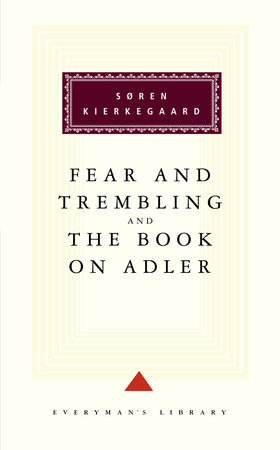

Fear and Trembling and The Book on Adler

Introduction by George Steiner

Introduction by George Steiner
Translated by Walter Lowrie
Look inside
Now recognized as one of the nineteenth century's leading psychologists and philosophers, Kierkegaard was among other things the harbinger of exisentialisim. In Fear and Trembling he explores the psychology of religion, addressing the question 'What is Faith?' in terms of the emotional and psychological relationship between the individual and God. But this difficult question is addressed in the most vivid terms, as Kierkegaard explores different ways of interpreting the ancient story of Abraham and Isaac to make his point.

Søren Kierkegaard not only ­trans­formed Protestant theology but also anticipated twentieth-century existentialism and provided it with many of its motifs. Fear and Trembling and The Book on Adler–addressed to a general audience–have the imaginative excitement and intense personal appeal of the greatest literature. Only Plato and Nietzsche have matched Kierkegaard’s ability to give ideas so compellingly vivid and dramatic a shape.

Translated by Walter Lowrie
Søren Kierkegaard (1813–1855) was a Danish philosopher and theologian whose work has been widely recognized as foundational both to modern psychology and existentialism.

A professor emeritus at Connecticut College, Bruce H. Kirmmse has published several books and numerous articles on Kierkegaard and is general editor of Kierkegaard’s Journals and Notebooks. He lives in Randolph, New Hampshire, and Copenhagen, Denmark.

A professor emeritus at Connecticut College, Bruce H. Kirmmse has published several books and numerous articles on Kierkegaard and is general editor of Kierkegaard’s Journals and Notebooks. He lives in Randolph, New Hampshire, and Copenhagen, Denmark. View titles by Søren Kierkegaard
Fear and Trembling is among the best-known and influential works in nineteenth- and twentieth-century philosophic theology and literature . . . The Book on Adler [is] one of the dark jewels in the history of philosophic psychology. As an examiner of the lives of the mind, of the associative pulses of the imagination, Kierkegaard has only two peers. His inquisition into Adler stands beside those descents into the deeps of the human psyche performed by Dostoevsky and by Nietzsche.” –from the Introduction by George Steiner

About

Now recognized as one of the nineteenth century's leading psychologists and philosophers, Kierkegaard was among other things the harbinger of exisentialisim. In Fear and Trembling he explores the psychology of religion, addressing the question 'What is Faith?' in terms of the emotional and psychological relationship between the individual and God. But this difficult question is addressed in the most vivid terms, as Kierkegaard explores different ways of interpreting the ancient story of Abraham and Isaac to make his point.

Søren Kierkegaard not only ­trans­formed Protestant theology but also anticipated twentieth-century existentialism and provided it with many of its motifs. Fear and Trembling and The Book on Adler–addressed to a general audience–have the imaginative excitement and intense personal appeal of the greatest literature. Only Plato and Nietzsche have matched Kierkegaard’s ability to give ideas so compellingly vivid and dramatic a shape.

Translated by Walter Lowrie

Author

Søren Kierkegaard (1813–1855) was a Danish philosopher and theologian whose work has been widely recognized as foundational both to modern psychology and existentialism.

A professor emeritus at Connecticut College, Bruce H. Kirmmse has published several books and numerous articles on Kierkegaard and is general editor of Kierkegaard’s Journals and Notebooks. He lives in Randolph, New Hampshire, and Copenhagen, Denmark.

A professor emeritus at Connecticut College, Bruce H. Kirmmse has published several books and numerous articles on Kierkegaard and is general editor of Kierkegaard’s Journals and Notebooks. He lives in Randolph, New Hampshire, and Copenhagen, Denmark. View titles by Søren Kierkegaard

Praise

Fear and Trembling is among the best-known and influential works in nineteenth- and twentieth-century philosophic theology and literature . . . The Book on Adler [is] one of the dark jewels in the history of philosophic psychology. As an examiner of the lives of the mind, of the associative pulses of the imagination, Kierkegaard has only two peers. His inquisition into Adler stands beside those descents into the deeps of the human psyche performed by Dostoevsky and by Nietzsche.” –from the Introduction by George Steiner

Mental Health Awareness Month Resources

May is Mental Health Awareness Month and educators are increasingly aware that integrating social-emotional learning into the curriculum is critical if we want students to succeed both in and out of the classroom. Download the thematic educator guides on Teaching About Anxiety and Mindfulness and Teaching About Student Wellness. Explore our specially curated collections on

Read more

Books for Asian American, Native Hawaiian, and Pacific Islander Heritage Month

Each May, we honor the stories, histories, and cultures of Asian Americans, Native Hawaiians, and Pacific Islanders. Below is a selection of acclaimed fiction and nonfiction books by AANHPI creators to share with your students this month and throughout the year. AANHPI Creators – Middle School titles AANHPI Creators – High School titles .

Read more