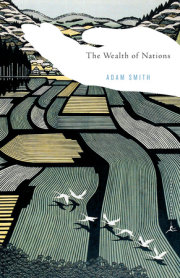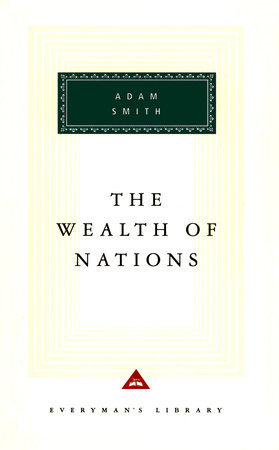

The Wealth of Nations

Introduction by D. D. Raphael and John Bayley

Author Adam Smith
Introduction by D. D. Raphael, John Bayley


Published in 1776, in the same year as the Declaration of Independence, The Wealth of Nations has had an equally great impact on the course of modern history. Adam Smith’s celebrated defense of free market economies was written with such expressive power and clarity that the first edition sold out in six months. While its most remarkable and enduring innovation was to see the whole of economic life as a unified system, it is notable also as one of the Enlightenment’s most eloquent testaments to the sanctity of the individual in his relation to the state. 
Adam Smith was born in a small village in Kirkcaldy, Scotland in 1723. He entered the University of Glasgow at age fourteen, and later attended Balliol College at Oxford. After lecturing for a period, he held several teaching positions at Glasgow University. His greatest achievement was writing The Wealth of Nations (1776), a five-book series that sought to expose the true causes of prosperity, and installed him as the father of contemporary economic thought. He died in Edinburgh on July 19, 1790.
.
"Adam Smith's enormous authority resides, in the end, in the same property that we discover in Marx: not in any ideology, but in an effort to see to the bottom of things."
--Robert L. Heilbroner

About


Published in 1776, in the same year as the Declaration of Independence, The Wealth of Nations has had an equally great impact on the course of modern history. Adam Smith’s celebrated defense of free market economies was written with such expressive power and clarity that the first edition sold out in six months. While its most remarkable and enduring innovation was to see the whole of economic life as a unified system, it is notable also as one of the Enlightenment’s most eloquent testaments to the sanctity of the individual in his relation to the state. 

Author

Adam Smith was born in a small village in Kirkcaldy, Scotland in 1723. He entered the University of Glasgow at age fourteen, and later attended Balliol College at Oxford. After lecturing for a period, he held several teaching positions at Glasgow University. His greatest achievement was writing The Wealth of Nations (1776), a five-book series that sought to expose the true causes of prosperity, and installed him as the father of contemporary economic thought. He died in Edinburgh on July 19, 1790.

Excerpt

.

Praise

"Adam Smith's enormous authority resides, in the end, in the same property that we discover in Marx: not in any ideology, but in an effort to see to the bottom of things."
--Robert L. Heilbroner

Mental Health Awareness Month Resources

May is Mental Health Awareness Month and educators are increasingly aware that integrating social-emotional learning into the curriculum is critical if we want students to succeed both in and out of the classroom. Download the thematic educator guides on Teaching About Anxiety and Mindfulness and Teaching About Student Wellness. Explore our specially curated collections on

Read more

Books for Asian American, Native Hawaiian, and Pacific Islander Heritage Month

Each May, we honor the stories, histories, and cultures of Asian Americans, Native Hawaiians, and Pacific Islanders. Below is a selection of acclaimed fiction and nonfiction books by AANHPI creators to share with your students this month and throughout the year. AANHPI Creators – Middle School titles AANHPI Creators – High School titles .

Read more