
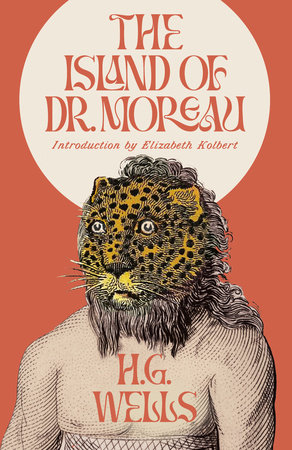






























































A visionary, shocking depiction of man's relationship to beast, first published in 1896 by the author of The War of the Worlds. With a new introduction by Elizabeth Kolbert.

Alone and adrift in the Pacific, Edward Prendick is rescued by a ship carrying an odd cargo of wild animals to an uncharted island. Though he is grateful for the hositality of the animals' keeper, Montgomery, and of Montgomery's employer, Dr. Moreau, he begins to be alarmed by the strangeness of the island--inhuman screams that keep him up at night, and bizarre beasts that roam the land. As Prendick digs deeper into the workings of the island, he finds that Dr. Moreau is more sinister than he seems: his torturous experiments in vivisection have thrown him from polite society, and he has developed these experiments on the island to truly horrifying results. As Dr. Moreau's tight control over his domain breaks down, his Beast Folk begin to show themselves in shocking ways.
H.G. Wells was born in Bromley, Kent, in 1866. After an education repeatedly interrupted by his family’s financial problems, he eventually found work as a teacher at a succession of schools, where he began to write his first stories.
Wells became a prolific writer with a diverse output, of which the famous works are his science fiction novels. These are some of the earliest and most influential examples of the genre, and include classics such as The Time Machine and The War of the Worlds. Most of his books very well-received, and had a huge influence on many younger writers, including George Orwell and Isaac Asimov. Wells also wrote many popular non-fiction books, and used his writing to support the wide range of political and social causes in which he had an interest, although these became increasingly eccentric towards the end of his life.
Twice-married, Wells had many affairs, including a ten-year liaison with Rebecca West that produced a son. He died in London in 1946. View titles by H.G. Wells

About

A visionary, shocking depiction of man's relationship to beast, first published in 1896 by the author of The War of the Worlds. With a new introduction by Elizabeth Kolbert.

Alone and adrift in the Pacific, Edward Prendick is rescued by a ship carrying an odd cargo of wild animals to an uncharted island. Though he is grateful for the hositality of the animals' keeper, Montgomery, and of Montgomery's employer, Dr. Moreau, he begins to be alarmed by the strangeness of the island--inhuman screams that keep him up at night, and bizarre beasts that roam the land. As Prendick digs deeper into the workings of the island, he finds that Dr. Moreau is more sinister than he seems: his torturous experiments in vivisection have thrown him from polite society, and he has developed these experiments on the island to truly horrifying results. As Dr. Moreau's tight control over his domain breaks down, his Beast Folk begin to show themselves in shocking ways.

Author

H.G. Wells was born in Bromley, Kent, in 1866. After an education repeatedly interrupted by his family’s financial problems, he eventually found work as a teacher at a succession of schools, where he began to write his first stories.
Wells became a prolific writer with a diverse output, of which the famous works are his science fiction novels. These are some of the earliest and most influential examples of the genre, and include classics such as The Time Machine and The War of the Worlds. Most of his books very well-received, and had a huge influence on many younger writers, including George Orwell and Isaac Asimov. Wells also wrote many popular non-fiction books, and used his writing to support the wide range of political and social causes in which he had an interest, although these became increasingly eccentric towards the end of his life.
Twice-married, Wells had many affairs, including a ten-year liaison with Rebecca West that produced a son. He died in London in 1946. View titles by H.G. Wells

Mental Health Awareness Month Resources

May is Mental Health Awareness Month and educators are increasingly aware that integrating social-emotional learning into the curriculum is critical if we want students to succeed both in and out of the classroom. Download the thematic educator guides on Teaching About Anxiety and Mindfulness and Teaching About Student Wellness. Explore our specially curated collections on

Read more

Books for Asian American, Native Hawaiian, and Pacific Islander Heritage Month

Each May, we honor the stories, histories, and cultures of Asian Americans, Native Hawaiians, and Pacific Islanders. Below is a selection of acclaimed fiction and nonfiction books by AANHPI creators to share with your students this month and throughout the year. AANHPI Creators – Middle School titles AANHPI Creators – High School titles .

Read more