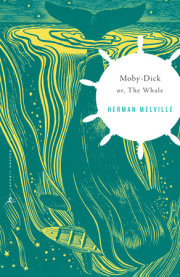
"Call me Ishmael" is one of the most familiar and oft-quoted opening lines ever written. Although it was originally published in 1851 to little success or acclaim, Moby Dick is generally regarded as Herman Melville's masterpiece and in many circles as the Great American Novel.
    Melville's epic story of Captain Ahab's obsessive hunt for the great white whale recalls Job in his quest for justice and Oedipus on his crusade for the truth. The tragic figure of Ahab, in whom virtuous and murderous impulses coexist, speaks for the defeats and triumphs of the human spirit. The richness of Melville's prose and the story's sweep are Shakespearean in their grandeur and symbolic power. Moby Dick remains the measure of literary achievement against which all subsequent American novels must be measured.
    This edition of Moby Dick is the companion volume to the Hallmark Entertainment television presentation, broadcast on USA Network.
   Enter the Moby Dick sweepstakes at www.usanetwork.com.

The Modern Library has played a significant role in American cultural life for the better part of a century. The series was founded in 1917 by the publishers Boni and Liveright and eight years later acquired by Bennett Cerf and Donald Klopfer. It provided the foun-dation for their next publishing venture, Random House. The Modern Library has been a staple of the American book trade, providing readers with affordable hard-bound editions of important works of liter-ature and thought. For the Modern Library's seventy-fifth anniversary, Random House redesigned the series, restoring as its emblem the running torchbearer created by Lucian Bernhard in 1925 and refurbishing jackets, bindings, and type, as well as inau-gurating a new program of selecting titles. The Modern Library continues to provide the world's best books, at the best prices.
Herman Melville was born in New York City in 1819. When his father died, he was forced to leave school and find work. After passing through some minor clerical jobs, the eighteen-year-old young man shipped out to sea, first on a short cargo trip, then, at twenty-one, on a three-year South Sea whaling venture. From the experiences accumulated on this voyage would come the material for his early books, Typee (1846) and Omoo (1847), as well as for such masterpieces as Moby-Dick (1851), Pierre (1852), The Piazza Tales (1856), and Billy Budd, Sailor, and Other Stories (posthumous, 1924). Though the first two novels—popular romantic adventures—sold well, Melville's more serious writing failed to attract a large audience, perhaps because it attacked the current philosophy of transcendentalism and its espoused "self-reliance." (As he made clear in the savagely comic The Confidence Man (1857), Melville thought very little of Emersonian philosophy.) He spent his later years working as a customs inspector on the New York docks, writing only poems comprising Battle-Pieces (1866). He died in 1891, leaving Billy Budd, Sailor, and Other Stories unpublished. View titles by Herman Melville

Rockwell Kent (1882–1971) was a prolific illustrator, writer, sailor, and explorer. His illustration credits include Voltaire’s Candide and Herman Melville’s Moby-Dick. View titles by Rockwell Kent

About

"Call me Ishmael" is one of the most familiar and oft-quoted opening lines ever written. Although it was originally published in 1851 to little success or acclaim, Moby Dick is generally regarded as Herman Melville's masterpiece and in many circles as the Great American Novel.
    Melville's epic story of Captain Ahab's obsessive hunt for the great white whale recalls Job in his quest for justice and Oedipus on his crusade for the truth. The tragic figure of Ahab, in whom virtuous and murderous impulses coexist, speaks for the defeats and triumphs of the human spirit. The richness of Melville's prose and the story's sweep are Shakespearean in their grandeur and symbolic power. Moby Dick remains the measure of literary achievement against which all subsequent American novels must be measured.
    This edition of Moby Dick is the companion volume to the Hallmark Entertainment television presentation, broadcast on USA Network.
   Enter the Moby Dick sweepstakes at www.usanetwork.com.

The Modern Library has played a significant role in American cultural life for the better part of a century. The series was founded in 1917 by the publishers Boni and Liveright and eight years later acquired by Bennett Cerf and Donald Klopfer. It provided the foun-dation for their next publishing venture, Random House. The Modern Library has been a staple of the American book trade, providing readers with affordable hard-bound editions of important works of liter-ature and thought. For the Modern Library's seventy-fifth anniversary, Random House redesigned the series, restoring as its emblem the running torchbearer created by Lucian Bernhard in 1925 and refurbishing jackets, bindings, and type, as well as inau-gurating a new program of selecting titles. The Modern Library continues to provide the world's best books, at the best prices.

Author

Herman Melville was born in New York City in 1819. When his father died, he was forced to leave school and find work. After passing through some minor clerical jobs, the eighteen-year-old young man shipped out to sea, first on a short cargo trip, then, at twenty-one, on a three-year South Sea whaling venture. From the experiences accumulated on this voyage would come the material for his early books, Typee (1846) and Omoo (1847), as well as for such masterpieces as Moby-Dick (1851), Pierre (1852), The Piazza Tales (1856), and Billy Budd, Sailor, and Other Stories (posthumous, 1924). Though the first two novels—popular romantic adventures—sold well, Melville's more serious writing failed to attract a large audience, perhaps because it attacked the current philosophy of transcendentalism and its espoused "self-reliance." (As he made clear in the savagely comic The Confidence Man (1857), Melville thought very little of Emersonian philosophy.) He spent his later years working as a customs inspector on the New York docks, writing only poems comprising Battle-Pieces (1866). He died in 1891, leaving Billy Budd, Sailor, and Other Stories unpublished. View titles by Herman Melville
Rockwell Kent (1882–1971) was a prolific illustrator, writer, sailor, and explorer. His illustration credits include Voltaire’s Candide and Herman Melville’s Moby-Dick. View titles by Rockwell Kent